
Part of why that gap exists: soft tissue injuries don't show up on X-rays. There's no fractured bone to point to on imaging, which gives insurers room to question severity, dispute causation, and push quick settlements before victims understand their full damages. The result is that settlement values for these claims vary enormously — from a few thousand dollars for minor sprains to well over $100,000 for cases involving surgery or permanent impairment.
This guide breaks down what drives that variation, how injury severity grades map to claim value, what damages a fair settlement should cover, and what steps protect your right to full compensation in Illinois.
TL;DR
- Settlements range from a few thousand dollars for minor Grade 1 sprains to six figures or more for Grade 3 injuries involving surgery or permanent limitations
- Injury grade, objective medical evidence, documented lost wages, and clear liability are the primary drivers of settlement value
- Insurance companies routinely make low initial offers — often generated by software that doesn't reflect your actual losses
- Strong medical records, consistent treatment, and an attorney who knows insurance tactics can make a measurable difference in what you recover
What Is the Average Soft Tissue Injury Settlement for a Car Accident?
There is no single average. Settlement values depend on injury severity, treatment costs, lost income, pain and suffering, and how well the case is documented and presented. Anyone quoting you a precise average for "soft tissue injuries" is oversimplifying — and insurance companies count on that ambiguity to anchor your expectations low.
The NAIC's 2022/2023 Auto Insurance Database Report puts Illinois bodily injury liability claim severity at $27,476 for 2022 — but that figure covers all bodily injury claims, not soft tissue specifically. The Insurance Information Institute reports a 2024 national average of $28,278 for auto bodily injury claims. These numbers give broad context, not a benchmark for your case.
The complicating factor: soft tissue injuries are harder to prove than broken bones because they often don't appear on standard X-rays. MRI or ultrasound may confirm damage, but if imaging isn't ordered, or if a claimant skips follow-up care, the insurer will treat the claim as minor regardless of how the person actually feels.
Typical Settlement Ranges by Severity
| Grade | Injury Type | Recovery Timeline | Typical Settlement Range |
|-------|-------------|-------------------|--------------------------|
| Grade 1 | Minor sprains/strains, microscopic tearing | ~2 weeks (per AAOS) | Lower range: primarily medical bills and short-term pain and suffering |
| Grade 2 | Partial ligament/muscle tearing, PT required | 6–12 weeks (per AAOS) | Mid-range: includes extended treatment, some lost wages, pain and suffering |
| Grade 3 | Complete rupture, possible surgery, potential permanent impairment | Months or longer | Upper range: six figures possible with strong evidence and representation |
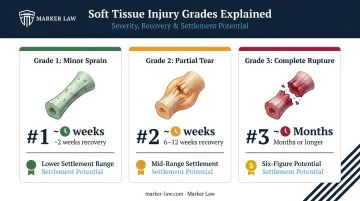
No authoritative public source publishes verified dollar ranges for each tier, and any firm quoting precise averages is typically drawing from their own marketing materials. What matters more is understanding what factors move your specific claim up or down within these tiers.
Why First Offers Fall Short
Insurance companies use computerized claims evaluation systems (Colossus, Claims Outcome Advisor, and Claims IQ) to generate initial settlement offers. According to a Consumer Federation of America report, these systems can be configured to produce targeted cost savings for insurers, in some cases projected at hundreds of millions of dollars across coverages.
These tools don't account for your actual life. They ignore:
- The specific job duties you can no longer perform
- How your injury affects daily activities and family responsibilities
- The full scope of ongoing or future treatment costs
- Any permanent limitations your doctor has documented
They produce a number. It is rarely generous.
Key Factors That Affect Your Soft Tissue Injury Settlement Amount
Settlement value reflects two things: the medical reality of your injury and the strength of the case built around it. Here's how each major factor works.
Severity and Diagnosis
Objective medical evidence is leverage. An MRI confirming a partial ligament tear gives an attorney something concrete to anchor a demand. Self-reported pain alone — without imaging, specialist notes, or physical therapy records — gives insurers room to argue the injury was minor or pre-existing.
The difference between a Grade 1 and Grade 2 classification in your medical records can directly shift settlement value.
Medical Expenses
All documented treatment costs factor into the settlement:
- Emergency room or urgent care visits
- Specialist consultations (orthopedics, neurology)
- Physical therapy sessions
- Pain injections or nerve blocks
- Surgery and rehabilitation (Grade 3 cases)
- Future medical needs if treatment is ongoing
Critical: don't settle before reaching maximum medical improvement (MMI). Once you sign a release, the case is closed — you cannot return for more if a surgery becomes necessary six months later.
Lost Wages and Earning Capacity
Missed work days are recoverable with employer documentation — pay stubs, a letter confirming absences, and tax records. Grade 2 and Grade 3 cases may also involve reduced future earning capacity if the injury forces career changes or limits hours. That calculation typically requires an economic or vocational expert.
Pain and Suffering
Non-economic damages — physical pain, emotional distress, loss of enjoyment of life — are real but require documentation. Illinois Pattern Jury Instructions (IPI 30.00) recognize pain and suffering and "loss of a normal life" as separate compensable elements.
Two common calculation approaches:
- Multiplier method: Economic damages multiplied by a factor (often 1–5) based on severity
- Per diem method: A daily dollar amount for each day of suffering
The Illinois Supreme Court in Caley v. Manicke rejected strict per diem formulas as creating an "illusion of certainty" — meaning these arguments need factual grounding, not just a daily dollar figure. Consistent medical records and a personal pain journal documenting daily limitations (kept after consulting your attorney) are the most practical ways to support these claims.
Liability and Fault
Even a well-documented injury can lose value if liability is unclear. Clear, undisputed fault gives a claimant maximum leverage. When liability is contested, settlement value often drops — or the case needs to go further into litigation before the insurer moves.
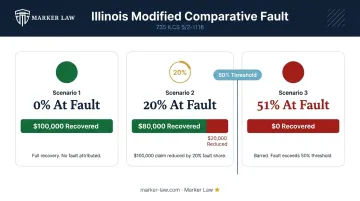
Illinois uses a modified comparative fault rule under 735 ILCS 5/2-1116. If you're found more than 50% at fault, you're barred from recovery entirely. At 50% or below, your damages are reduced proportionally by your share of fault. If you're 20% at fault on a $100,000 case, you recover $80,000. That same case at 51% fault pays nothing. Building strong evidence — witness statements, photos, police reports — keeps your assigned percentage as low as possible.
Injury Severity Grades and What They Mean for Your Settlement
Not all soft tissue injuries are equal — and the grade assigned to yours directly affects what an insurer will offer. Understanding where your injury falls on this scale helps you anticipate what your claim may realistically be worth.
Grade 1 (Minor)
Per the American Academy of Orthopaedic Surgeons, Grade 1 injuries involve slight stretching and microscopic tearing of ligament fibers, with mild tenderness and swelling. Most resolve within two weeks with rest and over-the-counter treatment. These cases typically land at the lower end of settlement value — covering medical bills and short-term pain and suffering. Without consistent follow-up care, insurers will argue the injury was minor and push for a fast, low settlement.
Grade 2 (Moderate)
Grade 2 injuries involve partial tearing — roughly 10% to 90% of tissue affected — with moderate swelling and some instability. Recovery typically runs 6 to 12 weeks and may involve physical therapy, pain injections, and limited work capacity. Well-documented treatment records and verified wage loss are what move these cases into mid-range settlement territory.
Grade 3 (Severe)
Grade 3 means complete rupture of a ligament or muscle. AAOS notes these injuries may require casting, surgery, and extended rehabilitation. Permanent impairment or chronic pain is possible. Settlement potential is highest here. Six-figure outcomes are realistic when future medical costs, long-term wage loss, and strong documentation support the claim.
Quick Reference: Grade Comparison
| Grade | Tissue Damage | Typical Recovery | Settlement Range |
|---|---|---|---|
| Grade 1 | Microscopic tearing | ~2 weeks | Low (medical bills + short-term pain) |
| Grade 2 | Partial tear (10–90%) | 6–12 weeks | Mid-range (documented treatment + wage loss) |
| Grade 3 | Complete rupture | Months to years | High (surgery, future costs, permanent impairment) |
What Damages Are Included in a Soft Tissue Injury Settlement?
A fair settlement covers every economic and non-economic consequence of the injury — not just the ER bill.
Economic Damages
These are calculable and require documentation:
- Medical bills — all treatment costs incurred to date
- Future medical costs — ongoing therapy, potential surgery, or pain management
- Lost wages — missed work days verified with employer records
- Reduced earning capacity — if the injury affects long-term work ability
- Out-of-pocket expenses — transportation to appointments, assistive devices, home care
If it's not documented, it's difficult to recover. Save every receipt, bill, and record.
Non-economic losses are harder to quantify, but Illinois law recognizes them as fully compensable.
Non-Economic Damages
- Physical pain and ongoing discomfort
- Emotional distress and anxiety
- Loss of enjoyment of life (a specific element under Illinois law)
- Impact on relationships or daily activities
Consistent medical records and therapy notes build the foundation for these claims. A personal pain and activity journal — one that tracks daily limitations honestly and specifically — adds critical detail. Start one early and keep it current.
How to Maximize Your Soft Tissue Injury Settlement
The gap between an insurer's first offer and the actual value of a claim can be significant. How you build and present your case determines where you land.
Seek Immediate and Consistent Medical Care
Prompt treatment creates the causation record connecting the accident to the injury. If you wait two weeks to see a doctor, the insurer will argue the injury happened elsewhere — or wasn't serious.
Gaps in treatment are equally damaging. If you skip appointments because you're busy or feeling slightly better, insurers interpret that as the injury resolving. If it's not in the medical records, it doesn't exist in the eyes of the insurer.
Document Everything
- Keep copies of all medical records and bills
- Save accident scene photos and the police report
- Maintain a pain and activity journal (after consulting your attorney)
- Track all missed work with employer documentation
- Preserve every communication related to the claim — emails, voicemails, adjuster notes
Do Not Accept the First Offer
Insurance companies' initial offers are generated by software that doesn't account for your specific life and losses. Negotiating — especially with legal representation — routinely produces significantly better outcomes. The first number is a starting point, not a fair resolution.
Work With an Attorney Who Understands Both Sides
Jason Marker of Marker Law spent three years on the defense side representing insurance carriers before transitioning exclusively to plaintiff advocacy. That experience means he knows exactly how adjusters evaluate soft tissue claims, how demand packages get picked apart, and where insurers look for reasons to reduce an offer.
That insider knowledge directly shapes how cases get built:
- Which medical records to prioritize in a demand package
- How to document non-economic damages persuasively
- When an insurer's offer is genuinely fair versus a lowball worth countering

Marker Law handles cases on a contingency basis — no fees unless compensation is recovered.
Common Mistakes That Lower Your Soft Tissue Injury Settlement
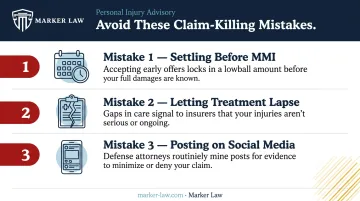
Even a strong claim can lose value through avoidable errors. Watch out for these three common mistakes:
- Settling before MMI — Early settlements often miss future surgeries, ongoing therapy, or long-term impairment. Once signed, you cannot reopen the claim regardless of what happens medically.
- Letting treatment lapse — Gaps in care signal to insurers that your injury was minor or has resolved. Consistent treatment is both medically necessary and legally protective.
- Posting on social media — Activity posts that contradict your claimed limitations can be used to reduce or deny your claim. The Illinois State Bar Association notes that social media content is fair game in discovery. When in doubt, don't post.
Frequently Asked Questions
What is the average settlement for a soft tissue injury in a car accident?
Settlements range from a few thousand dollars for minor Grade 1 injuries to well over $100,000 for severe cases involving surgery or permanent impairment. The amount depends on injury grade, documented medical costs, lost wages, and the strength of your evidence.
Do insurance companies prefer to settle soft tissue injury claims?
Insurers generally prefer to settle — but at the lowest possible amount. Because soft tissue injuries are harder to disprove than fractures, insurers rely on algorithmic pricing and early settlement pressure to close claims before victims understand their full damages.
What is a Grade 3 soft tissue injury?
A Grade 3 injury is a complete rupture of a ligament, tendon, or muscle. It's the most severe classification, typically requires surgery and extended rehabilitation, and may result in permanent impairment. These cases carry the highest settlement values.
How long does it take to settle a soft tissue injury claim?
Minor claims may resolve in 3–6 months; complex cases involving surgery or litigation can take 12–18 months or longer. Settling before you reach maximum medical improvement almost always undervalues the claim.
Should I accept the insurance company's first settlement offer?
Almost always, no. First offers are generated by claims software that doesn't account for your specific losses. Consult an attorney before accepting anything.
How does having an attorney affect my soft tissue injury settlement?
Represented claimants benefit from stronger demand packages, professional negotiation, and the credible threat of litigation — leverage that unrepresented claimants typically lack. An attorney also prevents documentation mistakes that reduce claim value and can file suit if the insurer refuses a fair offer.