

Introduction
Most injury victims in Illinois start their claims the same way: counting up medical bills and missed paychecks. Those numbers matter, but they represent only one slice of what the law allows you to recover.
Illinois personal injury claims can include three legally distinct categories of damages — each requiring different evidence, different legal strategy, and different standards of proof. Missing any one of them can mean leaving significant money unclaimed.
Illinois does not cap compensatory damages in standard personal injury cases. The Illinois Supreme Court struck down statutory damage caps as unconstitutional (Lebron v. Gottlieb Memorial Hospital, 237 Ill. 2d 217 (2010)), meaning no hard ceiling limits what a well-documented claim can recover.
What follows breaks down all three damage categories — what each covers, how it's proved, and what Illinois-specific rules determine its value.
TL;DR
- Illinois personal injury claims include economic (financial losses), non-economic (pain, suffering, life impact), and punitive (punishment for egregious conduct) damages.
- Economic damages are documented with bills, pay stubs, and expert reports.
- Non-economic damages rely on medical records, personal journals, and witness testimony.
- Illinois does not cap economic or non-economic damages in standard personal injury cases.
- Punitive damages require intentional, fraudulent, or grossly reckless conduct — ordinary negligence does not qualify.
- Under Illinois's modified comparative negligence rule, being more than 50% at fault bars any recovery at all.
What Are Personal Injury Damages in Illinois?
"Damages" is the legal term for the monetary compensation an injured person seeks from the at-fault party. They're not automatically assigned — you must claim them, prove them, and tie each one to the defendant's negligence.
Illinois law recognizes three categories in personal injury cases:
| Category | What It Covers | How Often Awarded |
|---|---|---|
| Economic | Measurable financial losses | Nearly every case |
| Non-Economic | Intangible suffering and life impact | Nearly every case |
| Punitive | Punishment for extreme misconduct | Rare — reserved for egregious cases |
Most cases involve only the first two. Punitive damages come into play only when a defendant's conduct crosses from ordinary negligence into something more deliberate or reckless.
One more thing that affects what you can recover: Illinois once imposed a $500,000 cap on non-economic damages under 735 ILCS 5/2-1115.1, but the Illinois Supreme Court struck it down as unconstitutional. Following Lebron v. Gottlieb Memorial Hospital, no operative cap on compensatory damages exists in standard personal injury cases in Illinois today.
Economic Damages: Your Documented Financial Losses
Economic damages compensate for out-of-pocket, measurable losses caused directly by the injury. They're provable with documentation and form the foundation of almost every claim.
What Economic Damages Cover
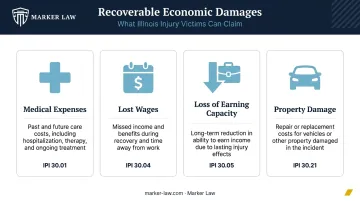
Illinois Pattern Jury Instructions recognize the following recoverable elements:
- Past and future medical expenses — emergency care, surgery, rehabilitation, medications, home health aides (IPI 30.06)
- Lost wages — income missed during recovery, verified with employer statements or pay stubs (IPI 30.07)
- Loss of earning capacity — when injuries permanently reduce your ability to earn at your prior level; expert economic or vocational testimony is commonly used to support this
- Property damage — repair or replacement costs for a vehicle or other property damaged or destroyed (IPI 30.10)
Future damages deserve particular attention. Projecting ongoing treatment costs and reduced earning capacity requires careful calculation — often with medical experts and vocational specialists. Victims who underestimate future costs routinely settle for far less than their injuries actually warrant.
How to Document and Prove Economic Damages
Documentation is everything in economic damage claims. Core evidence includes:
- Medical bills and insurance Explanation of Benefits (EOB) statements
- Employer wage verification letters
- Tax returns (especially for self-employed claimants)
- Expert reports projecting future medical costs or lost earning capacity
- Repair estimates or replacement receipts for damaged property
Illinois does not cap economic damages — once proven, the full documented amount is recoverable.
Insurers frequently challenge whether treatment was related to the accident or medically necessary. Jason Marker connects clients with trusted medical providers who document injuries thoroughly, because insurers actively look for gaps and inconsistencies to justify lower offers.
Non-Economic Damages: Compensation for Pain, Suffering, and More
Non-economic damages compensate for intangible losses — the ones that don't come with a receipt. These losses are real and legally recognized under Illinois law, but because they're subjective, how they're documented and presented directly shapes the award.
What Non-Economic Damages Cover
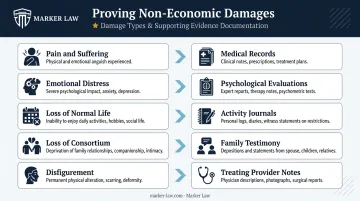
Illinois Pattern Jury Instructions recognize five primary categories:
- Pain and suffering — physical pain during and after the injury, including chronic pain (IPI 30.05)
- Emotional distress — anxiety, depression, PTSD, and psychological trauma (IPI 30.05.01)
- Loss of normal life — inability to participate in hobbies, sports, or daily activities the victim previously enjoyed (IPI 30.04.01)
- Loss of consortium — harm to the spousal or family relationship caused by the victim's injuries (IPI 32.00)
- Disfigurement — permanent scarring or physical changes affecting appearance and self-perception (IPI 30.04)
How Non-Economic Damages Are Calculated in Illinois
Illinois law doesn't prescribe a formula — juries are simply instructed to award an amount that "reasonably and fairly compensates" for each proven element.
Two approaches are commonly discussed in settlement negotiations and trial preparation:
- Multiplier method — total economic damages multiplied by a factor (typically 1.5 to 5) based on injury severity and life impact
- Per diem method — assigns a daily dollar value to suffering for each day of recovery
The Illinois Supreme Court in Caley v. Manicke, 24 Ill. 2d 390 (1962), cautioned against per diem arguments that create an "illusion of certainty" for losses without a fixed market value. Neither method is mandated — they're tools for structuring arguments, not legal formulas.
What actually drives non-economic damage awards:
- Consistent medical records documenting pain and psychological impact
- A personal recovery or symptom journal kept throughout treatment
- Testimony from family members or coworkers who observed life changes
- Detailed treating provider notes
That documentation gap works both ways. Insurers routinely point to missed appointments or treatment lapses to argue the injuries weren't serious — consistent, documented care protects both your health and your claim's value.
Punitive Damages: When Illinois Courts Want to Send a Message
Punitive damages — also called exemplary damages — go beyond compensating the victim. Their purpose is to punish a defendant whose conduct was intentional, fraudulent, malicious, or showed reckless disregard for others' safety.
The Illinois Supreme Court addressed this standard directly in Kelsay v. Motorola, Inc., 74 Ill. 2d 172 (1978), holding that punitive damages are appropriate for conduct involving fraud, actual malice, deliberate violence or oppression, or willful disregard of another's rights.
They're also rare in practice. According to the Bureau of Justice Statistics, punitive damages were awarded in approximately 5% of civil trials with plaintiff winners nationally in 2005, with a median award of $64,000. RAND research found punitive damages in fewer than 4% of civil jury verdicts across its 1985–1994 study period.
When Punitive Damages Apply in Illinois
Ordinary negligence is not enough. The legal threshold requires the defendant's conduct to rise to the level of intentional harm, fraud, or willful and wanton misconduct.
Several Illinois-specific rules govern punitive damage claims:
- Procedural restriction — Under 735 ILCS 5/2-604.1, punitive damages cannot be included in the initial complaint in covered bodily-injury or property-damage actions. The plaintiff must file a pretrial motion showing a reasonable likelihood of proving facts sufficient to support punitive damages, with the motion due no later than 30 days after the close of discovery.
- Compensatory damages first — Punitive damages cannot be awarded unless the plaintiff first receives compensatory damages.
- Medical malpractice prohibition — 735 ILCS 5/2-1115 expressly prohibits punitive damages in healing-art malpractice cases.
- Wrongful death expansion — Public Act 103-0514, effective August 11, 2023, amended the Illinois Wrongful Death Act to allow punitive damages when applicable, with exclusions for healing-art malpractice, legal malpractice, and actions against the State or local government.
- Insurability — Illinois public policy generally bars insurance coverage for punitive damages caused by the insured's own misconduct, meaning the defendant often pays personally rather than through their carrier.
A Note on Punitive Caps
735 ILCS 5/2-1115.05 contains a 3-times-economic-damages cap on punitive damages, but the ILGA marks this section as added by a public act held unconstitutional. Its enforceability is legally uncertain. If punitive damages are a serious consideration in your case, this is an area requiring careful legal analysis rather than a straightforward rule.
Key Factors That Influence Your Total Damages in Illinois
The category of damages is only part of the picture. Several Illinois-specific rules and case-level factors shape the final recovery.
Modified Comparative Negligence
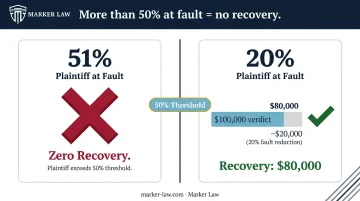
Illinois follows a modified comparative negligence rule under 735 ILCS 5/2-1116:
- If you are more than 50% at fault, you recover nothing
- If you are 50% or less at fault, your damages are reduced proportionally
A simple example: a $100,000 verdict where the plaintiff is found 20% at fault results in an $80,000 recovery. Insurance adjusters understand this math well — expect them to argue aggressively that you share fault, because every percentage point they shift to you reduces their payout.
Documentation, Severity, and Expert Support
Beyond fault allocation, these factors most directly influence total claim value:
- Permanent injuries consistently produce higher non-economic awards than temporary ones
- Gaps in treatment signal to insurers and juries that the injury wasn't serious
- Thorough medical records, timely reporting, and detailed provider notes directly affect claim value
- Expert witnesses: for complex economic losses, Marker Law works with medical and economic experts to calculate future care needs, reduced earning capacity, and long-term financial impact
Jason Marker spent three years on the defense side representing insurance carriers before switching exclusively to plaintiff work. He knows how adjusters evaluate claims from the inside — what documentation they look for, where they find inconsistencies, and how they build arguments to minimize payouts.
That perspective shapes how Marker Law builds damage claims from day one.
Statute of Limitations
Under 735 ILCS 5/13-202, Illinois personal injury victims generally have two years from the date of injury to file a lawsuit. Missing this deadline forfeits the right to any recovery. Limited exceptions exist for minors and certain disability situations, and claims against local government defendants carry a shorter one-year window. Consult an attorney promptly. In many cases, the clock starts running from when you discovered the injury — not necessarily when it occurred — and that distinction matters.
Frequently Asked Questions
Does Illinois put a cap on personal injury damages?
Illinois struck down damage caps as unconstitutional in 2010 and does not currently cap economic or non-economic compensatory damages in standard personal injury cases. The punitive damages cap statute (735 ILCS 5/2-1115.05) is flagged by ILGA as unconstitutional, so its enforceability remains an open legal question.
How is pain and suffering calculated in an Illinois personal injury case?
Illinois law does not prescribe a formula. Two common approaches used in negotiations are the multiplier method (economic damages multiplied by 1.5 to 5 based on severity) and the per diem method (a daily dollar rate for each day of suffering). Juries have broad discretion, so thorough documentation and strong evidence presentation make a measurable difference in the outcome.
Can I receive punitive damages in my personal injury case?
Punitive damages are rare and only available when the defendant's conduct was intentional, fraudulent, or grossly reckless — not ordinary negligence. They're also prohibited entirely in medical malpractice cases. Beyond that, punitive damages require a separate pretrial motion before they can even be pleaded.
How does comparative negligence affect my damages in Illinois?
Illinois uses a modified comparative negligence rule: if you are found more than 50% at fault, you recover nothing. If you are 50% or less at fault, your recovery is reduced by your percentage of fault — so 20% fault on a $100,000 verdict yields an $80,000 recovery.
What is the deadline to file a personal injury claim in Illinois?
The general statute of limitations is two years from the date of injury (735 ILCS 5/13-202). Limited exceptions apply for minors and legal disabilities. Claims against local government entities typically must be filed within one year. Missing these deadlines eliminates the right to compensation.
Are punitive damages taxable?
Yes. Under IRS Publication 4345 and IRC Section 104(a)(2), compensatory damages for physical injuries are generally excluded from taxable income, but punitive damages are taxable regardless of the underlying claim. Consult a tax professional if your case involves a punitive award.