
Here's what most accident victims don't realize: car accident lawyers are specifically structured so you pay nothing to get started. The entire fee model is built around that reality.
The actual cost depends on the fee arrangement, case complexity, and whether your case settles or goes to trial — but for the vast majority of car accident victims in Illinois, the answer to "what does this cost upfront?" is zero.
This guide breaks down exactly how car accident lawyer fees work, what case expenses are, how the math plays out at settlement, and how to decide whether hiring an attorney makes financial sense for your situation.
TL;DR
- Most car accident lawyers charge 33⅓% if your case settles before a lawsuit is filed, and up to 40% if it proceeds to litigation or trial — no upfront costs either way
- You owe attorney fees only if your lawyer wins — if they recover nothing, you pay nothing in fees
- Case expenses like court fees, medical records, and expert witnesses are separate from attorney fees — deducted from your settlement at the end
- The ABA confirms that contingency fees of one-third to 40% are the standard range for personal injury cases nationally
How Car Accident Lawyer Fees Actually Work
Car accident lawyers work on a contingency fee basis. There's no hourly rate, no retainer, and no invoice while your case is active. The attorney gets paid only if they recover compensation for you — a percentage of whatever they win.
Under Illinois Rule of Professional Conduct 1.5, every contingency fee agreement must be signed in writing by the client, state the exact fee method and percentages, and explain how expenses are handled. That's a client protection written into Illinois law, not a matter of firm discretion.
Pre-Litigation: Settlement Stage
When a case resolves through insurance negotiation — before any lawsuit is filed — the typical contingency fee is 33⅓% of the gross settlement. This covers everything the attorney does on your behalf:
- Investigating the accident and gathering evidence
- Communicating with insurance adjusters
- Calculating your full damages (medical, lost wages, pain and suffering)
- Negotiating the settlement
- Handling all legal paperwork
Most car accident cases settle at this stage, without ever reaching a courthouse.
Litigation and Trial Stage
If settlement negotiations fail and your attorney files a lawsuit, the contingency fee typically increases to 40%. That higher percentage reflects the substantially greater workload: depositions, court filings, pre-trial motions, expert preparation, and potentially a full trial.
Here's what the math looks like in practice:
| Scenario | Gross Settlement | Attorney Fee | Case Expenses | Net to Client |
|---|---|---|---|---|
| Pre-trial (33⅓%) | $90,000 | $30,000 | $3,000 | $57,000 |
| Trial (40%) | $120,000 | $48,000 | $8,000 | $64,000 |
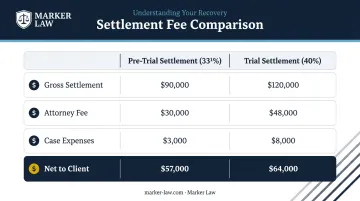
Case expenses are deducted separately from the settlement, on top of the attorney's percentage.
Key Factors That Affect Car Accident Lawyer Fees
The contingency fee structure is standard, but several variables determine exactly what percentage applies and how much total legal cost amounts to at resolution.
Case Complexity and Severity of Injuries
Soft-tissue injuries in straightforward two-car collisions are typically simpler to resolve than cases involving traumatic brain injuries, spinal damage, or wrongful death. More complex cases demand more attorney resources, specialist consultants, and preparation time, all of which factor into the fee agreement under Illinois Rule 1.5's reasonableness standard.
Stage at Which the Case Resolves
The single biggest driver of fee percentage is timing. A case that settles during insurance negotiations lands at 33⅓%. A case that requires filing suit and going through discovery, depositions, and trial lands at 40%. Cases that resolve early are less resource-intensive, so the lower percentage reflects the reduced workload.
Disputed Liability
When the at-fault party contests responsibility, your attorney must build the liability argument from scratch — accident reconstruction, witness testimony, and expert analysis. Contested liability cases are far more likely to reach litigation, which drives both the workload and the final fee percentage higher.
Number of Parties and Insurance Policies Involved
Multi-vehicle accidents, commercial truck cases, and rideshare accidents introduce additional layers of investigation and negotiation. Each scenario brings its own coverage complications:
- Commercial trucks may involve federal minimum coverage requirements up to $5M for certain hazardous materials carriers under federal motor carrier rules
- Rideshare accidents require determining which coverage tier applies based on whether the driver was available, en route, or completing a ride under Illinois TNC law
- Multi-defendant cases require fault allocation across all parties under Illinois joint and several liability rules
Each added layer increases the case workload and, in many situations, the total compensation available to pursue.
Attorney Fees vs. Case Expenses: What's the Difference?
This is where most people get confused. Attorney fees and case expenses are two separate categories. The contingency percentage covers the attorney's compensation. Case expenses are the out-of-pocket costs of building your claim.
What Are Case Expenses?
Case expenses are costs that get advanced by the firm throughout your case and then reimbursed from your settlement when your case settles. Common examples with approximate ranges:
- Court filing fees: $364–$388 depending on county (Cook County: $388; DuPage County: $350; Will County: $364)
- Medical record retrieval: Regulated in Illinois — handling fee of $36.68, plus per-page charges starting at $1.38/page for the first 25 pages
- Illinois State Police crash report: $5 by mail
- Expert witness fees: Non-medical experts average $248/hour for in-court testimony; medical experts average $555/hour (per SEAK's expert witness fee research)
- Accident reconstruction specialists: Fees vary by case complexity
- Deposition transcripts: Cook County official rates start at $4.00/page for originals
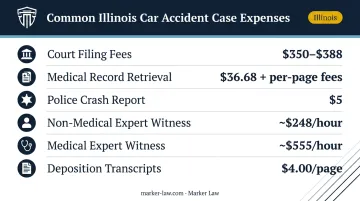
Expert witnesses are often the largest variable expense — a case involving a contested medical diagnosis or disputed liability can require multiple specialists.
How Case Expenses Affect Your Net Recovery
Marker Law advances these costs on the client's behalf throughout the case — you pay nothing out of pocket while the case is pending. When your case settles, the firm deducts expenses from your recovery, typically after the contingency fee is calculated on the gross amount.
The order of deductions matters. Illinois Rule 1.5 requires the written fee agreement to specify whether expenses are deducted before or after the contingency fee is calculated. Read that section carefully before signing.
Beyond the deduction order, lien negotiation is another way your net recovery can increase. Jason Marker works to reduce medical liens — amounts owed to health insurers, hospitals, or providers from your settlement — which puts more money in your pocket at the end of the case.
What the Fee Agreement Must Include
Under Illinois professional conduct rules, your written agreement must clearly state:
- The contingency percentage (or percentages at different case stages)
- Whether expenses are deducted before or after the fee calculation
- Who is responsible for case expenses if the case is unsuccessful
That last point varies by firm. Some firms forgive case expenses if the case is lost; others seek reimbursement regardless. Confirm this before signing.
Is It Worth Hiring a Car Accident Lawyer?
Insurance companies are businesses. Their adjusters handle dozens of claims simultaneously, and their job is to resolve yours quickly and at the lowest cost possible. Unrepresented victims frequently accept initial offers that don't account for future medical needs, lost earning capacity, or pain and suffering.
The III's 2024 data shows average bodily injury claim severity of $28,278 nationally — but severity varies enormously based on injury type, liability clarity, and representation. The gap between what an insurer initially offers and the full value of a serious claim can be substantial.
What an experienced car accident attorney actually does:
- Calculates true damages — including future medical care, reduced earning capacity, and non-economic losses insurers routinely minimize
- Preserves time-sensitive evidence before it disappears
- Handles all insurer communication so nothing you say gets used to undervalue your claim
- Negotiates medical liens to maximize what you actually keep
- Takes the case to trial if the insurer won't make a fair offer
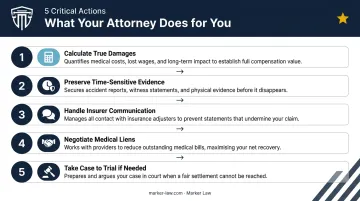
Insurance adjusters know which attorneys try cases and which ones don't. A lawyer with genuine trial experience negotiates from a fundamentally different position — and insurers adjust their offers accordingly.
Jason Marker at Marker Law spent three years on the defense side representing insurance carriers before switching exclusively to plaintiff work. He describes that time as learning "their playbook" — understanding how insurers evaluate claims, what arguments they use to minimize payouts, and where they're vulnerable. That perspective shapes how Marker Law approaches every car accident case from the first call.
The firm serves clients across DuPage, Will, Cook, Kane, and Kendall counties on a contingency basis — no fees unless compensation is recovered — with a free initial consultation to start.
What Most People Get Wrong About Car Accident Lawyer Costs
"I Can't Afford a Lawyer"
The contingency fee model makes this misconception worth addressing directly. You pay $0 to hire a car accident attorney. You pay $0 in attorney fees if the case is lost. The real question isn't whether you can afford a lawyer. It's whether you can afford to face an insurance company alone.
"The Lawyer Takes Too Much of My Settlement"
A 33⅓% fee on a well-negotiated settlement is not the same as 33⅓% of what you would have received unrepresented. The attorney's job is to increase the gross settlement — the fee pays for advocacy that makes the pie larger. Even after the percentage comes out, many represented clients net more than the full amount an insurer offered without an attorney in the picture.
"All Car Accident Lawyers Charge the Same"
Fee percentages, who advances case costs, whether expenses are forgiven if the case is lost, and what's negotiable all vary significantly by firm. Compare written fee agreements, not just advertised percentages.
A Stanford/Georgetown Law Journal study found that only 4.4% of 500 personal injury firm websites advertised a specific contingency percentage, and only one advertised rates lower than competitors. Fee transparency is rare. Ask directly, and get it in writing.
Conclusion
Car accident lawyer fees follow a straightforward model: contingency-based, with no upfront cost and no attorney fee if you don't win. The standard range is 33⅓% for pre-trial settlements and up to 40% for cases that proceed to litigation — both percentages apply to your gross recovery, with case expenses handled separately.
The real cost calculation isn't attorney fees alone. It's attorney fees weighed against the cost of going without representation — negotiating against a professional whose job is to pay you as little as possible, while leaving damages on the table you didn't know to claim.
Before accepting any settlement offer, review your options. At Marker Law, initial consultations are free — and if you decide to move forward, you pay nothing unless compensation is recovered. Review any fee agreement carefully, understand how expenses are handled, and make an informed decision from a position of knowledge, not pressure.
Frequently Asked Questions
What percentage does a car accident lawyer typically take?
Most car accident lawyers charge between 33⅓% and 40% of the gross recovery. The lower end applies when a case settles before a lawsuit is filed; the higher end applies if the case proceeds to litigation or trial. The exact percentage is agreed upon in a written contract before representation begins.
Do I have to pay anything upfront to hire a car accident lawyer?
Under a contingency fee arrangement, there are no upfront costs, no hourly charges, and no retainer. Most car accident lawyers, including Marker Law, also offer a free initial consultation to evaluate your case before any agreement is signed.
What happens to case expenses if I lose my case?
Case expenses — filing fees, expert costs, medical records — are treated separately from attorney fees. Some firms forgive these entirely if the case is lost; others may still seek reimbursement. Confirm this specific term in the written fee agreement before you sign.
How much are most car accident settlements?
Settlement amounts vary widely based on injury severity, liability, insurance policy limits, and damages. The III's 2024 data puts average bodily injury claim severity at $28,278 nationally, though that figure doesn't reflect catastrophic injuries, wrongful death claims, or commercial vehicle cases, which typically result in significantly higher recoveries.
Is it worth getting an attorney for a vehicle accident?
For most injury cases, yes. An experienced attorney calculates the full value of your damages, including future losses insurers routinely exclude, and takes the case to trial if needed. Under the contingency model, hiring a lawyer costs nothing if the case is unsuccessful.
Can I negotiate the contingency fee percentage with my lawyer?
Contingency fees can be negotiated before signing the retainer agreement, with case strength and complexity as reasonable discussion points. That said, the standard rates of 33⅓% pre-trial and 40% at trial are common because they reflect the real cost of taking a case through trial, so significant deviations are uncommon.