The good news: contingency fees mean you don't pay a lawyer anything upfront. The less obvious news is that the percentage you owe, and the costs deducted alongside it, vary more than most people realize — and those details live in the fine print of your fee agreement.
This article covers what car accident lawyers in Illinois typically charge, what drives that percentage up or down, how attorney fees differ from case costs, and what to look for before signing anything.
TL;DR
- Contingency fees for car accident cases typically range from 33% to 40%, depending on how far the case progresses
- You owe no attorney fee if there's no recovery
- Case costs (filing fees, medical records, expert witnesses) are separate from the fee percentage — and still come out of your settlement
- Cost deduction order — before vs. after the fee is calculated — directly affects your net payout
- Not all fee agreements are equal — the written contract terms are what matter
What Is a Contingency Fee?
A contingency fee is simple: the lawyer gets paid only if you win. Their payment is a pre-agreed percentage of your settlement or court award. No recovery, no attorney fee.
This arrangement dominates personal injury and car accident cases for a practical reason. Injured people — often facing mounting medical bills and lost wages — can't afford to pay an attorney $300–$500 per hour while their case drags on for months or years.
The contingency model gives them access to experienced legal representation without financial risk, while aligning the attorney's interests directly with the client's.
The American Bar Association recognizes contingency fees as the standard arrangement for personal injury matters — they remove the financial barrier that would otherwise leave accident victims negotiating alone against insurance companies.
Under Illinois Rule of Professional Conduct 1.5, every contingency fee agreement must be in writing and signed by the client. The written agreement must cover:
- The fee percentage at each stage of the case
- How litigation expenses are handled
- What happens to costs if you don't recover anything
What Percentage Do Car Accident Lawyers Typically Charge?
There's no single fixed rate. The most common benchmark nationally is one-third (33%) for cases that settle before a lawsuit is filed — but that's a starting point, not a ceiling.
Most attorneys use a sliding scale tied to how far the case must go before it resolves.
The Three-Tier Structure
| Case Stage | Typical Fee Range | Why It Changes |
|---|---|---|
| Pre-suit settlement | 25%–33% | Resolved through negotiation; less attorney time required |
| Post-filing settlement | 33%–38% | Lawsuit filed; pleadings drafted, discovery conducted |
| Trial or appeal | 40%+ | Maximum attorney time, cost, and risk invested |
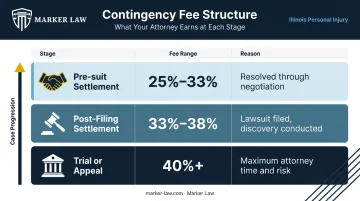
The ABA notes that contingency fees typically fall in the range of one-third to 40 percent, which maps directly to these tiers.
What This Looks Like in Dollars
Using a $100,000 settlement as an example:
- Pre-suit (33% fee): Attorney receives $33,000 → client receives $67,000 (before costs)
- Post-filing (38% fee): Attorney receives $38,000 → client receives $62,000 (before costs)
- Trial (40% fee): Attorney receives $40,000 → client receives $60,000 (before costs)
That $7,000 difference between pre-suit and trial reflects real costs: hundreds of additional attorney hours, deposition fees, expert witness costs, and the financial risk the attorney absorbs if the jury returns a low verdict.
Marker Law handles car accident cases on contingency, with fees typically around one-third (33.33%) of the recovery — adjusted based on case complexity and how far litigation must proceed.
Illinois Rule 1.5 requires that written agreement to clearly state the percentage at each stage before representation begins. Any attorney who can't or won't put those numbers in writing is a red flag.
What Factors Affect the Contingency Fee Percentage?
Fee percentages don't just depend on case stage. Several factors determine where within a tier a fee actually lands.
Case Complexity and Liability
Clear-cut cases move faster. A rear-end collision with a confirming police report and no disputed liability is more predictable than a multi-vehicle accident with three potentially at-fault parties. The more investigation, expert analysis, and litigation strategy required, the higher the fee is likely to sit within its tier.
Attorney Experience
More experienced attorneys — particularly those with trial verdicts — often charge at the higher end of the range. That's not a disadvantage for the client. An attorney who knows how to identify future medical costs, loss of earning capacity, and non-economic damages often produces a larger gross recovery, even after a higher percentage is deducted.
Jason Marker spent three years on the defense side representing insurance carriers before switching to plaintiff work exclusively. He's seen how adjusters evaluate claims from the inside, which makes him harder to lowball and better positioned to anticipate resistance before it happens.
Whether the Firm Advances Case Costs
Some firms front all case costs and deduct them from the settlement at the end. Others require clients to pay as expenses arise. Attorneys who advance costs take on more financial risk — which can factor into their fee structure. Marker Law advances case costs on behalf of clients, with reimbursement from the final settlement.
Attorney Fees vs. Case Costs: What's the Difference?
Most clients don't realize that the contingency percentage only covers the attorney's legal work — not the out-of-pocket expenses required to investigate and pursue your claim. Those costs are separate, and they also come out of your settlement.
Common Case Costs in a Car Accident Claim
- Court filing fees (Cook County: $388 for claims over $15,000; DuPage County: $350 for claims over $15,000)
- Medical records retrieval (Illinois: $36.68 handling fee plus per-page charges)
- Expert witness fees (national median: $300/hour for testimony, per SEAK's expert witness survey)
- Deposition and court reporter fees
- Accident reconstruction specialists
- Investigator fees
- Copying and postage
These costs can add several thousand dollars to a complex case. They matter because they also come out of your settlement — in addition to the attorney's percentage.
Two Questions to Ask Before Signing
- Will the firm advance costs, or do I owe them as they arise?
- Are costs deducted before or after the attorney's fee is calculated?
That second question matters more than most clients expect. The order in which costs and fees are deducted can shift your take-home amount by hundreds of dollars — as this example shows:
$100,000 settlement with $5,000 in case costs and a 33% fee:
- Costs deducted first (more favorable): $100,000 − $5,000 = $95,000 net → 33% fee = $31,350 → Client receives $63,650
- Costs deducted after fee (less favorable): 33% of $100,000 = $33,000 → $100,000 − $33,000 − $5,000 = Client receives $62,000
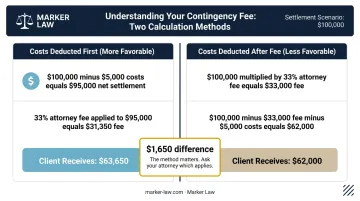
A $1,650 difference from one line in the contract. Illinois Rule 1.5 requires fee agreements to specify which method applies, so read that line carefully before you sign.
Gross vs. Net Recovery — How the Math Works
Gross recovery is the total settlement amount. Net recovery is what you actually deposit in your bank account after fees, costs, and liens are deducted. The net number is the only one that matters to you.
The Layer Most Clients Don't Anticipate: Medical Liens
If a health insurer, Medicare, or Medicaid paid for your accident-related treatment, they may have a legal right to be reimbursed from your settlement. Under the Illinois Health Care Services Lien Act, total liens are capped at 40% of the settlement — but that's still a significant reduction.
A skilled attorney can often negotiate these liens down. Consider what that means in practice:
- Lien at face value: $25,000 comes out of your settlement
- Negotiated lien: Reduced to $12,000 — keeping $13,000 in your pocket
That difference is real money, and it's one of the most overlooked ways an experienced attorney adds value.
That negotiation skill extends to how the settlement is handled overall. At Marker Law, every client receives a full itemized breakdown before disbursement — attorney fee, case costs, liens — each line explained before a dollar changes hands.
What to Look for Before Signing a Contingency Fee Agreement
Not all contingency agreements are structured the same way. The written contract is what governs — not what was discussed verbally.
Questions to Ask at Your Consultation
- What is the exact percentage at each stage (pre-suit, post-filing, trial)?
- Does the firm advance case costs, or am I responsible as they arise?
- Are costs deducted before or after your fee is calculated?
- If we lose, do I owe anything for advanced costs?
- Will I receive an itemized breakdown before settlement funds are disbursed?
- Who has final authority to accept or reject a settlement offer?
Red Flags Worth Noting
- Fee discussion is verbal only — nothing written
- No percentages specified by case stage
- Vague references to "administrative" or "file setup" charges
- No explanation of cost responsibility if the case is lost
- Refusal to provide a written agreement before starting work
If any of those red flags appear in your current or prospective agreement, getting a second opinion costs nothing. Marker Law offers free consultations where fee structure, case value, and litigation strategy are explained plainly and in full. Reach out at 331-295-8005 or visit the office at 1250 E. Diehl Rd., Suite 406, Naperville, IL.
Frequently Asked Questions
What percentage do most car accident lawyers take as a contingency fee?
Most car accident lawyers charge around 33% for cases that settle before a lawsuit is filed, with fees rising to 38%–40% if a lawsuit is filed or the case proceeds to trial. The exact rate depends on case complexity, the stage of resolution, and the specific terms in your written agreement.
How much of a settlement will I get after a car accident lawyer's contingency fee?
You receive the settlement amount minus the attorney's contingency percentage and any case costs. Whether costs come out before or after the fee is calculated changes your final number, so review the fee agreement closely before signing.
Are attorney fees the same as case costs in a car accident claim?
No — they're separate. Attorney fees are the contingency percentage paid for legal work. Case costs (court filing fees, expert witnesses, medical records, depositions) are out-of-pocket expenses that are also deducted from the settlement.
Can I negotiate a contingency fee with my car accident lawyer?
Sometimes. For straightforward cases with clear liability that are likely to resolve quickly, there may be room to discuss the rate. Attorneys won't typically volunteer a discount, so raise it during the initial consultation if you're concerned about the percentage.
What should I avoid saying to a car accident lawyer during the consultation?
Don't guess at details you don't know, exaggerate injuries, or downplay pain to seem tougher. Be precise and honest — the attorney uses everything you say to assess case value and strategy. Inconsistencies that surface later can be used against you by the opposing side.
Do I owe anything if my car accident lawyer doesn't win my case?
Under a true contingency fee arrangement, no attorney fee is owed without a recovery. However, some agreements still require reimbursement of advanced case costs even if the case is lost. Confirm this in writing before signing, as it should be spelled out explicitly in the fee agreement.