
In Illinois, car accident lawyers work on a contingency fee basis. You pay nothing upfront. No retainer, no hourly rate, no bill during the case. The attorney takes a percentage only if they recover money for you — and if there's no recovery, there's no fee.
This article explains exactly how that percentage is calculated, what other costs come out of your settlement, and how to evaluate whether hiring an attorney makes financial sense for your situation.
TL;DR
- Illinois car accident lawyers typically charge 33% before a lawsuit is filed, rising to up to 40% if trial is required
- You pay nothing upfront — the fee comes out of your settlement at the end
- Case expenses (medical records, court filings, expert witnesses) are separate deductions on top of the attorney fee
- Medical liens from health insurers, Medicaid, or Medicare reduce your final payout, though experienced attorneys often negotiate these down
- A lower contingency percentage doesn't always mean more money in your pocket — case strategy and willingness to fight matter more
How Contingency Fees Work: What Car Accident Lawyers Actually Charge
A contingency fee isn't a bill that arrives during your case. It's a percentage of whatever your lawyer recovers for you, deducted from the final settlement check. No recovery means no fee.
According to AllLaw, personal injury contingency fees commonly range from 25% to 40%, with one-third (33%) as the standard benchmark for cases that settle before a lawsuit is filed. If litigation or trial is required, that percentage can rise to 40% to account for the additional time and resources involved.
These are market benchmarks, not fixed legal rules. Your specific percentage depends on your case and attorney, which is why Illinois law requires the details to be in writing.
Illinois Requires a Written Fee Agreement
Under Illinois Rule of Professional Conduct 1.5(c), every contingency fee arrangement must be documented in a signed written agreement before representation begins. That agreement must spell out:
- The exact fee percentage for settlement, trial, and appeal
- How litigation expenses are handled
- Whether expenses are deducted before or after the fee is calculated
- Any costs the client owes regardless of outcome
This protects you. If an attorney can't or won't put the terms in writing, that's a problem.
Gross vs. Net Fee Calculation — The Detail That Changes Your Payout
This is the most overlooked variable in any contingency fee comparison. The fee is calculated differently depending on whether it's applied to the gross settlement (total amount) or the net settlement (after expenses are subtracted first).
Here's the difference on a $100,000 settlement with $8,000 in case expenses:
| Method | Calculation | Attorney Fee | Client Receives |
|--------|-------------|--------------|-----------------|
| Fee on gross | 33% × $100,000 | $33,000 | $59,000 |
| Fee on net | 33% × $92,000 | $30,360 | $61,640 |
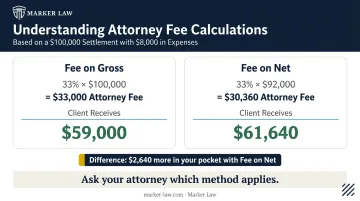
On this example alone, the calculation method creates a $2,640 difference in your take-home — before any liens are factored in. Ask this question during your first consultation.
What Factors Affect How Much a Lawyer Takes From Your Settlement
The 33%–40% range isn't arbitrary. Where a fee lands within that range depends on several case-specific factors.
Case Stage: Pre-Settlement vs. Trial
The single biggest variable is how far your case goes. Illinois Rule 1.5(c) explicitly anticipates stage-based fee structures, requiring written agreements to specify percentages at settlement, trial, and appeal. In practice:
- Settles during negotiation → typically 33%
- Requires filing a lawsuit or depositions → typically 35%–38%
- Goes to trial → can reach 40%
The additional percentage at trial reflects real additional work — months of discovery, depositions, expert preparation, and court appearances.
Case Complexity and Liability
A rear-end collision with a police report, clear fault, and documented injuries is straightforward. Cases involving:
- Disputed liability or shared fault
- Multiple vehicles or parties
- Underinsured or uninsured drivers
- Serious or permanent injuries requiring expert testimony
...require substantially more attorney time and resources. That added complexity often pushes fees toward the higher end of the range.
Attorney Experience
More experienced attorneys often charge on the higher end of the range. That's frequently worth it. An attorney who understands how insurance companies evaluate claims, and who has a track record of going to trial when necessary, tends to recover more for clients than one who settles quickly at a lower fee percentage.
Beyond the Attorney Fee: Other Costs That Come Out of Your Settlement
Attorney fees aren't the only deduction from your settlement. Case expenses and medical liens are subtracted separately — and understanding them upfront prevents surprises when your check arrives.
Common Case Expenses to Expect
These are advanced by your attorney throughout the case and reimbursed from the settlement at the end — you don't pay them out of pocket during the process. Typical expenses include:
- Obtaining medical records and police reports
- Court filing and process server fees
- Deposition and transcript costs
- Expert witness fees (accident reconstruction, medical experts)
- Copying, mailing, and administrative costs
For simple cases, these typically total $200–$500. Complex cases involving experts and extended litigation can run into thousands.
Medical Liens and How They Affect Your Payout
If your health insurance, Medicaid, or Medicare covered treatment after your accident, those parties generally have a legal right to be reimbursed from your settlement. Under the Illinois Health Care Services Lien Act, the total amount of health care liens is capped at 40% of your recovery. Medicare has separate reimbursement rights and must be repaid when a settlement is reached.
Experienced attorneys negotiate these liens down, often substantially, which means more money in your pocket at the end.
What the Math Actually Looks Like
Here's a realistic illustration of a $100,000 settlement:
| Item | Amount |
|---|---|
| Gross settlement | $100,000 |
| Attorney fee (33%) | −$33,000 |
| Case expenses | −$7,000 |
| Medical liens (negotiated) | −$15,000 |
| Client take-home | $45,000 |
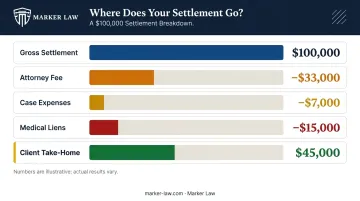
Without an attorney negotiating those liens and fighting for the full settlement value, the gross number — and every line below it — would likely be smaller. Numbers are illustrative; actual results vary based on the specifics of your case.
Is Hiring a Car Accident Lawyer Worth the Fee?
Here's the practical reality: insurance companies aren't neutral parties. Their adjusters are trained to minimize payouts, and they use specific tactics to do it — early settlement offers before your injuries are fully documented, delays designed to pressure you into accepting less, and challenges to the medical treatment you've received.
An attorney who understands those tactics from the inside changes the negotiation dynamic entirely. Jason Marker spent three years on the defense side representing insurance carriers before transitioning to plaintiff work exclusively. That background — how adjusters evaluate claims, how defense firms build arguments, where insurers have room to move — directly shapes how he builds and presents cases for clients at Marker Law.
Even in cases that never go near a courtroom, an attorney adds concrete financial value by:
- Negotiating medical liens and bills down — putting more of the settlement in your pocket
- Handling all deadlines and paperwork, protecting you from procedural missteps that can sink a claim
- Preventing premature settlement before the full extent of your injuries is known — accepting early typically means you can't go back for more
- Countering lowball offers with documented evidence of your actual damages

The fee comes out of your settlement. The question isn't whether you can afford an attorney — it's whether you can afford to negotiate against a trained insurance defense team on your own.
What to Watch Out For When Reviewing a Fee Agreement
Not all contingency arrangements are created equal. A few things to watch for:
Red flags:
- Pressure to sign quickly before you've had time to read and ask questions
- Fees significantly above 40% with no explanation
- Verbal-only agreements — Illinois law requires everything in writing
- Vague answers about how expenses are handled
The percentage itself doesn't tell the whole story. A lawyer charging 20% who settles fast and cheap may leave you with far less than one charging 33% who fights to maximize the recovery. What matters is the final dollar amount in your pocket, not the rate applied to it.
That's why the consultation matters. Before signing anything, ask:
Questions to ask during a free consultation:
- What is the exact percentage, and does it change if a lawsuit is filed?
- Is the fee calculated on the gross or net settlement amount?
- What case expenses might I be responsible for, and when are they deducted?
- Will I work directly with you throughout the case, or primarily with staff?
- What expenses, if any, am I responsible for if the case doesn't result in recovery?
Frequently Asked Questions
How much can a lawyer take from a car accident settlement?
In Illinois, car accident lawyers typically take 33% if the case settles before a lawsuit is filed, and up to 40% if litigation or trial is required. The exact percentage and all conditions must be spelled out in a written fee agreement signed before representation begins.
How much can you get for pain and suffering?
Pain and suffering damages are non-economic and vary based on injury severity, recovery duration, and impact on daily life. Illinois jury instructions direct jurors to award a reasonable amount supported by evidence — there's no statutory formula. An attorney builds that figure by documenting medical treatment, lost activities, and long-term limitations — specifics that carry weight with adjusters and juries alike.
Do I have to pay my car accident lawyer if they lose my case?
Under a contingency fee arrangement, you owe no attorney fees if there's no recovery. However, some agreements hold clients responsible for certain case expenses regardless of outcome — review your written contract carefully and ask about this explicitly.
Can I negotiate the contingency fee percentage?
Some negotiation is possible, particularly when liability is clear and you arrive with strong documentation. That said, the attorney's experience, strategy, and willingness to litigate typically matter more to your final outcome than shaving a point or two off the percentage.
What other costs are deducted from my settlement besides the lawyer's fee?
Common case expenses include obtaining medical records and police reports, court filing fees, deposition costs, and expert witness fees. Attorneys advance these costs during the case and are reimbursed from the settlement at the end.
How long after my case settles will I receive my check?
After settlement, the insurance company sends payment to the attorney's trust account. Once the check clears (typically 3–10 business days), the attorney deducts fees, case expenses, and any outstanding liens before issuing the client's portion. Unresolved Medicare or Medicaid liens can add time to this process.