Here's the honest answer to whether you need a lawyer: no, not legally. Illinois doesn't require you to hire an attorney to file a claim or accept a settlement. But the situations where going it alone is actually the smart choice are narrower than most accident victims realize — and misjudging which category your case falls into can cost you far more than an attorney's fee ever would.
This guide covers how to tell which situation you're in, what an attorney actually does for your settlement, and the most common mistakes people make when they try to handle it themselves.
Key Takeaways
- You are not legally required to hire a lawyer to file a claim or accept a settlement in Illinois.
- Self-representation makes sense only in a narrow set of cases: no injuries, clear fault, and minimal property damage.
- Any injury, disputed fault, missed work, or uncooperative insurer changes the picture — an attorney almost always recovers more.
- Insurance adjusters work for the insurance company, not you. Their job is to close claims for as little as possible.
- Marker Law and most car accident attorneys work on contingency — you pay nothing upfront and owe no fee unless they recover compensation.
When You May Not Need a Lawyer
There is a real category of car accident claims where hiring an attorney doesn't make financial sense — it's just smaller than most people assume.
Self-representation is reasonable when all of the following are true:
- No injuries were sustained, or any symptoms resolved completely within a day or two
- Vehicle damage is minor and the repair cost is straightforward
- Fault is clear, undisputed, and the other driver's insurer accepts liability without challenge
- You're not missing work or facing any ongoing medical treatment
The financial logic here is simple. The American Bar Association notes that contingency fees are typically one-third to 40% of the recovery. If your total damages are a few hundred dollars in property damage with no injuries, a lawyer's fee could consume most of your recovery. In that scenario, handling it yourself makes sense.
The Delayed Symptom Problem
The problem is that "no injuries" isn't always obvious right away.
The CDC notes that mild TBI and concussion symptoms may not appear for hours or days after an injury. The Mayo Clinic similarly states that whiplash symptoms often begin within days — not immediately — following a collision. Soft tissue injuries and spinal trauma follow the same pattern.
Accepting a settlement before you understand the full scope of your injuries permanently closes the door on additional compensation. Once you settle, there is no going back for more — regardless of what symptoms develop later.
Signs You Should Hire a Car Accident Lawyer
The following situations move your case well outside the "handle it yourself" category.
You Sustained Injuries Requiring Medical Treatment
Once medical bills enter the picture, the stakes change completely. Adjusters won't volunteer to calculate the full scope of what you're owed. A lawyer accounts for every damage category, including costs you haven't incurred yet:
- Current and ongoing medical treatment
- Future care and rehabilitation
- Long-term physical limitations
- Pain and suffering
Insurers count on unrepresented claimants undervaluing their own claims. Knowing what to ask for — and proving it — is where legal representation makes the biggest difference.
Fault Is Disputed
When the other driver's insurer challenges who caused the accident, the case requires evidence gathering, witness statements, and potentially accident reconstruction. That's not a process most people can execute effectively on their own.
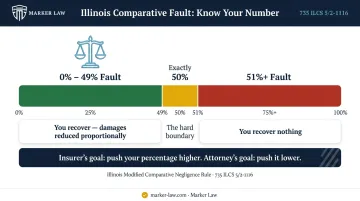
Illinois follows a modified comparative negligence rule under 735 ILCS 5/2-1116: if you're found more than 50% at fault, you recover nothing. If you're found partially at fault, your damages are reduced proportionally. The insurer has every incentive to push your fault percentage as high as possible. An attorney's job is to push back.
You Missed Work or Face Income Loss
Lost wages — past and future — are a damages category insurers routinely minimize. If your injuries have kept you out of work for weeks, or may affect your earning capacity long-term, an attorney will make sure that number isn't left on the table.
The Insurer Is Delaying, Denying, or Lowballing
Early settlement offers are a deliberate tactic. Insurers make quick offers to close claims before the full extent of injuries is known. Once you sign a release, that's final — you cannot return for additional compensation, regardless of what develops medically.
Multiple Parties or an Uninsured Driver
Cases involving rideshare drivers, commercial vehicles, multiple insurers, or uninsured/underinsured motorist coverage carry overlapping liability questions and procedural requirements. Marker Law handles UM/UIM claims throughout Illinois. Given how many drivers on Illinois roads carry no insurance or inadequate coverage, the firm recommends carrying at least $100,000/$300,000 in UM/UIM coverage to protect yourself.
What a Car Accident Lawyer Does for Your Settlement
Builds the Evidentiary Foundation Early
An attorney gathers police reports, witness statements, photos, vehicle damage documentation, and traffic or surveillance footage — all within the window when that evidence still exists. Illinois statute requires crash reports to be submitted to IDOT within 10 days of an accident, and witness recall degrades quickly. Many victims wait too long to hire a lawyer and miss this window entirely.
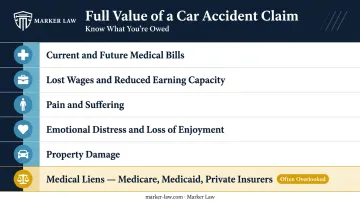
Calculates the Full Value of Your Claim
A lawyer accounts for:
- Current and future medical bills
- Lost wages and reduced earning capacity
- Pain and suffering
- Emotional distress and loss of enjoyment of life
- Property damage
- Medical liens from Medicare, Medicaid, or private insurers (which must be negotiated and resolved before a settlement is finalized)
That last point catches many self-represented claimants off guard. Both federal Medicare rules and Illinois Medicaid recovery law require repayment from settlements when a third party is liable. Mishandling a lien can cost thousands.
Controls All Communication With the Insurer
Anything you say to an adjuster can be used to minimize your claim. A lawyer structures every communication to protect your position and ensures you never give a recorded statement without guidance — a mistake that frequently derails otherwise solid cases.
Negotiates From a Position of Leverage
Insurance companies treat represented claimants differently than unrepresented ones. An attorney carries the credible threat of taking the case to court, and insurers account for that when calculating what they're willing to offer. Negotiation leverage isn't just skill — it's the realistic possibility of litigation.
Jason Marker spent the first three years of his career on the defense side, representing insurance carriers and employers. He knows how adjusters evaluate claims, what factors they use to justify lowball offers, and which pressure points actually move settlements. Few plaintiff attorneys have worked both sides of the same case type.
Mistakes People Make When Going It Alone
Giving a Recorded Statement
Adjusters routinely tell unrepresented claimants they need a recorded statement before the claim can be processed. This is a negotiating tactic, not a legal requirement. Anything said in that statement can later be used to challenge your account of events or minimize the payout.
If you've already given a recorded statement before contacting an attorney, that doesn't end your case — but it's a reason to get legal guidance sooner rather than later.
Settling Before Treatment Is Complete
Signing a release before you understand the full scope of your injuries is one of the most consequential mistakes accident victims make. Concussions, soft tissue injuries, and spinal trauma can take days or weeks to fully manifest.
Once you've settled and released your claims, there's no going back. It doesn't matter what your next MRI shows.
Missing Entire Categories of Damages
Unrepresented claimants typically claim only the bills sitting in front of them right now. That leaves a lot on the table — often the most expensive items. They miss:
- Future medical treatment and rehabilitation costs
- Lost earning capacity (not just current missed paychecks)
- Pain and suffering
- Emotional distress and loss of enjoyment of life
- Medical liens that will reduce net recovery if not negotiated
Missing Illinois's Statute of Limitations
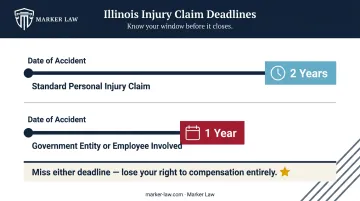
Illinois law gives car accident victims two years from the date of the accident to file a personal injury lawsuit. Miss that deadline and you lose your right to compensation entirely — regardless of how clear the fault was or how serious the injuries are.
If the at-fault driver was a government employee or a local public entity was involved, the deadline shrinks to one year, not two. That shorter window catches many victims off guard — and by the time they realize it, the deadline has already passed.
Frequently Asked Questions
Do I need a lawyer for a car accident settlement?
There's no legal requirement to hire one. But any case involving injuries, disputed fault, or an uncooperative insurer benefits from legal representation. Since Marker Law works on contingency with no upfront cost, a free consultation costs you nothing and helps you decide with full information.
How much are most car accident settlements?
Amounts vary widely based on injury severity, liability, and insurance policy limits. Verisk reported an average bodily-injury claim severity of $25,118 for 2023–2024, but that figure covers everything from minor fender-benders to catastrophic injuries — your case's value depends on your specific facts and damages.
What's the biggest mistake people make when dealing with an insurance claim?
It's a tie between two errors: giving a recorded statement to an adjuster before consulting an attorney, and accepting a settlement offer before treatment is complete. Either one can permanently cap your recovery well below what your case is actually worth.
How much does a car accident lawyer cost?
Marker Law handles car accident cases on a contingency fee basis — typically around one-third of the recovery. If there's no recovery, there's no fee. You pay nothing upfront, and the attorney's financial interest is directly aligned with getting you the best possible result.
How long do I have to file a car accident claim in Illinois?
Two years from the date of the accident for most personal injury claims. If a government entity or employee is involved, that window shrinks to one year. Missing either deadline forfeits your right to compensation regardless of how strong the case is.
Should I get a lawyer if the accident wasn't my fault?
Yes. Even when fault seems obvious, the other driver's insurer will look for ways to reduce the payout — disputing injury severity, raising comparative fault arguments, or pushing a quick undervalued offer. An attorney documents liability properly and makes sure you receive full compensation.
If you were injured in a car accident in Naperville, Aurora, Wheaton, or anywhere in the Chicagoland area, Marker Law offers free consultations available 24/7. Call 331-INJURED (331-295-8005) to talk through your situation with no obligation.