
What research does show is that legal representation affects claim size in ways that matter. According to the Insurance Research Council, attorney-represented auto injury claimants had average claimed economic losses more than three times higher than similarly injured unrepresented claimants. The calculus is more nuanced than "lawyers always net you more," but the gap in what gets claimed and negotiated is real.
This guide covers realistic settlement ranges, what pushes values up or down, how contingency fees work, and what Illinois victims specifically need to know before agreeing to anything.
TL;DR
- Car accident settlements range from a few thousand dollars to millions — injury severity is the dominant driver
- Attorney-represented victims consistently recover significantly more than those who negotiate alone
- Illinois's modified comparative fault rule reduces your recovery proportionally if you share fault
- Contingency fees are typically 33%, meaning no upfront cost to you
- Accepting an insurer's first offer before reaching maximum medical improvement almost always leaves money on the table
What Is the Average Car Accident Settlement With a Lawyer?
There's no single reliable "average" that applies universally. The NAIC's 2022/2023 Auto Insurance Database Report puts countrywide bodily injury liability claim severity at $28,918 for 2022, with Illinois coming in at $27,477. These are insurance benchmarks, not what represented claimants recover — but they give useful context for the middle of the market.
Settlement Ranges by Injury Severity
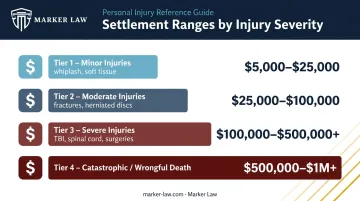
The more useful framework is injury tier. These ranges reflect approximate real-world outcomes, not guarantees:
| Injury Category | Approximate Range |
|---|---|
| Minor (whiplash, soft tissue, minor sprains) | $5,000 – $25,000 |
| Moderate (herniated discs, fractures, lacerations) | $25,000 – $100,000 |
| Severe (spinal cord damage, TBI, multiple surgeries) | $100,000 – $500,000+ |
| Catastrophic/wrongful death | $500,000 – $1M+ |
Why Attorneys Move These Numbers
At every tier, represented victims tend to recover more. The difference comes down to non-economic damages — categories that insurance adjusters routinely undervalue when dealing with unrepresented claimants:
- Pain and suffering
- Loss of enjoyment of life
- Emotional distress
- Loss of consortium
Unrepresented claimants often undervalue these claims or fail to assert them at all.
Illinois-specific variables — comparative fault, available policy limits, and strength of liability evidence — can push a case above or below any published range. Each of those factors is examined in the sections that follow.
Key Factors That Affect Your Car Accident Settlement Amount
Medical Expenses
Documented medical costs form the foundation of every economic damages claim. ER visits, surgeries, physical therapy, specialist care, medications, and projected future treatment all feed into the baseline.
Two things will protect your claim from the start:
- Seek treatment immediately, even if you feel fine. Delayed-onset symptoms are common, and gaps in care give insurers ammunition to deny or discount claims.
- Keep every record. Bills, discharge summaries, prescription receipts, and therapy notes all become leverage in negotiations.
Lost Wages and Diminished Earning Capacity
You can claim income lost during recovery and any permanent reduction in your ability to earn. This second category — diminished earning capacity — is particularly significant for physical tradespeople, sole breadwinners, or anyone with lasting restrictions.
Marker Law brings in vocational and economic experts for cases involving catastrophic injuries, spinal cord damage, TBI, or permanent disability to calculate the full financial toll through retirement age.
Pain and Suffering
Non-economic damages are calculated through two common methods:
- Multiplier method: Total economic damages multiplied by a factor (typically 1.5 to 5) based on severity and permanence
- Per diem method: A daily rate applied across the expected recovery period
These damages often exceed economic losses in serious cases. They're also where insurers push back hardest. Having an attorney who spent three years on the defense side — and knows exactly how carriers argue these numbers down — makes a measurable difference at the negotiating table.
Liability Clarity and Shared Fault
The cleaner the evidence of the other driver's fault, the stronger your position. Any contested liability — disputed police reports, conflicting witness accounts, unclear road conditions — gives the insurer room to argue your recovery down.
How much fault is assigned to each party directly shapes your final recovery under Illinois's modified comparative fault rule, which is covered in detail below.
Insurance Policy Limits
Even massive damages don't guarantee large recoveries if the at-fault driver carries minimum coverage. An experienced attorney identifies every potential source of compensation:
- The at-fault driver's bodily injury liability policy
- Your own underinsured motorist (UIM) coverage
- Umbrella policies
- Third-party liability (for example, an employer's coverage if the at-fault driver was working at the time)
How Much Does a Car Accident Lawyer Take — And Is It Worth It?
The Contingency Fee Model
Car accident attorneys work on contingency: you pay nothing upfront, and the attorney collects a percentage of the recovery only if they win. The ABA describes contingent fees as "often one third," and IRC data supports this — 73% of represented auto injury claimants reported a contingency arrangement, with a median fee of 30% and 58% estimating 30–33%.
Fees can rise to 40% or more if a case proceeds to trial, given the additional time and resources involved. Marker Law operates on a contingency basis — no upfront costs, no fees unless compensation is recovered.
Does a Lawyer Actually Net You More?
The honest answer is: usually, but not automatically. The IRC data shows represented claimants claimed far larger economic losses, but also notes that average net payments after attorney fees and medical reimbursements were lower in some comparisons. The variables that tip the scale toward higher net recovery with a lawyer:
- Complex or disputed liability
- Severe or permanent injuries with significant non-economic damages
- Multiple insurance sources to identify and pursue
- Insurers using tactics to minimize legitimate claims
A quick illustration: if an unrepresented victim accepts a $30,000 first offer, but a represented victim negotiates to $90,000 with a 33% fee ($29,700 to the attorney), the client still clears roughly $60,000 — double the unrepresented outcome, before lien negotiations.
Beyond Attorney Fees: Medical Liens
Attorney fees aren't the only deduction from a settlement. Medical providers often have reimbursement rights that must be resolved before you see a dollar.
Common deductions include:
- Medical provider liens — hospitals and treating physicians may claim a share
- Medicare/Medicaid subrogation — Medicare has recovery rights for conditional payments when a liability settlement is reached
- Health insurance subrogation — your insurer may seek reimbursement for injury-related claims paid
- Case expenses — expert fees, filing costs, and medical records, typically advanced by the attorney and recouped at resolution
An experienced attorney negotiates these liens down, which can meaningfully increase what you actually take home after settlement.
How Insurance Companies Evaluate (and Minimize) Your Claim
Insurance adjusters are not there to pay you fairly. Their job is to resolve claims for as little as possible, and they're trained to find every reason to justify a lower number.
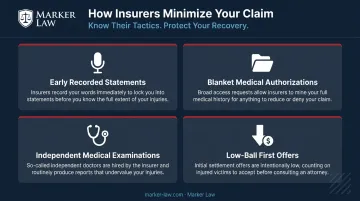
Common tactics that reduce settlement value:
- Recorded statements taken early — before the full scope of injuries is known, locking you into descriptions that may later undervalue your condition
- Blanket medical authorizations — access to years of unrelated medical records, used to argue pre-existing conditions caused your injuries
- Independent medical examinations (IMEs) — physicians hired by the insurer whose reports often minimize findings or dispute treatment necessity
- Low-ball first offers — designed to pressure quick acceptance from claimants without representation, often before maximum medical improvement is reached
Jason Marker spent three years on the defense side representing insurance carriers before transitioning to plaintiff-side work. As he puts it: "I learned their playbook."
That background shapes how Marker Law builds every case. Demand packages are structured to anticipate IME challenges, early offers are measured against the claim's full value, and clients are guided away from adjuster-friendly statements from day one.
Illinois Laws That Impact Car Accident Settlements
Modified Comparative Fault
Under 735 ILCS 5/2-1116, Illinois follows a modified comparative fault rule:
- If you are 50% or less at fault, you can recover damages — but your award is reduced proportionally by your fault percentage
- If you are more than 50% at fault, you are barred from recovery entirely
Example: If you're found 20% at fault and total damages are $100,000, you recover $80,000.
This rule makes how fault is allocated a critical negotiating point. Insurance companies routinely inflate the victim's share of fault to reduce payouts.
Statute of Limitations
Illinois personal injury victims have two years from the date of the accident to file a lawsuit under 735 ILCS 5/13-202. Miss that deadline and the right to sue is permanently gone — even if liability is clear and damages are significant. Early legal consultation protects that option before it closes.
Illinois Insurance Minimums and Coverage Gaps
Illinois sets minimum coverage requirements, but those floors are low enough that a serious crash can exhaust them quickly:
| Coverage Type | State Minimum | Marker Law Recommends |
|---|---|---|
| Bodily injury liability | $25,000 per person / $50,000 per accident | — |
| Property damage liability | $20,000 | — |
| Uninsured motorist (UM) | $25,000 per person / $50,000 per accident | $100,000 per person / $300,000 per accident |
Illinois law requires liability policies to automatically include UM coverage at the state minimums. That floor is rarely enough. With roughly 1 in 7 drivers nationally uninsured as of 2023, your own UM/UIM policy may be the only source of meaningful recovery if the at-fault driver carries no coverage — or not enough.
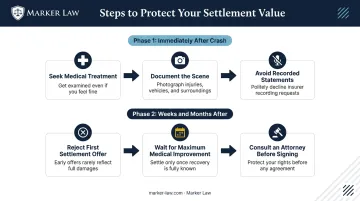
Steps to Protect Your Settlement Value After a Crash
Getting the settlement you deserve starts in the hours after a crash, not months later.
Immediately after the accident:
- Seek medical treatment — even if symptoms seem minor. Gaps in treatment are the first thing adjusters flag to minimize claims.
- Document the scene — photos, witness contact information, police report number.
- Do not give a recorded statement to the other driver's insurance company before speaking with an attorney. Early statements, taken before your injuries are fully understood, can be used to limit what you recover.
In the weeks and months that follow:
- Do not accept the first settlement offer. Initial offers are almost always below claim value, especially before the full extent of injuries, future treatment needs, and long-term impacts are known.
- Wait for maximum medical improvement (MMI) before settling. Settling too early can leave future medical costs, long-term limitations, and full pain and suffering damages off the table for good.
- Consult an attorney before signing anything. A free consultation with Marker Law gives you a clear picture of what your claim is actually worth — before you sign away the right to pursue more.
Frequently Asked Questions
How much will I receive from a car accident settlement after lawyer fees?
Your net recovery depends on the total settlement, the contingency fee percentage (typically 30–33%), and any medical liens requiring reimbursement. Most represented victims recover more than unrepresented claimants even after fees, especially in cases involving serious injuries, non-economic damages, or multiple insurance sources.
What is the typical lawyer percentage on a car accident settlement?
Contingency fees generally run around 33% for pre-litigation settlements and can reach 40% or more if the case goes to trial. Confirm the exact structure during your initial consultation, as terms vary by firm and case complexity.
What should I do with a $500,000 car accident settlement?
Address outstanding medical liens first, including any Medicare or Medicaid subrogation obligations. Most personal injury settlements are not federally taxable, but structured settlement interest and punitive damages may be — consult a tax professional and financial advisor before distributing funds from a large recovery.
How long does a car accident settlement take in Illinois?
Straightforward cases with minor injuries and clear liability can resolve in a few months. Cases involving severe injuries, disputed fault, or litigation typically take one to three years. Settling too quickly before MMI routinely undervalues the claim.
Can I still get a settlement if I was partially at fault in Illinois?
Yes. Under Illinois's modified comparative fault rule, you can recover as long as your fault does not exceed 50%. Your total recovery is reduced proportionally: 25% fault on a $100,000 claim yields $75,000.
Do I have to pay taxes on my car accident settlement?
Under IRS guidance on IRC Section 104, compensation for physical injuries and related medical expenses is generally excluded from gross income. Punitive damages and settlement interest are taxable. For large settlements, consult a tax professional before distributing funds.