How do you pursue accountability? Who has the legal right to file? What can you actually recover? And how long do you have before the opportunity disappears entirely?
This guide answers those questions under Illinois law. It covers what a wrongful death lawsuit is, who can file, what must be proven, what compensation Illinois families can recover, and why timing matters more than most people realize.
TLDR
- Illinois wrongful death claims are governed by the Wrongful Death Act (740 ILCS 180) and must generally be filed within two years of the date of death.
- The personal representative of the estate files the lawsuit on behalf of surviving family members.
- Families must prove duty, breach, causation, and damages to succeed.
- Recoverable damages can cover financial losses, grief and mental suffering, and punitive damages where applicable.
- Case values vary widely — speak with an attorney to understand what your specific claim may be worth.
What Is a Wrongful Death Lawsuit?
A wrongful death lawsuit is a civil legal claim filed when someone's death is caused by another party's negligent, reckless, or intentional act. In Illinois, these claims are governed by the Illinois Wrongful Death Act (740 ILCS 180), which allows surviving family members to seek compensation for losses they would not have suffered had the death not occurred.
Civil vs. Criminal Proceedings
This is a civil action, not a criminal one.
- Criminal charges are brought by the State of Illinois against the defendant — the goal is punishment (fines, imprisonment).
- A wrongful death claim is brought by the family through a legal representative — the goal is compensation.
These proceedings are independent, and a defendant can face both simultaneously. Even if someone is acquitted in criminal court, they can still be found liable in a civil wrongful death case.
That's because the civil burden of proof is lower: preponderance of the evidence, meaning it's more probably true than not that the defendant is responsible.
Wrongful Death vs. Survival Action
Illinois law also recognizes a second claim that often accompanies wrongful death: the survival action under 755 ILCS 5/27-6.
| Claim Type | Who Benefits | What It Recovers |
|---|---|---|
| Wrongful Death | Surviving family members | Family's own losses — grief, lost financial support, companionship |
| Survival Action | The decedent's estate | Damages the deceased could have claimed before death (pain, suffering, pre-death medical bills) |
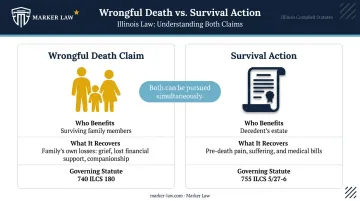
Both claims can be pursued simultaneously. If the victim survived their injuries for days or weeks before dying, the survival action preserves their right to compensation for that period of suffering.
Who Can File a Wrongful Death Lawsuit in Illinois?
The Personal Representative Requirement
Illinois follows a procedural rule that surprises many families. Unlike states where surviving relatives file directly, 740 ILCS 180/2 requires that the personal representative of the decedent's estate bring the wrongful death action.
This is the person named as executor in the will — or someone appointed by the court if no will exists.
The lawsuit is filed on behalf of — and any recovery goes to — the surviving spouse and next of kin (children, parents, siblings). Illinois distributes that recovery in proportion to each beneficiary's percentage of dependency on the deceased.
If no estate representative has been appointed yet, any surviving heir can petition the court to appoint one. Don't delay this step — it is a prerequisite to filing, and time is already running.
The Statute of Limitations
Illinois wrongful death claims must generally be filed within two years of the date of death. There are limited exceptions:
- Violent intentional conduct: The period extends to five years, or within one year after final disposition of a related criminal case (applying only to the accused, not other defendants).
- Fraudulent concealment: If the liable party concealed the cause of action, a five-year window may apply from the date of discovery under 735 ILCS 5/13-215.
- Minors: Tolling provisions under 735 ILCS 5/13-211 may extend deadlines for minor beneficiaries in certain circumstances.
Missing the deadline by even one day bars the family's right to any compensation — courts make exceptions only in rare, narrow circumstances. If you have any question about whether a deadline applies to your case, contact an attorney before that window closes.
What Are the Elements Required to Bring a Wrongful Death Lawsuit?
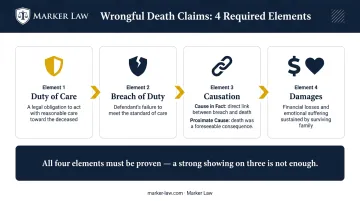
To succeed on a wrongful death claim in Illinois, the personal representative must establish four elements. All four must be proven — a strong showing on three is not enough.
1. Duty of Care
The defendant must have owed the deceased a legal duty to act with reasonable care — a duty that arises directly from the relationship between the parties:
- A driver owes a duty to follow traffic laws and avoid endangering others.
- A property owner owes a duty to maintain reasonably safe premises.
- An employer owes a duty to provide a safe working environment.
Whether a duty exists is a question of law that the court decides.
2. Breach of Duty
The plaintiff must show the defendant failed to meet that duty. This is the negligent, reckless, or intentional act at the core of the case — running a red light, ignoring a known safety hazard, or manufacturing a defective product.
3. Causation
Causation has two components under Illinois law:
- Cause in fact: But for the defendant's conduct, the death would not have occurred.
- Proximate (legal) cause: The death was a foreseeable result of the breach, not a remote or unrelated consequence.
Illinois Pattern Jury Instruction 15.01 defines proximate cause as a cause that, in the natural or ordinary course of events, produced the injury. It need not be the only cause or the last cause.
4. Damages
The family must have suffered measurable losses — financial, emotional, or both. This element establishes the value of the claim. Recoverable losses typically include:
- Lost income and financial support the deceased would have provided
- Medical and funeral expenses
- Loss of companionship, guidance, and emotional support
- Grief and mental suffering of surviving family members
Common Examples of Wrongful Death Cases
Wrongful death claims arise across a wide range of circumstances. The most frequent scenarios include:
- Traffic accidents — Illinois recorded 1,178 traffic deaths in 2024, including 106 from tractor-trailer crashes alone, according to IDOT's 2024 Crash Facts & Statistics. Car, truck, and motorcycle crashes are among the most common sources of wrongful death claims.
- Workplace and construction accidents — The BLS reported 156 fatal work injuries in Illinois in 2024, with falls, transportation incidents, and violent acts among the leading causes.
- Defective products — A design or manufacturing defect that causes a death can create liability for the manufacturer and others in the distribution chain.
- Intentional acts — Wrongful death isn't limited to accidents; an assault or other deliberate act that results in death can qualify for a civil claim.
One thing that applies across all of these scenarios: the victim doesn't have to die at the scene. If someone survives their injuries for days or weeks before passing, the wrongful death claim still runs from the original incident — not the date of death.
Identifying All Liable Parties
In many cases, more than one party bears responsibility. An employer may be liable for an employee's negligence. A trucking company may share liability with its driver. A manufacturer may be responsible alongside a negligent operator. Identifying every potentially liable party — not just the most obvious one — can substantially increase the compensation available to the family.

At Marker Law, attorney Jason Marker routinely investigates the full chain of liability in serious injury and death cases. His early career on the defense side — representing employers and insurance carriers — taught him exactly how these entities minimize exposure and shift accountability. That knowledge now works for families, not against them.
What Damages Can You Recover in a Wrongful Death Lawsuit?
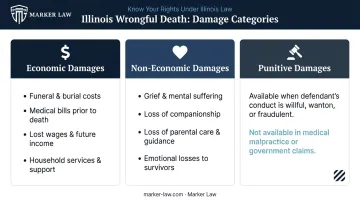
Illinois law authorizes two broad categories of damages in wrongful death cases. Illinois's current Wrongful Death Act sets no statutory cap on compensatory damages, and Illinois Supreme Court precedent has invalidated statutory caps on noneconomic damages.
Economic Damages
These are the quantifiable financial losses:
- Funeral and burial expenses
- Pre-death medical bills (often pursued through the survival action)
- The decedent's lost wages and future earning capacity
- Value of household services and financial contributions the deceased would have provided
Non-Economic Damages
Under 740 ILCS 180/2, Illinois explicitly authorizes recovery for grief, sorrow, and mental suffering of the surviving spouse and next of kin. This also includes:
- Loss of companionship, society, and guidance
- Loss of parental care and instruction for minor children
- The emotional and relational void the death creates
Punitive Damages
When the defendant's conduct was willful, wanton, or fraudulent — not merely careless — Illinois courts may award punitive damages. Courts award punitive damages to punish the defendant and deter similar conduct. Punitive damages are unavailable in actions for medical malpractice, legal malpractice, or claims against the State or units of local government.
What Determines Settlement Value
There is no reliable "average" wrongful death settlement. Value depends on:
- The decedent's age, income, and earning trajectory
- The number and ages of surviving dependents
- The degree of fault and egregiousness of conduct
- Available insurance coverage and defendant assets
Any attorney who quotes you an average figure without reviewing your case is guessing. The only meaningful number comes from a thorough review of your specific facts — the decedent's earnings, your family's losses, and the defendant's conduct and resources.
How a Wrongful Death Attorney Can Help Your Family
What the Attorney Actually Does
A wrongful death case involves far more than filing paperwork. An experienced attorney:
- Investigates the cause of death and identifies every liable party
- Preserves time-sensitive evidence — surveillance footage, accident data, maintenance records, witness statements — before it disappears
- Handles all communications with insurance companies and defense counsel
- Coordinates any survival action alongside the wrongful death claim
- Builds the damages picture, including future economic losses
That leaves the family focused on what matters — not managing a legal dispute.
The Insurance Company Problem
Insurance carriers do not wait for grieving families to get organized. They move quickly — assigning adjusters, gathering evidence, and in some cases making early settlement offers designed to close the file cheaply before the family understands what the case is worth.
Jason Marker spent three years on the defense side representing insurance carriers before transitioning exclusively to plaintiff advocacy. He knows the evaluation criteria adjusters use, the arguments defense attorneys raise to minimize liability, and the tactics used to pressure families toward undervalued settlements. As Jason puts it: "I learned their playbook." That background directly informs how Marker Law builds and presents wrongful death claims.
No Upfront Costs
Marker Law handles wrongful death cases on a contingency fee basis. There are no attorney fees unless compensation is recovered. The firm offers free initial consultations and is available 24/7 — reachable any hour by calling or texting 331-INJURED — because serious losses don't happen on a business schedule.
Frequently Asked Questions
What are the elements required to bring a wrongful death lawsuit?
A successful claim requires proving four elements: the defendant owed the deceased a duty of care, the defendant breached that duty, the breach directly caused the death, and the surviving family suffered measurable damages as a result. All four must be established — weakness in any one element can defeat the claim.
What are common examples of wrongful death that lead to a lawsuit?
Fatal car, truck, and motorcycle accidents are among the most frequent causes, along with workplace accidents, defective products, and intentional acts like assault. Any death caused by another party's negligence or wrongful conduct may qualify. The central question is whether the deceased could have sued for their injuries had they survived.
What is the average settlement for a wrongful death lawsuit?
There is no reliable average. Settlement value depends heavily on case-specific factors including the decedent's age, income, family situation, available insurance coverage, and the nature of the defendant's conduct. An attorney can review your specific facts and give you a realistic picture of what your case may be worth.
Who can file a wrongful death lawsuit in Illinois?
In Illinois, the personal representative of the decedent's estate files the lawsuit rather than family members directly. Any recovery goes to the surviving spouse and next of kin, distributed in proportion to each person's dependency on the deceased.
How long do you have to file a wrongful death lawsuit in Illinois?
The general rule is two years from the date of death. Limited exceptions exist for cases involving violent intentional conduct, fraudulent concealment, or minor beneficiaries. Missing this deadline by even a single day typically eliminates the family's right to compensation permanently.
What is the difference between a wrongful death lawsuit and a survival action?
A wrongful death claim compensates surviving family members for their own losses — grief, lost financial support, loss of companionship. A survival action is filed on behalf of the estate to recover damages the deceased suffered before death, such as pre-death pain, suffering, and medical expenses. Both can be pursued simultaneously in Illinois.