Illinois law generally requires wrongful death lawsuits to be filed within two years of the date of death under 740 ILCS 180/2. But that rule has important exceptions. The discovery rule, tolling provisions for minors and fraud, and special rules for medical malpractice cases can all shift when that deadline actually falls.
This article covers the core two-year rule, when and how the discovery rule delays the clock, exceptions that can toll the deadline, and what happens if you miss it.
TL;DR: Key Takeaways
- Illinois wrongful death claims must generally be filed within two years of the date of death (740 ILCS 180/2)
- The discovery rule delays the clock until you knew — or should have known — the death was wrongfully caused
- Special exceptions toll the deadline for minors, fraudulent concealment, and defendant absence from Illinois
- Medical malpractice wrongful death cases face a hard 4-year statute of repose — no exceptions apply
- Missing the deadline almost always means permanent dismissal — consult an attorney as early as possible
The Illinois Wrongful Death Statute of Limitations: The 2-Year Rule
The Baseline Rule
Under 740 ILCS 180/2, a wrongful death lawsuit must be commenced within two years after the death of the person. This applies to the most common wrongful death scenarios: car accidents, truck accidents, motorcycle accidents, premises liability, workplace fatalities, and construction accidents.
"Commenced" means filed in court. Under 735 ILCS 5/2-201, Illinois civil actions begin when a complaint is filed — not when a demand letter goes out, not when you notify the insurance company. Sending a letter to a defendant or adjuster does not stop the clock.
The two-year period also runs from the date of death, not the date of the accident. If a victim survived the crash or incident for days or weeks before dying, the limitations clock starts when death occurred — not when the injury happened.
Extended Deadlines for Violent Acts and Government Defendants
Not every case follows the standard two-year rule. Two significant exceptions apply:
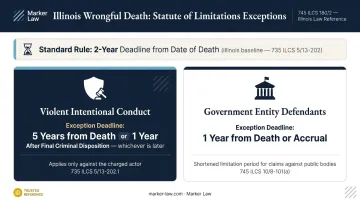
- Violent intentional conduct (first-degree murder, second-degree murder, involuntary manslaughter, reckless homicide, drug-induced homicide): Families have five years after death to file — or one year after the final disposition of related criminal proceedings, whichever comes later. This extended window applies only against the alleged violent actor or charged defendant, not other parties.
- Government entity defendants: Claims against local public entities or their employees must be filed within one year of death or accrual under 745 ILCS 10/8-101(a). Many families don't realize government defendants receive this shortened window. Missing it typically results in dismissal.
What Is the Discovery Rule in Illinois Wrongful Death Cases?
How the Discovery Rule Works
The discovery rule is a legal doctrine that delays the start of the statute of limitations until the plaintiff knew — or through reasonable diligence should have known — two things:
- That the death occurred
- That it was wrongfully caused
In many wrongful death cases, especially those involving medical negligence, the cause of death isn't obvious. A family may know their loved one died without immediately understanding that someone's negligence contributed to it.
The Moon v. Rhode Standard
The Illinois Supreme Court addressed this directly in Moon v. Rhode, 2016 IL 119572. The court held that the discovery rule under 735 ILCS 5/13-212(a) applies to wrongful death and survival actions alleging medical malpractice. The limitations period begins when the claimant knows or reasonably should know of the death and that it was wrongfully caused — both elements are required.
A family who suspected something went wrong but had no reasonable basis to confirm negligence may have more time than a simple date-of-death calculation would suggest.
The "Reasonably Should Have Known" Standard
Courts apply an objective test: when would a reasonable person in the plaintiff's position have discovered that negligence contributed to the death? Common moments that start the clock include:
- Receiving and reviewing medical records
- Obtaining an expert opinion on causation
- Learning new facts about the circumstances surrounding the death
- A second doctor raising concerns about prior care
The rule is not unlimited. Courts evaluate the specific facts, and families cannot simply wait indefinitely. The clock starts when discovery reasonably should have occurred, whether or not the family actually connected the dots by that point.
Why Defense Attorneys Fight This Hard
Insurance carriers and defense lawyers routinely argue that a family "should have known sooner" — specifically to claim the statute of limitations already expired before the lawsuit was filed. This argument can be raised even when families had no realistic way to know about negligence without expert review.
Jason Marker spent three years on the defense side before transitioning exclusively to representing injury victims. That experience means he knows precisely how these arguments are built and where they fall apart. When the defense tries to use a clock argument to avoid accountability, that insider knowledge directly shapes how the case is fought.
Exceptions That Can Toll or Extend the Wrongful Death Filing Deadline
Minors
Under 740 ILCS 180/2(f), if the person entitled to bring the wrongful death claim was under age 18 when the cause of action accrued, the two-year statute of limitations is tolled until their 18th birthday. They then have two years from that point to file. This tolling provision is written directly into the Wrongful Death Act, not borrowed from general civil procedure rules.
Fraudulent Concealment
If the at-fault party actively concealed information that prevented the family from discovering the true cause of death, the statute of limitations may be tolled under 735 ILCS 5/13-215. Families may then have up to five years from the date they discovered — or reasonably should have discovered — the concealed cause of death to file suit. This exception requires deliberate concealment; it does not apply simply because information was difficult to find.
Defendant's Absence From Illinois
Under 735 ILCS 5/13-208, if the defendant leaves Illinois after the incident and before the family can file suit, the period of absence is excluded from the two-year window. The clock resumes only when the defendant returns to the state.
Medical Malpractice Wrongful Death: Discovery Rule and the Statute of Repose
Medical malpractice wrongful death cases operate under a different — and stricter — framework than most wrongful death claims.
The Two-Year Discovery Period
Under 735 ILCS 5/13-212(a), wrongful death claims based on medical malpractice use the discovery rule: the two-year clock begins when the family knew or should have known that the death was wrongfully caused by medical negligence — not necessarily on the date of death itself. Moon v. Rhode confirmed this standard applies to both wrongful death and survival claims.
The 4-Year Statute of Repose
Medical malpractice cases add a second, harder deadline on top of the two-year limitation:
| Rule | Trigger | Can Be Extended? |
|---|---|---|
| Statute of limitations | Discovery of wrongful cause | Yes — by discovery rule and some tolling exceptions |
| Statute of repose | Date of the negligent act or omission | No — absolute hard deadline |
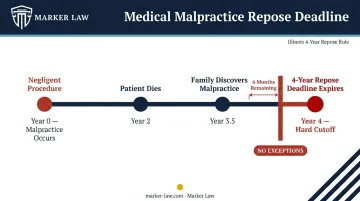
The statute of repose under 735 ILCS 5/13-212(a) bars any medical malpractice action brought more than four years after the act or omission alleged to have caused the death — regardless of when the family discovered the malpractice.
Consider the practical stakes:
- A loved one dies two years after a negligent procedure
- The family connects the death to that procedure 18 months later
- Only six months remain on the four-year repose clock
- Filing even a day late extinguishes the claim permanently
One narrow exception: Lawler v. University of Chicago Medical Center held that a wrongful death amendment can relate back to a timely-filed original complaint under 735 ILCS 5/2-616(b) — but that requires a prior complaint already on file, which most families won't have.
Anyone who suspects medical negligence contributed to a family member's death should consult an attorney immediately.
Note: Marker Law does not handle medical malpractice cases. Families dealing with suspected medical negligence should seek a referral to an Illinois medical malpractice attorney.
What Happens If the Statute of Limitations Expires?
Filing even one day after the applicable deadline means the case gets dismissed. Defendants file motions to dismiss, and courts grant them.
In Giles v. Parks, 2018 IL App (1st) 163152, the Illinois Appellate Court affirmed dismissal where an untimely original filing could not support relation back of a wrongful death claim. The family permanently lost their right to pursue compensation.
Courts recognize no grace period for grieving families who missed the deadline without knowing it existed.
What an Attorney Does to Protect Against This
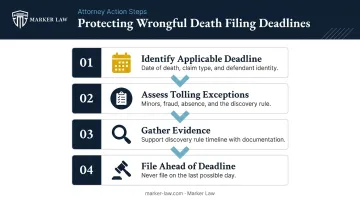
When Marker Law takes on a wrongful death case, the immediate priorities are:
- Identify the applicable deadline based on the date of death, claim type, and defendant identity
- Assess all tolling exceptions — minor beneficiaries, fraudulent concealment, defendant absence, or discovery rule arguments
- Gather evidence to support the discovery rule timeline if the cause of death was not immediately apparent
- File well ahead of any deadline — not on the last possible day
Marker Law offers free consultations and handles wrongful death cases on a contingency fee basis — families pay nothing unless compensation is recovered. The firm serves clients throughout DuPage, Will, Cook, Kane, and Kendall counties.
Don't Forget Survival Claims
A survival claim under 735 ILCS 5/13-209 is a separate action — the personal injury lawsuit the deceased could have filed had they survived — and it runs on its own deadline. The deadline is the personal injury statute of limitations that would have applied to the decedent, or one year after death, whichever is later. An attorney can evaluate both claims simultaneously and ensure neither deadline is missed.
Frequently Asked Questions
What is the statute of limitations for wrongful death in Illinois?
Illinois generally requires wrongful death lawsuits to be filed within two years of the date of death under 740 ILCS 180/2. Important exceptions can shorten this period — such as claims against government entities — or extend it, depending on the circumstances.
Does the discovery rule apply to all Illinois wrongful death cases or only medical malpractice?
Moon v. Rhode confirmed the discovery rule applies to wrongful death and survival claims based on medical malpractice. While some courts have applied discovery principles more broadly, consulting an attorney is the only reliable way to confirm whether it applies to your case.
What is the difference between a statute of limitations and a statute of repose?
The statute of limitations is the general filing deadline, which can be extended by the discovery rule or tolling exceptions. The statute of repose is an absolute outer deadline (in medical malpractice cases, four years from the negligent act) that cannot be extended regardless of when the family discovered the cause of death.
Can I still file if the two-year deadline has already passed?
Once the statute of limitations expires, courts will typically dismiss the case. That said, an attorney should evaluate immediately whether exceptions apply — such as the discovery rule, minor claimants, fraudulent concealment, or defendant absence — that might still preserve the right to file.
Who can file a wrongful death lawsuit in Illinois?
Under Illinois law, a wrongful death action is filed by the personal representative (executor or administrator) of the deceased's estate, for the benefit of the surviving spouse and next of kin, including children and parents.
How soon should I contact a wrongful death attorney after losing a loved one?
Contact an attorney as soon as possible — ideally within weeks of the death. Evidence must be preserved, deadlines must be identified early, and some exceptions (like the one-year requirement for government defendants) run far shorter than the standard two-year period.