Many families in the Chicagoland area don't realize how quickly that window can close — or how much work must happen before a wrongful death lawsuit can even be filed. Under the Illinois Wrongful Death Act (740 ILCS 180/1 et seq.), most families have two years from the date of death to file a claim. In truck accident cases, that window is under pressure from day one.
This article covers who can file, when the clock starts, what exceptions apply, and why commercial truck accident deaths demand immediate legal action.
TL;DR
- Illinois law gives most families two years from the date of death to file a wrongful death lawsuit.
- Key truck accident evidence (ELD data, driver logs, dashcam footage) can be legally overwritten or destroyed within 30 to 90 days of a crash.
- Multiple parties may be liable: the driver, trucking company, cargo loader, and manufacturer.
- Claims against government entities fall under a one-year deadline, not two.
- Acting early, not at the deadline, is what preserves evidence and protects your claim.
Illinois Statute of Limitations for Truck Accident Wrongful Death Claims
Who Files the Lawsuit — and When
Under Illinois law, wrongful death actions must be filed by the personal representative of the deceased's estate — not by surviving family members directly. The personal representative files on behalf of eligible next of kin, and any recovery is distributed to those beneficiaries. If no personal representative has been appointed, that step must happen before litigation can begin.
A spouse or parent who wants to sue cannot simply file on their own — that surprises many families. Identifying or appointing a personal representative is a threshold step, and it takes time.
The two-year clock begins on the date of death — not the date of the crash. If someone was injured in a truck accident and died in the hospital three weeks later, the statute of limitations starts from the day they died, not the day of impact.
Who Qualifies as a Beneficiary
Recovery under the Wrongful Death Act goes to the surviving spouse and next of kin. Illinois courts define "next of kin" by reference to the state's laws of descent and distribution, per Booker v. Lal.
Relationships that may face complications:
- Unmarried domestic partners (without a civil union) are not expressly included in the statutory beneficiary class
- Unadopted stepchildren face similar limitations unless formal adoption occurred
- Civil union partners have the same legal protections as spouses under Illinois law
- Adopted children are treated as descendants of the adopting parent
Non-traditional family structures require careful legal analysis — an attorney will need to map your specific relationships against Illinois's descent and distribution statutes to confirm standing before any claim is filed.
The Survival Action — A Parallel Claim
Alongside a wrongful death action, Illinois law allows a survival action under 755 ILCS 5/27-6. This preserves the deceased's own legal claims — the damages they personally suffered before dying. That includes:
- Conscious pain and suffering between the crash and death
- Lost wages during that period
- Medical expenses incurred before death
Both actions are typically filed together by the personal representative, but they are governed by separate statutes with potentially different deadlines. Missing the wrongful death deadline is almost always fatal to the case — courts will dismiss late-filed claims regardless of how compelling the evidence is.
Why Truck Accident Wrongful Death Cases Create Unique Time Pressures
Evidence That Disappears Fast
Commercial truck accidents are governed by federal regulations that require trucking companies to retain specific records — but only for limited periods. Once those windows close, data can be legally destroyed.
| Evidence Type | Mandatory Retention Period |
|---|---|
| ELD / hours-of-service records | 6 months |
| Supporting HOS documents | 6 months |
| Driver vehicle inspection reports | 3 months |
| Inspection, repair & maintenance records | 1 year (6 months after vehicle leaves carrier) |
| Driver qualification file | Duration of employment + 3 years |
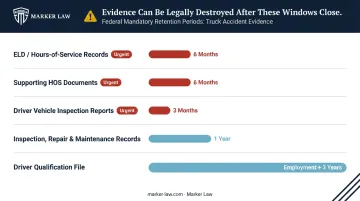
Beyond federal retention rules, electronic logging device data and dashcam footage are often overwritten within 30 to 90 days of a crash. Without a formal legal hold notice sent to the carrier, that evidence may be gone before a family has even hired an attorney.
Marker Law sends preservation demands to trucking companies immediately upon engagement — putting the carrier on notice that evidence must be retained. If a trucking company destroys records after receiving that notice, it can constitute spoliation, and under Illinois Pattern Jury Instruction 5.01, courts can allow juries to draw adverse inferences against the company.
The Rapid Response Imbalance
Trucking companies don't wait. Within hours of a serious crash, commercial carriers and their insurers deploy accident response teams — investigators, attorneys, and accident reconstruction specialists — to begin building their defense. Evidence deteriorates fast: cleanup crews arrive, weather changes road conditions, and skid marks fade. Within the first 24 hours, the physical record of a crash begins to disappear.
Meanwhile, most families are in emergency rooms or handling funeral arrangements.
Every day without legal representation is time the other side uses to shape the record. Jason Marker spent three years on the defense side before transitioning exclusively to plaintiff work — he knows exactly how insurance carriers approach these cases and what they're doing in those first critical hours.
Multiple Liable Parties — and the Investigation Required to Find Them
Truck accident wrongful death cases rarely involve just one defendant. Potential liable parties include:
- The truck driver — fatigue, distraction, impairment, or Hours of Service violations
- The trucking company — negligent hiring, inadequate training, pressure to violate HOS rules
- The cargo loading company — improperly secured or overloaded freight
- The truck manufacturer — defective brakes, tires, or other components
- Road maintenance entities — dangerous conditions that contributed to the crash
Identifying all of them requires investigation. That investigation takes time — and every day counts against the statute of limitations.
Exceptions and Circumstances That Can Modify Your Deadline
Claims Against Government Entities
If the truck was operated by a municipal or state agency, Illinois tort immunity rules under the Local Governmental and Governmental Employees Tort Immunity Act (745 ILCS 10/8-101) apply. Civil actions against a local public entity or its employees generally must be commenced within one year from the date the cause of action accrued — not two.
This dramatically shortens your window. If there's any possibility a government vehicle was involved, contact an attorney immediately.
Minor Beneficiaries
Under 740 ILCS 180/2, if a person entitled to recover wrongful death benefits is under age 18 when the cause of action accrued, that person may cause the action to be brought within two years after reaching age 18.
This provision applies narrowly — it governs the minor beneficiary's individual rights, not the overall wrongful death filing deadline. Key points to understand:
- A minor child's presence does not automatically pause the two-year deadline for all parties
- The provision may protect the minor's own claim while leaving other claims time-barred
- How the two interact depends on case-specific facts that require attorney review
Do not assume your case is preserved past two years without confirming the exact interaction with a qualified attorney.
The Discovery Rule
In cases where the cause of death was not immediately apparent — for example, a fatal defect in a truck component that wasn't identified until later investigation — Illinois courts may apply the discovery rule, which starts the limitations clock when the family knew or reasonably should have known that negligence caused the death (Moon v. Rhode, 2016 IL 119572).
Courts apply this exception carefully. It requires a showing that the connection between negligence and death genuinely could not have been discovered earlier — not simply that it was overlooked.
Why You Cannot Afford to Wait — Even With Two Years on the Clock
Two years sounds like a long time. It isn't.
Consider what must happen before a wrongful death lawsuit can be filed:
- Grieve and stabilize — families need time to function after a catastrophic loss
- Identify and consult an attorney — finding the right firm takes time
- Appoint a personal representative — a threshold legal step
- Investigate the crash — scene evidence, electronic records, witness interviews
- Identify all liable parties — this alone can take months in complex cases
- Build a demand package — comprehensive documentation of all damages
- Attempt pre-suit negotiation — required before or alongside filing in many cases
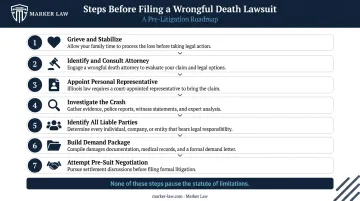
None of those steps pause the statute of limitations.
Record preservation adds another layer of urgency. Trucking companies retain records because they're legally required to, but once they reasonably conclude no litigation is coming, the incentive to preserve beyond minimum requirements diminishes. An attorney who sends a formal spoliation letter early creates a legal obligation to preserve: failure to comply then becomes evidence of bad faith.
The Early Settlement Trap
Commercial trucking insurers may contact grieving families within days of a fatal crash offering a fast settlement. These initial offers are almost always far below what a properly litigated wrongful death case would recover — and accepting one permanently waives the right to further compensation.
Marker Law handles all communications with insurance companies, preventing families from unknowingly harming their claims through early statements or premature settlements. Insurance adjusters work to settle claims quickly and cheaply. Having an attorney in place before those calls happen changes the dynamic entirely.
Damages Families Can Recover in an Illinois Wrongful Death Claim
Illinois wrongful death damages fall into two categories:
Economic damages:
- Funeral and burial expenses
- The deceased's lost future income and benefits
- Loss of financial support the family depended on
Non-economic damages:
- Grief, sorrow, and mental suffering (expressly included in 740 ILCS 180/2)
- Loss of companionship, society, and guidance
- Loss of parental guidance for surviving children
Illinois has no cap on non-economic wrongful death damages. The Illinois Supreme Court struck down statutory caps in Lebron v. Gottlieb Memorial Hospital, and the current wrongful death statute contains no such limitation.
The survival action adds recovery for the deceased's personal damages before death — conscious pain and suffering, medical expenses, and lost wages during the period between the crash and death. Attorneys typically file both actions together.
Those damages have to come from somewhere — and in truck accident cases, the available coverage is substantially higher than in typical auto claims. Federal regulations require minimum coverage of $750,000 for standard for-hire interstate carriers, compared to Illinois' personal auto minimum of $25,000 per person. Hazardous materials carriers face minimums up to $5,000,000.
Accessing that coverage involves navigating FMCSA filings, identifying all liable parties across the trucking chain, and dealing with carriers experienced at minimizing payouts. These cases require attorneys who understand commercial truck litigation from both sides of the table.
Frequently Asked Questions
Can I sue for a truck accident death that happened years ago?
If the two-year window has closed, the family typically loses the right to sue. Narrow exceptions — such as the discovery rule or tolling for minor beneficiaries — may still apply, so consult an attorney immediately even if significant time has passed.
How long do I have to file a wrongful death claim in Illinois after a truck accident?
Illinois law allows two years from the date of death under the Illinois Wrongful Death Act. Truck accident cases involve additional time-sensitive steps — preserving evidence and identifying all liable parties — so earlier is always better.
Who can file a wrongful death lawsuit in Illinois?
Under Illinois law, the personal representative of the deceased's estate files the wrongful death action on behalf of eligible surviving family members — typically a spouse, children, or parents. The court distributes any recovery to the beneficiaries after the case resolves.
What happens if the trucking company destroyed evidence before I filed my claim?
Destroying evidence after a preservation demand — or once litigation is reasonably foreseeable — is spoliation. Courts can sanction the company or instruct the jury to draw adverse inferences against it. An attorney should send a preservation letter as soon as possible.
Can I file both a wrongful death claim and a survival action after a truck accident?
Yes. Illinois families can pursue both a wrongful death action for the family's losses and a survival action for damages the deceased suffered before death. The personal representative typically files both claims together.
What if my loved one was partially at fault for the truck accident?
Illinois follows a modified comparative fault rule under 735 ILCS 5/2-1116. Families can still recover wrongful death damages as long as the deceased was not more than 50% at fault. The recovery amount is reduced proportionally by the percentage of fault assigned to the deceased.
Marker Law represents wrongful death families throughout DuPage, Will, Cook, Kane, and Kendall counties. The firm operates on a contingency fee basis — no recovery, no fee — and is available 24/7 for families who need immediate guidance after a fatal truck accident. Call 331-INJURED or reach out online for a free consultation.