Illinois law provides a legal path forward. Under the Illinois Wrongful Death Act (740 ILCS 180/), families can hold negligent parties accountable through a civil claim entirely separate from any criminal investigation. The compensation available addresses both the financial losses and the deeply personal ones — the loss of a parent, a spouse, a provider.
This guide explains how wrongful death claims work after fatal truck accidents in Illinois: who can be held liable, what compensation is available, what factors drive the final number, and how to build a case strong enough to withstand the aggressive defense tactics trucking companies and their insurers routinely deploy.
TL;DR
- Illinois wrongful death claims must be filed within two years of death — delays destroy evidence and forfeit rights
- Multiple parties can be held liable: the trucking company, cargo loaders, and manufacturers — not just the driver
- Recoverable damages include lost future income, loss of companionship, and punitive damages in egregious cases
- Federal law requires commercial carriers to carry minimum $750,000 in liability coverage — often much more
- ECM data and driver logs can be overwritten within weeks — early legal action preserves critical evidence
What Is a Wrongful Death Claim After a Fatal Truck Accident in Illinois?
The Civil Claim Explained
Under 740 ILCS 180/, a wrongful death claim arises when a death results from another party's "wrongful act, neglect or default" — conduct that would have given the deceased the right to sue had they survived. The claim is civil, not criminal. It runs parallel to any prosecution but operates independently.
The personal representative of the deceased's estate files the claim. The recovery goes to the surviving spouse and next of kin, including adoptive parents and adopted children.
Wrongful Death vs. Survival Action
Families often hear both terms used together — and they should be. These are two distinct claims typically filed simultaneously:
| Claim | Who Benefits | What It Covers |
|---|---|---|
| Wrongful Death | Surviving family members | Their own losses — grief, loss of companionship, lost financial support |
| Survival Action | The deceased's estate | Losses the victim suffered before death — pain, suffering, pre-death medical bills |
Illinois Pattern Jury Instructions specifically address both claims together and include guidance to prevent duplicate damages.
The Two-Year Deadline
Illinois law gives families two years from the date of death to file. Missing this window forfeits the right to compensation entirely.
Limited exceptions exist, but they apply to a narrow set of circumstances:
- Minor beneficiaries may toll the deadline until two years after turning 18
- Violent intentional conduct may allow an extension under specified conditions
For most fatal truck accident cases, two years is the hard limit — and evidence starts disappearing well before that. Black box data gets overwritten. Trucking companies destroy logs. Witnesses move on. Filing promptly isn't just procedural; it's the difference between a recoverable case and a lost one.
Who Can Be Held Liable After a Fatal Truck Accident?
Multiple Parties, Multiple Policies
Liability in fatal truck accidents rarely stops with the driver. A thorough investigation will examine:
- The trucking company — for negligent hiring, inadequate driver training, or pressuring drivers to violate hours-of-service rules under 49 CFR Part 395
- Cargo loading companies — for improperly secured loads in violation of 49 CFR Part 393 Subpart I
- Vehicle manufacturers — for defective components such as brake failures
- Independent maintenance contractors — for negligent inspections under 49 CFR Part 396
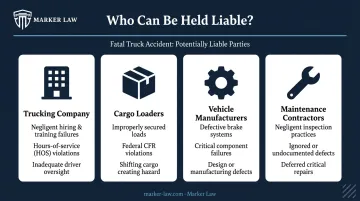
Each potentially liable party may carry its own insurance policy. Identifying all of them significantly increases the total compensation available.
FMCSA Regulations as Evidence
Federal Motor Carrier Safety Administration regulations establish the standard of care for commercial carriers. Violations are powerful evidence of negligence. According to FMCSA's 2022 crash data, driver-related factors were recorded in 33.2% of large-truck fatal crashes — speeding, distraction, and impairment including fatigue being among the most common.
When a driver exceeded hours-of-service limits or a carrier falsified inspection records, they've created documented proof of negligence — exactly the kind of evidence that builds a wrongful death case.
Illinois Comparative Fault
Proving negligence is only part of the battle. Defense teams will also try to limit what families recover. Illinois follows a modified comparative fault rule: if the deceased is found 50% or less at fault, the family can still recover — but the award is reduced proportionally. Defense teams routinely try to pin blame on victims to shrink payouts. Strong evidence and an attorney who anticipates these tactics are essential to counter them.
What Compensation Can Families Recover?
Illinois wrongful death claims can recover three categories of damages: economic losses, non-economic losses, and — in cases involving serious misconduct — punitive damages. Here's what each covers.
Economic Damages
These cover measurable financial losses, including:
- Funeral and burial expenses
- Medical bills incurred between the accident and death
- Lost future wages and benefits — projected over the deceased's remaining working life using expert economist testimony, accounting for raises, benefits, and inflation
- Value of household services the deceased provided — childcare, home maintenance, caregiving
Non-Economic Damages
These compensate losses that don't appear on any invoice but are equally real. Under Illinois law and Pattern Jury Instructions, recoverable non-economic damages include:
- Loss of society — love, affection, care, attention, companionship, comfort, guidance, and protection
- Loss of consortium for a surviving spouse (including companionship and sexual relations, per Elliott v. Willis)
- Loss of parental guidance for dependent children (recognized in Bullard v. Barnes)
- Mental and emotional anguish suffered by surviving family members
Punitive Damages
Unlike economic and non-economic damages, punitive damages exist to punish the wrongdoer and deter similar conduct — not to reimburse the family's losses. Illinois courts award them when a defendant's conduct was fraudulent, intentional, or willful and wanton.
In truck accident cases, this threshold can be met when a driver operated a commercial vehicle while knowingly intoxicated, or when a carrier concealed dangerous vehicle defects. The Illinois Wrongful Death Act explicitly permits punitive damages in these circumstances.
What Factors Affect How Much Compensation a Family Receives?
No reliable "average" exists for fatal truck accident settlements. Payouts range from hundreds of thousands to tens of millions of dollars depending on the specific facts of each case. CVN has reported individual trucking wrongful death verdicts reaching $19.25 million.
Several factors drive the final number:
- The deceased's age, income, and remaining earning years
- The number and ages of surviving dependents
- Available insurance coverage across all liable parties
- Any comparative fault finding against the deceased
Earning capacity shapes the economic damages calculation more than almost any other factor. Age, career stage, and income trajectory all matter — a 38-year-old engineer with 25 working years ahead generates a far larger loss figure than a retired individual. Expert economists project lifetime earning losses factoring in promotions, benefits, and inflation.
Dependent relationships directly influence non-economic damages. A parent of three young children will typically receive substantially higher awards than a case involving no dependents, because courts and juries recognize the decades-long impact of losing parental guidance and support.
Insurance coverage sets the practical ceiling on recovery in many cases. Federal law establishes minimum financial responsibility requirements for commercial carriers under 49 CFR Part 387:
| Carrier Type | Minimum Required |
|---|---|
| General freight (10,001+ lb GVWR) | $750,000 |
| Hazardous materials (oil/hazmat) | $1,000,000 |
| High-risk hazardous substances | $5,000,000 |
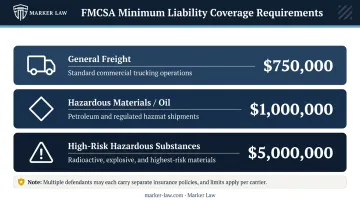
Multiple defendants — the driver, trucking company, cargo company, and manufacturer — may each carry separate policies contributing to total recovery.
Comparative fault is the factor families least expect — and the one defense teams push hardest. If the defense successfully argues partial fault, the award is reduced by that percentage. A 20% fault finding on a $2 million case costs the family $400,000.
How to Build a Strong Wrongful Death Case
Act Before Evidence Disappears
Trucking companies and their insurers launch their own investigations within hours of a fatal crash. Electronic logging device (ELD) data, dashcam footage, and GPS records get overwritten within 30 to 90 days. A litigation hold letter sent immediately can legally require the carrier to preserve all relevant evidence. Without it, critical data is gone before most families have even spoken to an attorney.
Key Evidence in Fatal Truck Cases
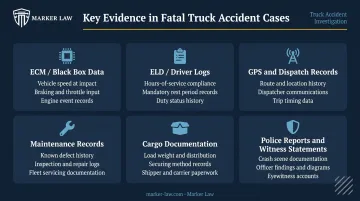
A thorough investigation pursues multiple evidence streams simultaneously:
- ECM/black box data — records vehicle speed, brake application, throttle position, engine RPM, and anti-lock brake status at the time of the crash
- Driver logbooks and ELD records — retained by carriers for a minimum of six months under 49 CFR 395.8, documenting hours-of-service compliance
- GPS and dispatch communications — can show whether the driver was pushed to violate HOS limits
- Maintenance and inspection records — reveal whether known defects were ignored
- Cargo loading documentation — establishes whether the load was properly secured
- Police accident report, witness statements, and surveillance footage
The Role of Expert Witnesses
Collecting evidence is only half the equation. Expert witnesses are what transform raw data into a compelling case at trial or at the negotiating table. Fatal truck cases typically require multiple specialists:
- Accident reconstruction specialists — use physics and vehicle data to establish exactly what happened
- Forensic/mechanical engineers — identify equipment failures or maintenance violations
- Medical professionals — connect injuries to cause of death
- Economic experts — calculate lifetime financial losses for the family
Illinois recognizes spoliation of evidence as negligence, but the duty to preserve requires a triggering event — an agreement, statute, or voluntary undertaking. Getting an attorney involved immediately creates that trigger and puts the carrier on notice before key data disappears.
How Marker Law Helps Chicagoland Families Pursue Wrongful Death Claims
When a trucking company's insurer gets involved in a wrongful death claim, they send experienced defense teams with one goal: minimize the payout. Families navigating that process deserve representation that knows how it works from the inside.
Jason Marker spent three years early in his career on the defense side, representing employers and insurance carriers before dedicating his practice exclusively to injured victims. That background directly shapes how Marker Law handles every fatal truck accident case — anticipating defense arguments before they're made, identifying which evidence the other side will challenge, and countering tactics that less experienced attorneys often miss.
Marker Law's approach to fatal truck accident cases includes:
- Immediate evidence preservation: litigation hold letters sent at the outset to prevent data from being overwritten
- Thorough investigation: gathering ECM data, driver logs, maintenance records, and dispatch communications
- Expert witness coordination: working with accident reconstruction specialists, mechanical engineers, and economic damages experts
- Direct attorney access: families work with Jason Marker personally throughout the case, not handed off to staff
- Full contingency representation: no upfront costs, no fee unless compensation is recovered

Marker Law serves families throughout Chicagoland including Naperville, Aurora, Wheaton, Bolingbrook, Plainfield, Downers Grove, and the surrounding communities across DuPage, Will, Cook, Kane, and Kendall counties. Free initial consultations are available by phone, Zoom, or in person — and the firm is reachable 24/7 at 331-INJURED.
Frequently Asked Questions
What's the average wrongful death payout for families in a fatal truck accident?
There's no reliable single average — payouts vary widely based on the deceased's income, number of dependents, severity of negligence, and available insurance. Truck accident cases typically produce larger recoveries than car accident cases because commercial carriers carry higher mandatory insurance minimums and multiple parties may share liability. Individual verdicts in trucking wrongful death cases have reached tens of millions of dollars.
What are the odds of winning a wrongful death claim after a fatal truck accident?
Most wrongful death claims involving truck accidents settle before reaching trial. Clear FMCSA violations — such as falsified logs or documented hours-of-service violations — significantly strengthen a family's position and put real pressure on carriers to settle.
How much of a wrongful death settlement would my family actually receive?
Attorney contingency fees and litigation costs are deducted from the final recovery. In Illinois personal injury cases, contingency fees commonly run approximately one-third of the recovery, though this varies by case complexity and stage of resolution. Ask your attorney for a clear net recovery estimate before accepting any settlement.
Who can file a wrongful death claim in Illinois after a truck accident?
Under Illinois law, the personal representative of the deceased's estate files the claim. The surviving spouse, children, and parents are the primary beneficiaries of any recovery. Adoptive parents and adopted children are expressly included under the Illinois Wrongful Death Act.
How long do I have to file a wrongful death claim in Illinois?
Illinois law allows two years from the date of death. Waiting diminishes the ability to preserve evidence — ECM data and driver logs can be gone within weeks of the crash. Consulting an attorney as soon as possible protects both the legal deadline and the evidence needed to meet it.
What is the difference between a wrongful death claim and a survival action?
A wrongful death claim compensates surviving family members for their own losses — grief, lost financial support, loss of companionship. A survival action compensates the deceased's estate for losses the victim suffered before death, including pre-death pain, suffering, and medical expenses. Both are typically filed together after a fatal truck accident.