IDOT reported 122 people killed in Illinois tractor-trailer crashes in 2023 — 103 separate fatal crashes involving tractor-trailers in a single year. Behind each of those numbers is a family asking the same question: what are we entitled to, and how do we fight for it?
No settlement reverses what happened. But Illinois law gives surviving families real legal tools — and understanding how these cases are valued is the first step toward using them.
TL;DR
- Illinois wrongful death truck accident claims consistently produce some of the largest personal injury payouts in the state, ranging from hundreds of thousands to tens of millions of dollars
- The Illinois Wrongful Death Act (740 ILCS 180) allows families to recover lost financial support, funeral costs, and loss of companionship — with no statutory cap on damages
- Settlement value turns on carrier negligence, federal insurance policy limits, the victim's earning capacity, and how many defendants share liability
- A Winnebago County jury awarded $67 million in a 2025 Panera truck crash case, demonstrating that Illinois juries hold negligent carriers fully accountable
- Illinois's 2-year statute of limitations means families must act fast to preserve black box data, driver logs, and other perishable evidence before it disappears
What Illinois Wrongful Death Truck Accident Settlements Are Worth
Wrongful death truck accident cases settle for more than non-fatal injury claims. These cases include the full economic value of a person's future earnings, household contributions, and companionship across an entire projected lifetime — losses that non-fatal claims simply cannot capture.
No Damage Cap in Illinois
Illinois has no current statutory cap on compensatory damages in personal injury or wrongful death cases. The Illinois Supreme Court struck down a 2005 noneconomic damages cap in Lebron v. Gottlieb Memorial Hospital (decided February 4, 2010), holding it violated separation of powers. Families can pursue the full scope of their loss without an artificial ceiling cutting off recovery.
Federal Insurance Requirements
Motor carriers operating in Illinois must carry minimum liability coverage under 49 CFR § 387.9:
| Carrier/Cargo Type | Minimum Coverage |
|---|---|
| For-hire nonhazardous property carriers (over 10,001 lbs GVWR) | $750,000 |
| Oil and certain hazardous materials | $1,000,000 |
| High-risk hazardous materials (explosives, poison gas, etc.) | $5,000,000 |
These minimums far exceed standard auto insurance limits — meaning the available recovery pool in a truck wrongful death case is far larger than in a typical car accident.
What the Numbers Actually Look Like
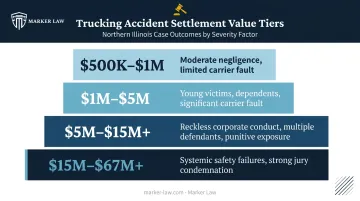
Settlement ranges vary based on facts, liability, and jurisdiction:
- $500,000–$1 million: Moderate wrongful death claims with clear but limited negligence
- $1 million–$5 million: Cases involving young victims, dependents, or significant carrier fault
- $5 million–$15 million+: Reckless corporate conduct, multiple defendants, or punitive exposure
- $15 million–$67 million+: Systemic safety failures with strong jury condemnation (see verdict examples below)
Real Illinois Wrongful Death Truck Accident Verdicts
Actual verdict data from Illinois courts is the most reliable way to calibrate expectations. These cases show what juries award when trucking companies are found negligent and a life is lost.
$67 Million Combined Verdict — Winnebago County (2025)
In September 2025, a Winnebago County jury awarded $67 million in a case involving Panera LLC and driver Eluid Valencia. The breakdown:
- $15 million to the estate of Fred Krischon
- $37 million to injured survivor Bob Krischon
- $15 million to the estate of Ruthie Fairchild
Plaintiffs alleged the driver caused a multi-victim crash through off-tracking — the dangerous condition where large trucks swing into adjacent lanes on curves. Evidence showed the carrier allowed the driver to continue operating despite prior collisions, without adequate retraining on this specific risk. The verdict reflected both the human loss and the jury's condemnation of the company's systemic safety failures.
One corporate failure, three victims, three separate awards. Each estate and the surviving injured party pursued independent claims — and each received a full verdict. That structure matters when evaluating how multi-victim truck crashes translate into total liability exposure.
$22 Million Wrongful Death Settlement — Cook County (2026, Analogous Case)
This case is not a truck accident — but the principle it illustrates applies directly. Chicago approved a $22 million settlement in January 2026 for the family of a 25-year-old man killed in a high-speed police pursuit crash. A stolen vehicle traveling 88 mph ran a red light and struck his car.
Illinois defendants — public and private — will pay eight-figure sums when a death results from reckless, preventable conduct. That threshold applies equally when a trucking company's safety failures cause the same outcome.
What Factors Drive Settlement Value
Severity of Carrier Negligence
Cases anchored to willful or systemic safety failures produce the highest verdicts. Examples that support punitive damages exposure:
- Knowingly violating FMCSA hours-of-service rules
- Falsified driver logbooks
- Retaining a driver with a documented crash history
- Improperly secured cargo
- Disabled or tampered safety equipment
Punitive damages in Illinois require conduct showing wanton disregard — willful misconduct approaching intentional harm. They're not guaranteed, but when the facts support them, they substantially shift settlement leverage.
Victim's Age and Financial Profile
Illinois courts and insurers calculate the present cash value of projected lifetime losses — earnings, employment benefits, and financial contributions to the household. Economic experts build that number using:
- BLS wage data and occupation-specific income projections
- Life expectancy tables from the National Center for Health Statistics (NCHS)
- Projected household financial contributions over the victim's remaining years
A 35-year-old parent supporting two children with decades of earning ahead anchors a fundamentally different number than a retired individual. That figure becomes the floor of any serious negotiation.
Number of Liable Defendants
Illinois truck accidents frequently involve multiple responsible parties:
- The driver (negligent operation)
- The trucking company (vicarious liability, plus independent negligence in hiring and supervision)
- Cargo loaders (improper loading or securement)
- Maintenance contractors (mechanical failures)
- Truck manufacturers (defective equipment)
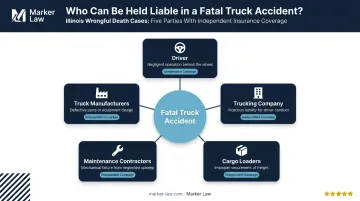
Each additional defendant brings its own insurance coverage. More defendants means more total coverage available — and more negotiation leverage.
Comparative Negligence Rules
Under Illinois's modified comparative negligence statute (735 ILCS 5/2-1116), families recover nothing if the deceased is found more than 50% at fault. Defense teams routinely try to shift blame onto the victim to eliminate or reduce the claim.
Countering this requires:
- Independent accident reconstruction
- Black box (ECM) data analysis
- Driver log and dispatch record review
- Eyewitness testimony
- Expert testimony on causation
At Marker Law, Jason Marker spent three years on the defense side before switching to plaintiff work. He knows which records insurers subpoena first, how they frame comparative fault arguments, and where most families' cases get undercut before trial. Cases are built from day one to close those gaps.
Jurisdiction
Where the case is filed matters. Cook County juries have historically returned higher verdicts than many downstate venues. A skilled attorney evaluates where the accident occurred, where defendants are incorporated or headquartered, and which venue offers the strongest strategic position for the family.
What Damages Illinois Families Can Recover
Two separate legal claims are typically filed after a fatal truck accident in Illinois:
Wrongful Death Act (740 ILCS 180) — Filed by the personal representative of the estate for the benefit of surviving spouse and next of kin. Recovers:
- Lost financial support the victim would have provided over their projected lifetime
- Funeral and burial expenses
- Loss of companionship, guidance, and consortium
- Loss of household services
- Grief, sorrow, and mental suffering of surviving family members
Survival Act (755 ILCS 5/27-6) — Preserves claims the deceased could have brought had they survived. Recovers:
- Pre-death conscious pain and suffering
- Medical expenses between the crash and death
- Lost earnings from the date of injury to death
Both claims are filed together. The Survival Act is frequently overlooked by families navigating this process without counsel — but it can represent a substantial portion of total recovery, in cases where the victim survived hours or days before dying.
Beyond compensatory recovery, Illinois courts can award punitive damages when a carrier's conduct was willful or reckless. Common examples include:
- Knowingly deploying a fatigued driver in violation of federal hours-of-service rules
- Ignoring repeated safety violations documented in the carrier's own records
- Falsifying driver logs or inspection reports to conceal non-compliance
Punitive damages require a separate pleading amendment under 735 ILCS 5/2-604.1. Even so, the threat of punitive exposure is often enough to push carriers toward early settlement — before the case ever reaches a jury.
How to Maximize Your Family's Settlement
Act Immediately to Preserve Evidence
Electronic logging device (ELD) data, dashcam footage, and onboard GPS records are typically overwritten within 30 to 90 days of a crash. Driver logs, dispatch records, and maintenance files can be altered or "lost" without a formal legal hold.
Marker Law issues a spoliation notice to the carrier as a first-priority action upon engagement, before critical evidence disappears.
Know Your Deadline
Illinois gives families 2 years from the date of death to file a wrongful death lawsuit (735 ILCS 5/13-202). Missing this deadline almost always bars any recovery. Early engagement also allows independent accident reconstruction before the scene changes and memories fade.
Why Defense-Side Experience Matters
Jason Marker spent the first three years of his career on the defense side representing insurance carriers before transitioning exclusively to plaintiff advocacy. That background provides direct insight into how trucking company insurers approach cases:
- How insurers evaluate cases and set initial reserves
- What evidence they prioritize when building a defense
- What arguments they use to suppress settlement offers
Knowing the defense playbook in advance shapes how Marker Law builds and positions each case for maximum recovery.
Marker Law serves families throughout Naperville, Aurora, DuPage County, Will County, Cook County, Kane County, and the broader Chicagoland region. Consultations are free, and the firm works on a contingency fee basis — no fees unless compensation is recovered.
Call 331-295-8005 to speak directly with Jason Marker about your family's case.
Frequently Asked Questions
What is the average settlement for a wrongful death lawsuit in Illinois?
Wrongful death truck accident settlements in Illinois commonly range from several hundred thousand dollars into the multi-millions, depending on the victim's age and earning capacity, the carrier's level of negligence, and available insurance coverage. Cases with clear carrier liability and a young victim with dependents frequently exceed $1 million.
What are signs of a good settlement offer?
A fair offer should account for all economic losses, non-economic damages, and liability evidence — including future income loss, loss of companionship, and potential punitive exposure. If an insurer's initial offer ignores any of these categories, it needs negotiation or litigation before it reflects actual case value.
Who can file a wrongful death truck accident lawsuit in Illinois?
Under the Illinois Wrongful Death Act (740 ILCS 180), the lawsuit must be filed by the personal representative of the deceased's estate — typically the surviving spouse or a court-appointed administrator. The recovery flows to the surviving spouse, children, and next of kin.
What is the statute of limitations for wrongful death claims in Illinois?
Illinois law gives families 2 years from the date of death to file a wrongful death lawsuit (735 ILCS 5/13-202). Missing this deadline bars recovery entirely, so families should consult an attorney as soon as possible.
Can you sue both the truck driver and the trucking company in Illinois?
Yes. Illinois law allows claims against the driver for negligent operation and against the trucking company for vicarious liability and independent negligence in hiring, training, and supervision. Multiple defendants typically means multiple insurance policies available to the family.
How much of a $25,000 settlement will I get?
After a standard contingency fee of roughly 33% and case costs, a $25,000 settlement would typically net approximately $15,000–$17,000. Wrongful death truck accident cases in Illinois routinely involve far higher stakes, and early insurer offers frequently undervalue the full claim — attorney review before accepting is essential.