
There is no single "average" wrongful death settlement. Payouts in Illinois range from tens of thousands of dollars to tens of millions — and that gap exists because every case turns on specific facts. What drives those numbers, what your family can realistically expect, and how to avoid leaving money on the table are exactly what this article explains.
TL;DR
- Illinois wrongful death settlements range from under $500,000 to several million dollars — every case turns on its own facts
- Key factors include the deceased's age and income, how clear liability is, available insurance coverage, and surviving family relationships
- Recoverable damages include economic losses (lost income, funeral costs), non-economic losses (grief, companionship), and sometimes punitive damages
- Illinois law gives most families two years from the date of death to file — acting quickly protects your case
- Marker Law handles wrongful death cases on contingency — no fees unless your family recovers compensation
What Are Typical Wrongful Death Settlement Amounts in Illinois?
Illinois does not publish a statewide database of wrongful death settlement averages. Private services like Jury Verdict Reporter have collected over 55,000 Illinois case summaries across more than 60 years, tracking verdicts and settlements. Their data is subscription-only, though, and not designed to produce a meaningful "average" for public use. Any figure you find online claiming to represent the typical Illinois wrongful death payout is an oversimplification.
General tiers can still give families a useful starting point.
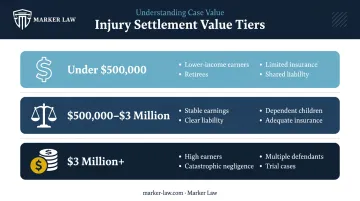
Settlement Range Tiers
| Range | Common Characteristics |
|---|---|
| Under $500,000 | Lower-income earners, retirees, limited insurance coverage, shared liability; often resolve quickly against policy limits |
| $500,000 – $3 million | Stable earnings, clear liability, dependent children or spouse, adequate insurance coverage |
| $3 million+ | High earners, catastrophic negligence (trucking accidents, DUI fatalities, defective products), multiple defendants, or cases that go to trial |
Publicly reported Illinois verdicts show how high values can reach in the right circumstances. A fatal sidewalk-fall settled for $4.4 million, while product-liability and government-negligence wrongful death verdicts have reached $45 million, $60 million, and even $79.85 million.
These figures are not benchmarks. Publicly reported cases disproportionately represent large outcomes — the vast majority of cases settle confidentially and never appear in any database.
Why Online Wrongful Death Calculators Fall Short
Online calculators cannot account for:
- The defendant's actual insurance policy limits
- Local jury sentiment across different Illinois counties
- The specific strength (or weakness) of your evidence
- Whether multiple defendants or coverage layers exist
What matters is the value of your specific case — and that requires an attorney who can assess the actual facts, defendants, and coverage involved.
Key Factors That Determine Your Wrongful Death Settlement Amount
Five variables consistently have the greatest influence on what an Illinois wrongful death claim is worth.
Age, Income, and Earning Potential of the Deceased
Economic damages calculations start with what the deceased would have earned and contributed had they lived. A 35-year-old with a stable career, employer benefits, and decades of projected income creates a much larger damages model than a retiree with no active earnings.
Forensic economists typically model:
- Expected lifetime earnings and salary trajectory
- Lost employee benefits (health insurance, retirement contributions)
- Value of household services (childcare, transportation, cooking)
- Present value of all future losses
These projections depend on documentation. W-2s, employment records, benefits statements, and pension information all feed into the damages model — the stronger the financial picture, the harder it is for the defense to minimize the numbers.
Clarity of Liability
When negligence is clear — a distracted driver running a red light, a drunk driver causing a fatality — the defendant's insurer knows a jury would likely find full liability. That produces higher settlement offers.
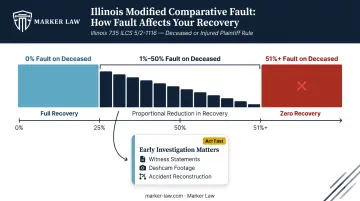
Illinois uses a modified comparative fault rule: if the deceased was partially at fault, damages are reduced by that percentage. If found more than 50% at fault, the family recovers nothing. Defense attorneys routinely attempt to shift fault onto the deceased to reduce their client's exposure. Early investigation — securing witness statements, dashcam footage, and accident reconstruction — protects against that tactic.
Available Insurance Coverage
Most wrongful death settlements are paid by the at-fault party's insurer. Illinois minimum auto liability is just $25,000 per person — far below what a serious wrongful death claim is worth. Federal trucking rules require minimums of $750,000 to $5 million depending on cargo risk, which is one reason fatal trucking accidents often produce larger recoveries.
An experienced attorney investigates every potential coverage layer:
- Primary auto or commercial liability policies
- Umbrella and excess policies
- Employer policies (if the at-fault driver was working)
- Underinsured motorist coverage on the deceased's own policy
Jason Marker at Marker Law spent three years on the defense side representing insurance carriers before switching to plaintiff work. That background means he understands exactly how insurers evaluate and cap their exposure — and where they might be undervaluing a claim or overlooking applicable coverage.
Strength of Family Relationships and Number of Dependents
Under the Illinois Wrongful Death Act (740 ILCS 180), recovery is for the exclusive benefit of the surviving spouse and next of kin. Courts allocate proceeds based on dependency and the closeness of each family relationship.
A surviving spouse with young dependent children typically generates higher non-economic damages than adult, financially independent children. The evidence presented — testimony, records, family history — directly shapes these awards.
Aggravating Conduct by the Defendant
When the at-fault party's behavior was especially reckless — a truck driver violating hours-of-service rules, a repeat DUI offender, a company that ignored known safety defects — insurers raise offers because juries punish that conduct. In cases involving extreme misconduct, punitive damages may also be available — an additional layer of recovery beyond compensatory losses.
What Damages Can Be Recovered in an Illinois Wrongful Death Claim?
Illinois wrongful death settlements can include three categories of damages.
Economic Damages
These are calculable financial losses the family would not have suffered if the deceased had lived:
- Lost wages and future earning capacity
- Lost employee benefits and retirement contributions
- Value of household services (childcare, cooking, transportation)
- Funeral and burial expenses
- Medical expenses between injury and death (recovered through a separate Survival Act claim)
Non-Economic Damages
Non-economic damages compensate for relational and emotional losses:
- Grief and mental anguish
- Loss of companionship and society
- Loss of guidance and parental care for children
- Loss of consortium for a surviving spouse
These damages are harder to quantify but can equal or exceed economic damages, particularly for young victims or cases involving close family relationships. The quality of evidence presented — including family testimony and records — shapes these awards.
Punitive Damages
Punitive damages are not available in every case. Illinois courts allow them only when the defendant's conduct was willful, wanton, or intentional; ordinary negligence does not qualify. Unlike compensatory damages, punitive damages are meant to penalize egregious conduct.
Tax note: Under IRS rules, compensatory damages (economic and non-economic) from wrongful death claims are generally not taxable. Punitive damages, however, are considered taxable income. Families should consult a tax professional about how their specific settlement is structured.
How Wrongful Death Settlements Are Paid Out
The two primary payout structures are:
- Lump sum — Full payment at once. Provides immediate access to funds for debts, medical bills, legal fees, and investment. Most families choose this option.
- Structured settlement — Regular installment payments over a defined period. Offers long-term income stability but limits access to the full amount upfront.
The choice between structures is negotiable, and the financial stakes are real — lump sums offer flexibility and investment potential, while structured payments provide predictable income but limit access to the full amount. Families should weigh immediate debts, long-term income needs, and how they realistically plan to use the funds before committing to either structure.
Illinois law requires court approval before wrongful death proceeds are distributed. At a dependency hearing, a judge allocates funds proportionally among beneficiaries based on each person's demonstrated loss. Any shares belonging to minor children are held in a supervised trust until they reach adulthood — a procedural requirement that Marker Law walks families through during the settlement process.
What Can Reduce Your Wrongful Death Settlement — and What to Do About It
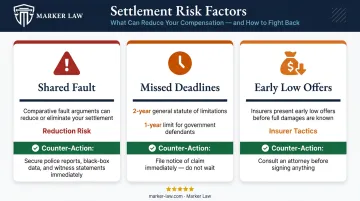
Three factors most commonly reduce — or eliminate — wrongful death recoveries in Illinois.
Shared fault by the deceased. If evidence shows the deceased contributed to the accident, Illinois' comparative fault rules reduce recovery proportionally. Defense teams routinely try to shift blame onto the deceased to lower their client's exposure. Counter this early — secure police reports, black-box data, witness statements, and accident reconstruction before the other side shapes the narrative.
Waiting too long. Illinois has a two-year statute of limitations for most wrongful death claims. Miss it, and recovery is typically barred entirely. Cases involving government defendants — a city, county, school district, or transit authority — may face a one-year deadline under the Local Governmental Tort Immunity Act. File a notice of claim with any government defendant as soon as possible.
Accepting an early offer without legal counsel. Insurance companies often extend quick, low offers to families before they understand their case's full value. An attorney who knows how insurers calculate offers — and what they're trying to avoid paying — is essential before signing anything.
If any of these situations apply to your case, speaking with an attorney early gives you the best chance of protecting your recovery.
Frequently Asked Questions
What is the average wrongful death lawsuit payout?
Illinois cases range from under $100,000 to tens of millions, depending on the deceased's earnings, liability facts, insurance limits, and family relationships. The meaningful question is what your specific case is worth — not a statistical average drawn from cases with entirely different facts.
What are signs of a good wrongful death settlement offer?
A strong offer covers full projected economic losses (lifetime earnings, benefits, household services), meaningful non-economic damages for grief and loss of companionship, and realistic litigation risk for both sides. A fast, low offer that doesn't itemize damages is a red flag — insurers often push early settlements before families understand full case value.
Who gets the money in a wrongful death lawsuit payout?
In Illinois, the personal representative of the estate files the claim and receives the settlement. A court then distributes proceeds to eligible beneficiaries — typically the surviving spouse, children, and next of kin — in proportion to each person's documented loss, with minors' shares protected under court supervision.
Are wrongful death settlements taxable in Illinois?
Compensatory damages — economic and non-economic — are generally not subject to federal or Illinois income tax. Punitive damages are taxable. Settlement agreements should allocate each component clearly, and families should consult a tax advisor for their specific situation.
How long does a wrongful death settlement take in Illinois?
Straightforward cases with clear liability and adequate insurance can settle within several months. Complex or disputed cases — and those that proceed to trial — often take one to three years or more. The two-year statute of limitations means families should not wait to consult an attorney, even while grieving.
Do I need a wrongful death lawyer to file a claim in Illinois?
There is no legal requirement, but insurance companies have experienced adjusters and defense attorneys working to minimize payouts from day one. An experienced wrongful death attorney works on contingency — no fee unless you recover — investigates all insurance sources, and consistently secures substantially better outcomes than unrepresented families. At Marker Law, Jason Marker offers free consultations for wrongful death families across DuPage, Will, Cook, Kane, and Kendall counties and can be reached at 331-295-8005.