That clock is ticking from day one.
Under the Illinois Wrongful Death Act, families generally have 2 years from the date of death to file a civil lawsuit. But exceptions tied to medical malpractice, government defendants, criminal acts, and other circumstances make the actual deadline more complicated than it first appears. Understanding those rules before time runs out is the difference between justice and nothing.
TL;DR: Key Takeaways
- Illinois's standard wrongful death deadline is 2 years from the date of death—not the accident date
- Criminal acts, minor claimants, fraudulent concealment, and absent defendants can extend the deadline
- Medical malpractice wrongful death claims carry a 4-year statute of repose—a hard outer filing limit
- Government entity claims require extra procedural steps, often with a 1-year notice window
- Missing the deadline almost always means permanent loss of your right to compensation
Illinois Wrongful Death Statute of Limitations: The Standard 2-Year Rule
The Illinois Wrongful Death Act gives families 2 years from the date of death to file a civil lawsuit. That deadline runs from the date of death — not the date of the accident, and not when injuries first appeared.
That distinction matters more than families often realize. If someone was injured in a car crash in January and died from those injuries in March, the wrongful death clock starts in March—not January. This separation from the underlying incident can create confusion, especially when families are also managing parallel insurance claims or estate proceedings.
Which Cases Fall Under This Rule
The 2-year deadline applies to deaths caused by "wrongful act, neglect or default" under Illinois law. In practice, that covers:
- Car, truck, and motorcycle accidents
- Pedestrian accidents
- Premises liability deaths (slip and falls, unsafe property conditions)
- Most workplace accidents not covered by a separate statute
- Construction site deaths
Survival Actions: The Parallel Claim
Alongside a wrongful death claim, families can often file a survival action, a separate claim that recovers damages the deceased would have pursued had they survived. These include pre-death pain and suffering, medical bills incurred before death, and related losses.
Both claims are typically filed together in the same lawsuit, and both carry the same 2-year deadline. Illinois Pattern Jury Instruction 45.04B provides a combined verdict form specifically for this reason.
Why 2 Years Feels Like Plenty But Isn't
Several things quietly consume months before a family takes any legal step:
- Grief and emotional recovery
- Estate administration and probate proceedings
- Back-and-forth with insurance companies
- Tracking down medical records and accident documentation
- Finding and consulting with an attorney
By the time those steps are complete, six months or more may be gone. Consulting an attorney early — even while still grieving — gives the investigation enough runway. Starting late creates pressure that's entirely avoidable.
Situations That Extend or Pause the Illinois Deadline
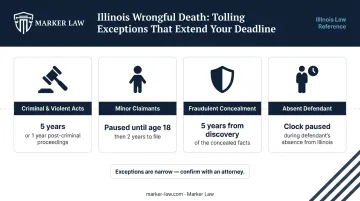
Illinois law allows the statute of limitations to be "tolled" (legally paused) under specific circumstances. These exceptions are narrow. Insurance companies and defense attorneys challenge them aggressively. Don't count on tolling as a safety net without confirming it applies to your situation.
Violent or Criminal Acts
If a loved one's death resulted from violent intentional conduct—first-degree murder, second-degree murder, involuntary manslaughter, reckless homicide, or drug-induced homicide—families have two options under the Wrongful Death Act:
- 5 years from the date of death, or
- 1 year after the final disposition of criminal proceedings, whichever is later
This extension applies only against the alleged violent actor or criminally charged defendant. If the defendant has a Criminal Victims' Escrow Account established under Illinois law, a separate 2-year window runs from the date that account is created.
Minors and People With Legal Disabilities
If the person entitled to bring the claim was under 18 at the time of death, the statute of limitations is paused until their 18th birthday, at which point they have 2 years to file. That said, if an adult family member (a surviving spouse or parent) can file sooner, don't wait. Acting early preserves evidence and avoids unnecessary risk.
For individuals under legal disability or incompetency, Illinois law under 735 ILCS 5/13-211 allows tolling while the disability continues. Illinois courts may require a court-appointed representative to bring the claim.
Fraudulent Concealment and Absent Defendants
When the at-fault party actively concealed the cause of death, which occurs in medical and workplace cases, 735 ILCS 5/13-215 allows families to file within 5 years after discovering the true cause of action.
If the responsible party has left Illinois and cannot be located or served, 735 ILCS 5/13-208 pauses the clock for the duration of their absence. The statute does not treat a defendant as "absent" if Illinois jurisdiction can still be established through other means.
If you're unsure whether any of these exceptions apply to your situation, an attorney can review the facts and confirm whether your deadline has shifted before you take any further steps.
Special Rules: Government Entities and Product Liability Deaths
Government Entity Defendants
Suing a government body involves rules that can shorten—not extend—your effective deadline.
For the State of Illinois:
- File a Notice of Claim with the Attorney General and Clerk of the Court of Claims within 1 year (unless the lawsuit itself is filed within that year)
- File the actual lawsuit within 2 years of the death
- Missing the notice requirement can doom the case even if the 2-year window is still technically open
For counties and cities: Under 745 ILCS 10/8-101, most civil actions against local public entities must be filed within 1 year—a full year shorter than the standard wrongful death deadline. The old general notice provision (8-102) has been repealed, so no separate notice requirement currently applies to most county and city claims.
If your loved one died due to a government entity's negligence—a municipal vehicle accident, unsafe public property, or similar situation—the effective deadline may be 1 year, not 2.
Product Liability Wrongful Death
Government deadlines are compressed. Product liability deadlines work differently — they can stretch across decades, or cut off claims you'd expect to be valid. Deaths caused by defective products involve layered deadlines under 735 ILCS 5/13-213:
| Deadline Type | Time Period |
|---|---|
| Outer limit from first seller sale/lease/delivery | 12 years |
| Outer limit from first delivery to initial user | 10 years |
| Discovery window after death occurs within repose period | 2 years |
| Hard cap from the injury/death event | 8 years |
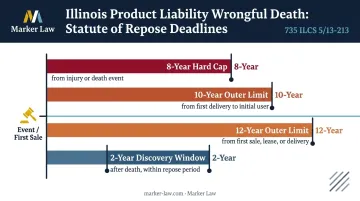
This is especially relevant for construction workers and industrial workers whose deaths may involve equipment, machinery, or materials sold years before the fatal incident. If the product left the distribution chain more than 12 years ago, a claim may be barred regardless of circumstances.
A Note on Medical Malpractice Wrongful Death
The Illinois Supreme Court held in Moon v. Rhode (2016) that the 2-year clock in medical malpractice wrongful death cases begins when the family knew or reasonably should have known that negligence caused the death—not automatically at the date of death. A 4-year statute of repose from the date of the medical error sets a hard outer limit that no discovery rule can override. Medical malpractice falls outside Marker Law's current practice areas, but families dealing with these situations should verify these deadlines with a qualified Illinois medical malpractice attorney promptly.
What Happens If You Miss the Filing Deadline?
Under 735 ILCS 5/2-619(a)(5), Illinois civil procedure allows involuntary dismissal when an action wasn't filed within the time limit set by law. In Beetle v. Wal-Mart Associates, Inc. (2001), the Illinois Appellate Court affirmed exactly this — a wrongful death complaint filed more than 2 years after death was dismissed outright. No amount of evidence of negligence overcomes an expired deadline. The at-fault party raises it as a complete defense, and the case ends.
That outcome is exactly what the defense counts on. Jason Marker spent three years representing employers and insurance carriers before transitioning exclusively to plaintiff work. That experience shapes how Marker Law advises clients on timing: insurance companies track these deadlines carefully, and delay shifts the advantage to their side. Early legal consultation puts families in a stronger position before that dynamic plays out.
If you think the deadline may have already passed: consult an attorney immediately anyway. Tolling exceptions may still apply, and only a qualified Illinois wrongful death attorney can determine whether any path forward remains.
What Damages Can a Wrongful Death Claim Recover in Illinois?
Illinois wrongful death law allows recovery for pecuniary injuries—a term that extends well beyond funeral bills.
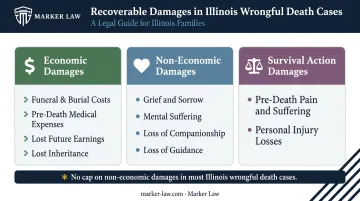
Economic Damages
- Funeral and burial costs
- Medical expenses incurred before death (typically pursued through the survival action)
- The deceased's lost future earnings and benefits
- Lost inheritance the family would have received
These require documentation: pay stubs, tax returns, employment records, expert economic analysis.
Non-Economic Damages
The Illinois Wrongful Death Act expressly includes grief, sorrow, and mental suffering as recoverable losses. Loss of companionship, guidance, and emotional support also fall within this category. Illinois does not cap these damages in most wrongful death cases. The Illinois Supreme Court struck down a non-economic damages cap in Lebron v. Gottlieb Memorial Hospital (2010) as unconstitutional.
Survival Action Damages (Filed Alongside)
The survival action, filed alongside the wrongful death claim, recovers the deceased's own pre-death losses: pain and suffering experienced before death and related personal injury damages. These are distinct from what the family recovers under the Wrongful Death Act, but can represent a significant portion of the total recovery.
Where the facts support it, Marker Law pursues both claims together so no category of loss goes unaddressed.
Frequently Asked Questions
What is the statute of limitations for a wrongful death lawsuit in Illinois?
The general deadline is 2 years from the date of death under the Illinois Wrongful Death Act. Exceptions exist for medical malpractice, government entities, criminal acts, minors, and other specific circumstances. Consult an attorney to determine which deadline applies to your case.
Who can file a wrongful death lawsuit in Illinois?
Under Illinois law, the deceased's personal representative files the lawsuit for the exclusive benefit of the surviving spouse and next of kin. Children and parents may qualify as next of kin depending on family structure. Only one lawsuit is filed on behalf of all eligible family members.
What happens if I miss the wrongful death statute of limitations in Illinois?
The court will almost certainly dismiss the case, and compensation cannot be recovered. Families should still consult an attorney immediately—certain tolling exceptions may provide a path forward in limited circumstances, but only an attorney can assess whether any apply.
Does the discovery rule apply to wrongful death cases in Illinois?
Yes, but only in specific circumstances—primarily medical malpractice wrongful death claims, where the clock begins when the family knew or should have known negligence caused the death. For most other wrongful death cases—car accidents, workplace deaths, premises liability—the clock starts at the date of death regardless of when negligence was discovered.
Can the statute of limitations be extended in Illinois wrongful death cases?
Yes, under specific circumstances. Criminal acts, minor claimants, fraudulent concealment, and absent defendants can toll the deadline. These exceptions are narrow and frequently challenged by defense attorneys—confirm with an attorney before assuming one applies to your case.
How much does it cost to hire a wrongful death attorney at Marker Law?
Marker Law handles wrongful death cases on a contingency fee basis—families pay nothing upfront, and attorney fees are only owed if compensation is recovered. The initial consultation is free. Call 331-295-8005 or reach out to discuss your situation at no cost or obligation.