When another driver's negligence caused the crash, Illinois law gives surviving family members a civil path to pursue accountability and financial recovery. That path is a wrongful death claim. It won't undo the loss, but it can prevent a negligent driver from walking away without consequences while your family bears the full financial burden.
This article explains how wrongful death claims work under Illinois law, what your family needs to prove, what you can recover, and what mistakes to avoid along the way.
TL;DR
- A wrongful death claim is a civil lawsuit — separate from any criminal case — filed when someone is killed due to another party's negligence
- In Illinois, only the personal representative (the court-appointed estate administrator) of the deceased's estate can file; families don't sue directly
- Recoverable damages include lost income, medical bills, grief, loss of companionship — Illinois places no cap on wrongful death damages
- The statute of limitations is 2 years from the date of death — but accident scene evidence and witness accounts can disappear within days
- Insurance companies move fast to minimize payouts — having an attorney early protects evidence, counters lowball offers, and keeps you ahead of their tactics
What Is a Wrongful Death Claim After a Fatal Car Accident?
The Civil Case vs. the Criminal Case
A wrongful death claim is a civil legal action brought by a deceased person's estate when another party's wrongful act, neglect, or default caused their death. Under the Illinois Wrongful Death Act (740 ILCS 180/1), the action applies whenever death results from conduct for which the deceased could have sued had they survived.
This matters because it runs on a completely separate track from any criminal charges. The Act explicitly preserves civil liability "although the death shall have been caused under such circumstances as amount in law to felony." A criminal prosecution may never happen, charges may be reduced, or the at-fault driver may be acquitted — none of that touches your civil claim.
Civil cases use a lower standard of proof ("preponderance of the evidence" rather than "beyond a reasonable doubt"), and the goal is financial compensation for your family — not punishment through incarceration.
What Makes a Car Accident Death "Wrongful"
Not every fatal accident supports a wrongful death claim — the death must result from someone else's negligence or fault. Common causes that qualify include:
- Distracted driving — phone use, eating, inattention
- Drunk or impaired driving — alcohol or drugs
- Speeding — IDOT's 2024 crash data shows speeding contributed to 45.3% of Illinois fatal crashes; alcohol was a factor in 20.4%
- Reckless driving — street racing, aggressive lane changes, running red lights
- Vehicle defects — manufacturer negligence contributing to the crash
Wrongful Death vs. Survival Action
Illinois also recognizes a survival action under 755 ILCS 5/27-6, which is separate but often filed alongside a wrongful death claim. Here's the distinction:
| Claim Type | What It Covers | Who Benefits |
|---|---|---|
| Wrongful Death | Family's losses after the death | Surviving spouse and next of kin |
| Survival Action | Deceased's losses before death — pain, suffering, medical bills | The estate |
Filing both claims together ensures your family recovers for its ongoing losses — lost income, grief, companionship — while the estate also recovers for the final medical bills and suffering your loved one endured before death.
Who Can File — and Who Receives the Damages — in Illinois
Filing Rights: The Personal Representative Rule
Individual family members cannot file a wrongful death lawsuit directly. Under 740 ILCS 180/2, only the personal representative (executor or administrator) of the deceased's estate may bring the action.
If no estate has been opened yet:
- A probate court can appoint an administrator under 755 ILCS 5/9-3
- Under 740 ILCS 180/2.1, when the wrongful death claim is the only estate asset, a court can appoint a special administrator without opening a full probate estate
This procedural step is manageable, but it needs to happen before the lawsuit can be filed.
Who Receives the Damages
Damages flow to surviving family members based on their proportionate dependency and losses. The general priority order is:
- Surviving spouse and children — first in line for recovery
- Parents — eligible if no surviving spouse or children
- Siblings — may qualify when no spouse, children, or parents survive
The court distributes the recovery; family members don't divide it themselves.
Who Can Be Held Liable
The at-fault driver is often just the starting point. Depending on the circumstances, liability may extend to:
- The driver's employer — if the driver was working at the time of the crash
- The vehicle owner — if they allowed an unsafe driver to operate their vehicle
- A vehicle manufacturer — if a defect contributed to the crash
- A government entity — if a road design or maintenance failure was a contributing factor (note: claims against local public entities carry a 1-year filing deadline under 745 ILCS 10/8-101, shorter than the standard 2 years)
Missing a liable party early can mean leaving significant compensation on the table — or worse, losing the right to pursue that party entirely. At Marker Law, attorney Jason Marker spent three years on the defense side representing insurance carriers and employers, which means he knows exactly how each of these parties assesses their own exposure and where they look for ways to limit it.
What Families Must Prove to Win a Wrongful Death Car Accident Case
The Four Core Elements
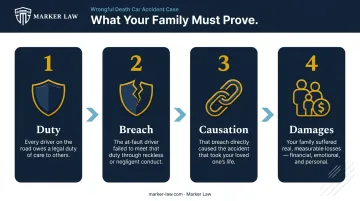
Every wrongful death car accident case comes down to four things:
- Duty — Every driver owes a legal duty to drive safely and follow traffic laws
- Breach — The defendant failed that duty (speeding, DUI, running a red light, distracted driving)
- Causation — That breach directly caused the fatal crash
- Damages — The death produced measurable losses for the surviving family
Proving Breach and Causation
Breach is usually demonstrated through police reports, traffic citations, eyewitness accounts, and physical crash evidence. Running a stop sign, weaving between lanes while intoxicated, or driving 80 mph in a 45 mph zone are clear examples of conduct that satisfies this element.
Causation requires showing the defendant's conduct was the proximate cause of the death — not just a contributing factor in a chain of events. This typically requires accident reconstruction experts, medical records linking crash mechanics to cause of death, and autopsy or coroner reports.
Illinois's Modified Comparative Fault Rule
Under 735 ILCS 5/2-1116, Illinois follows a modified comparative fault standard:
- If the deceased is found 50% or less at fault, the family's recovery is reduced proportionally
- If the deceased is found more than 50% at fault, the family may be completely barred from recovering
Insurance companies routinely try to shift blame onto the deceased to exploit this rule. Jason Marker spent three years on the defense side before switching to plaintiff work — he's seen this tactic used firsthand and knows how to counter it.
Evidence That Can't Wait
Critical evidence starts disappearing from the moment of the crash. Priorities include:
- Police report and crash scene documentation
- Traffic and surveillance camera footage
- Vehicle black box (EDR) data
- Witness statements
- Medical records and autopsy report
- Financial records documenting the deceased's income and earning history
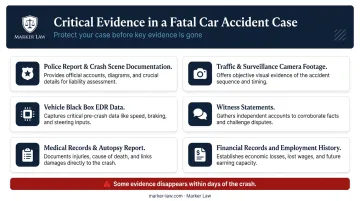
Surveillance footage can be overwritten within days. Witness memories fade. Black box data can be lost once the vehicle is repaired or totaled. Getting an attorney involved immediately is the single best way to ensure this evidence is secured.
How a Wrongful Death Claim Works in Illinois
Most wrongful death cases settle before trial, but families should understand the full process.
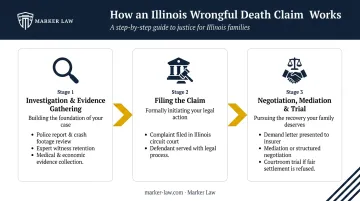
Step 1: Investigation and Evidence Gathering
The attorney moves immediately: obtaining the police report, preserving vehicle evidence, collecting camera footage, retaining accident reconstruction experts, and documenting financial losses through pay stubs, tax returns, and employment records. This phase shapes every negotiation and courtroom argument that follows.
Jason Marker spent three years representing insurance companies before switching to plaintiff advocacy. He knows which evidence insurers scrutinize and which gaps they use to undervalue claims — and builds cases that close those gaps before negotiations begin.
Step 2: Filing the Claim and Serving the Defendant
The personal representative formally initiates the lawsuit by filing a complaint in the appropriate Illinois court. In Naperville, that means either the 18th Judicial Circuit Court in Wheaton (DuPage County) or the 12th Judicial Circuit Court in Joliet (Will County), depending on where the accident occurred.
The complaint outlines the allegations, the legal basis for liability, and the damages sought. The defendant is then served and given a set period to respond.
Step 3: Negotiation, Mediation, and Trial
Most cases enter a negotiation phase after discovery concludes. The attorney presents a demand to the insurance company supported by the evidence gathered. If a fair settlement isn't reached, mediation or trial follows.
One factor shapes settlement outcomes more than any other: whether the insurance company believes your attorney will actually go to trial. Carriers offer better settlements when they know opposing counsel is prepared — retained experts, deposed witnesses, and a trial-ready file. Marker Law builds every case to that standard from the first consultation.
What Damages Can Families Recover After a Fatal Car Accident?
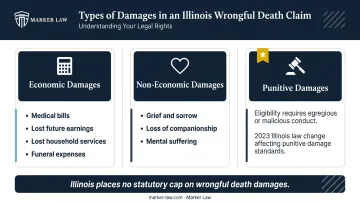
Economic Damages
These cover the financial losses that can be calculated with documentation:
- Medical bills incurred between the accident and death
- The deceased's lost future earnings and benefits (based on age, earning history, and career trajectory)
- Lost household services the deceased would have provided
- Funeral and burial expenses
NHTSA's economic analysis puts the economic cost per traffic fatality at $11.3 million when quality-of-life valuations are included — a figure that reflects how substantial these losses actually are.
Non-Economic Damages
These address losses that don't appear in a bank statement but are equally real:
- Grief and sorrow
- Loss of companionship, society, and guidance
- Mental suffering of surviving family members
Illinois places no statutory cap on wrongful death damages, which distinguishes it from several other states. Under 740 ILCS 180/2, the jury is directed to award "fair and just compensation" for pecuniary injuries — including these intangible losses.
Punitive Damages
As of Public Act 103-0514 (effective August 11, 2023), Illinois law now permits punitive damages in wrongful death actions "when applicable." There are exceptions — punitive damages are excluded in healing art malpractice, legal malpractice, and actions against the State or government entities.
In car accident cases involving egregious conduct by a private defendant, however, punitive damages are a legitimate consideration.
What Determines the Value of a Claim
Key factors include:
- The deceased's age at the time of death
- Earning capacity and career trajectory
- Number of surviving dependents and their degree of dependency
- Strength of family relationships
- Severity and clarity of the defendant's negligence
- Available insurance coverage (liability limits, UIM coverage)
Key factors include:
- The deceased's age at the time of death
- Earning capacity and career trajectory
- Number of surviving dependents and their degree of dependency
- Strength of family relationships
- Severity and clarity of the defendant's negligence
- Available insurance coverage (liability limits, UIM coverage)
Because these variables differ in every case, there's no reliable "average settlement" figure. What a claim is worth depends entirely on the specific facts — which is why an attorney evaluation matters early.
Common Misconceptions and Insurance Company Tactics to Watch Out For
"The Criminal Case Will Handle It"
Many families assume that if the at-fault driver is charged with a crime — DUI manslaughter, for example — the criminal system will provide financial justice. It won't. Criminal courts can impose fines, license suspension, probation, and incarceration. They cannot award your family compensation. A separate civil wrongful death lawsuit is the only mechanism for financial recovery.
The Early Settlement Trap
The Illinois Department of Insurance confirms that insurers are not required to offer a fair settlement — their primary obligation runs to their own policyholder, not to your family. Under Illinois administrative rules, an insurer must present a payment offer within 30 days after affirming liability. That timeline creates pressure to move quickly.
What looks like a substantial offer often falls far short of the claim's full value once lifetime lost earnings, long-term support losses, and non-economic damages are calculated. Adjusters know this. A few tactics families encounter early:
- Building rapport to create goodwill before a lowball offer arrives
- Moving quickly before families understand what the claim is actually worth
- Framing a release as routine paperwork
The IDOI is explicit: signing a release makes the offered amount the "final and only compensation" your family will ever receive for that loss.
Do not sign anything or accept any offer before speaking with an attorney.
"Two Years Is Plenty of Time"
The statute of limitations under 740 ILCS 180/2 gives most families two years from the date of death to file. Waiting carries direct consequences for the case. Surveillance footage gets overwritten. Vehicle black box data may not be preserved after the car is repaired or sold. Witnesses move, memories fade, and physical evidence at the crash scene disappears.
Every week that passes narrows what evidence can still be recovered. Marker Law offers free consultations, so families can assess their options before any of that window closes.
Frequently Asked Questions
Who can file a wrongful death claim in Illinois?
Under Illinois law, only the personal representative or administrator of the deceased's estate can file a wrongful death lawsuit. If no estate exists, a probate court can appoint an administrator — or a special administrator — to act on the family's behalf.
What is the statute of limitations for wrongful death claims in Illinois?
Illinois requires wrongful death lawsuits to be filed within 2 years of the date of death under 740 ILCS 180/2. Missing this deadline can permanently bar the family from any compensation. Claims against government entities face a shorter 1-year window.
Does auto insurance cover wrongful death in a car accident?
The at-fault driver's liability insurance is typically the primary source of compensation, subject to the policy limits. When those limits are insufficient to cover the full damages, the deceased's own underinsured motorist (UIM) coverage may provide additional recovery.
How much compensation can I get from a wrongful death settlement?
Settlement amounts vary based on the deceased's age, earning capacity, number of dependents, severity of negligence, and available insurance coverage. No two cases are alike, so a case-specific legal evaluation is the only reliable way to estimate value.
Is it worth pursuing a wrongful death claim after a car accident?
For most families, a wrongful death claim is the only way to recover financial losses and hold a negligent driver accountable. Marker Law handles these cases on a contingency fee basis, meaning no fee is charged unless compensation is recovered — so there is no financial risk to a free consultation.