A wrongful death lawsuit can hold negligent employers, contractors, or equipment manufacturers accountable in ways workers' comp simply cannot. But building that case requires the right evidence, gathered quickly, before it disappears.
According to the Bureau of Labor Statistics, Illinois recorded 156 fatal work injuries in 2024 — up from 145 the prior year. Behind each of those statistics is a family trying to understand their options.
This guide covers exactly what families in Illinois need to know: when a workplace death qualifies as a wrongful death claim, what legal elements must be proven, which specific evidence matters most, and how to avoid the common mistake of waiting too long.
TL;DR
- Illinois wrongful death claims require proving duty, breach, causation, and damages — each supported by specific documentation
- OSHA records, incident reports, training logs, and maintenance records are among the most powerful workplace-specific evidence
- Workers' comp limits recovery — a wrongful death lawsuit against employers or third parties can pursue full damages
- The statute of limitations is two years from the date of death; critical evidence can vanish well before that deadline
- Third-party claims against equipment manufacturers, subcontractors, or property owners frequently deliver the most complete compensation
When a Workplace Accident Qualifies as a Wrongful Death Case
The Legal Threshold in Illinois
Under the Illinois Wrongful Death Act (740 ILCS 180/1), a wrongful death claim exists when a death is caused by the "wrongful act, neglect, or default" of another party, and when the deceased would have had the right to sue had they survived.
The lawsuit is filed by the personal representative of the estate, with any recovery going to the surviving spouse and next of kin.
Common Workplace Scenarios That Qualify
Most workplace wrongful death claims trace back to preventable failures:
- Construction falls from scaffolding, ladders, or unprotected elevated surfaces
- Machinery accidents involving missing safety guards or lockout/tagout failures
- Struck-by incidents where workers are hit by vehicles, equipment, or falling objects
- Toxic chemical or electrical exposure in environments without proper safeguards
- Structural collapses at worksites where safety protocols were ignored
In each scenario, another party's negligence must have contributed to the death. A fatal accident caused entirely by unforeseeable circumstances — or by the worker's own sole actions — may not clear the threshold. The specific facts of the incident determine whether a claim exists.
The Four Legal Elements You Must Prove
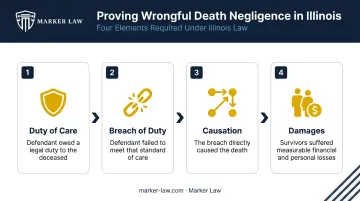
Illinois wrongful death claims, like most negligence-based civil cases, require proving four elements. Missing any one of them can defeat an otherwise solid claim.
| Element | What It Means in a Workplace Context |
|---|---|
| Duty of care | The employer, contractor, or manufacturer had a legal obligation to protect the worker |
| Breach of duty | They failed to meet that obligation — by ignoring OSHA standards, skipping maintenance, or providing inadequate training |
| Causation | That breach directly caused the death, not just contributed to a general dangerous environment |
| Damages | Surviving family members suffered real losses — financial, emotional, and relational |
The Burden of Proof
Illinois civil cases use a "preponderance of the evidence" standard — meaning the claim must be more probably true than not true, as defined in Illinois Pattern Jury Instructions. This is meaningfully lower than the criminal standard. Even so, it still requires organized, credible evidence presented compellingly.
An employer's duty isn't vague. Federal OSHA's General Duty Clause requires every employer to provide a workplace free from recognized hazards likely to cause death or serious harm. Illinois OSHA imposes the same obligation on public employers. When those standards are ignored, breach isn't hard to establish, but proving it caused this specific death requires careful documentation.
Key Evidence Needed to Prove Wrongful Death
Medical Records and Autopsy Reports
This is the foundation. Autopsy reports establish the cause of death, while ER and hospital records document the nature of fatal injuries and the chain of events from the accident to death. Illinois health care facilities must respond to records requests within 30 days. Get this process started immediately.
Incident and Accident Reports
The employer's internal incident report and any OSHA or state workplace safety investigation findings establish the official account of what happened. Attorneys scrutinize these reports for admissions, skipped safety protocols, or internal contradictions that undermine the employer's later legal position.
Eyewitness and Coworker Testimony
Coworkers who witnessed the accident, or who observed dangerous conditions beforehand, are among the most persuasive sources of evidence available. Move quickly. Employees transfer, leave jobs, or have their recollections shaped over time. A witness who clearly recalls what they saw on the day of the incident — before an employer's version of events takes hold — can be decisive at trial.
Photographs and Video Evidence
Surveillance footage, cell phone video, and photographs of the accident scene, defective equipment, or hazardous conditions can be decisive. The problem: workplaces often repair or alter conditions within days of a fatal incident. This evidence must be preserved immediately, before the scene is cleaned up or equipment is replaced.
Expert Witness Testimony
Complex cases require experts who can explain technical failures to a jury:
- Workplace safety experts — testify whether the employer violated OSHA standards
- Medical examiners — establish the precise cause and mechanism of death
- Engineers or equipment specialists — analyze machinery or structural failures
- Economic experts — calculate the full financial impact on the surviving family
One important caveat from Illinois case law: OSHA citations strengthen a negligence claim, but the Illinois Supreme Court has held that an OSHA violation does not automatically establish negligence as a matter of law. Expert testimony bridges that gap.
Workplace-Specific Evidence That Strengthens Your Claim
OSHA Records and Investigation Files
Employers must report a work-related fatality to OSHA within 8 hours. OSHA then typically conducts an investigation, which may result in citations and findings. Those records — inspection reports, citations, violation descriptions — can directly support breach and causation arguments.
OSHA fatality inspection data is publicly accessible through OSHA's fatality inspection database, and additional records can be requested under FOIA. An attorney can obtain these records faster and more completely than a family can on their own.
OSHA Form 300 Logs and Prior Incident History
OSHA requires employers to maintain Form 300 injury and illness logs, with 5-year retention requirements. These logs can reveal:
- Prior injuries or near-misses at the same worksite
- A pattern of the same safety violation being ignored
- Evidence the employer had notice of dangerous conditions long before the fatal accident
Employees and their representatives can request copies of the OSHA 300 Log — employers must provide them by the end of the next business day.
Training Records and Safety Certifications
Missing or incomplete training documentation is powerful evidence of both breach and causation. OSHA regulations require specific written certification records for certain operations:
- Fall protection training under OSHA 1926.503 must include the employee's name, training dates, and trainer signature
- Powered industrial truck certification under OSHA 1910.178 must document operator name, training date, and evaluator identity
If those records don't exist — or show the deceased was never properly trained — that absence is direct evidence of negligence.
Equipment Maintenance and Third-Party Liability
Deferred maintenance records, skipped inspections, or ignored manufacturer safety warnings can demonstrate the employer knew equipment was dangerous and did nothing. Equipment failures also open a separate avenue worth pursuing in parallel: product liability claims against the manufacturer.
Illinois strict product liability requires proving:
- The injury resulted from a product condition
- That condition was unreasonably dangerous
- The condition existed when the product left the manufacturer's control
Workers' comp bars most direct lawsuits against the employer — but third-party claims against manufacturers, subcontractors, property owners, or other companies on the worksite are not barred. For many families, these claims represent the largest portion of their total recovery.
Workers' Compensation vs. Wrongful Death: What Illinois Families Need to Know
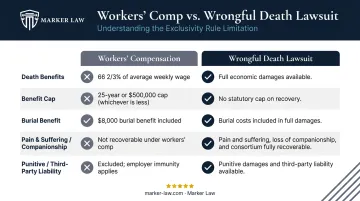
Workers' comp provides real benefits — but it comes with real limits.
What workers' comp provides:
- Death benefits at 66 2/3% of the deceased's average weekly wage
- Benefits paid for 25 years or $500,000, whichever is greater
- $8,000 burial expense benefit (for deaths from injuries after February 1, 2006)
What workers' comp does not provide:
- Compensation for pain and suffering
- Loss of companionship damages
- Punitive damages
- Full replacement of lost future earnings
Under 820 ILCS 305/5, the Workers' Compensation Act generally bars direct lawsuits against the employer. Compensation under the Act is typically the limit of the employer's responsibility. That's the exclusivity rule — and for many families, it means substantial compensation categories — pain and suffering, companionship, punitive damages — go entirely unclaimed.
When a Wrongful Death Lawsuit Is Still Available
The exclusivity rule isn't absolute. Three situations allow families to pursue a wrongful death claim despite the workers' comp bar:
- A third party contributed to the death: contractors, equipment manufacturers, property owners, and other non-employer parties on the worksite remain fully liable and can be sued directly
- The employer carried no workers' comp insurance: uninsured employers forfeit Act protections entirely — and proof of the injury becomes prima facie evidence of negligence under Illinois law
- Intentional employer misconduct: deliberate acts — such as knowingly concealing a lethal hazard or intentionally harming a worker — can remove the employer from Act coverage
The Two-Year Deadline
Illinois wrongful death claims must generally be filed within two years of the date of death under 740 ILCS 180/2. Exceptions exist for minor beneficiaries and cases involving violent intentional conduct — but the standard deadline is firm. Because the clock starts at the date of death — not at the conclusion of any workers' comp proceeding — families who wait for their comp case to resolve can inadvertently lose the right to pursue a wrongful death claim entirely.
How an Attorney Investigates and Preserves Evidence for Your Case
Evidence in workplace accident cases doesn't wait. Employers repair equipment. Surveillance footage gets overwritten. Coworkers leave the job. OSHA closes its investigation. Within weeks, critical evidence can be gone.
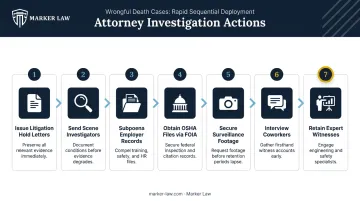
A wrongful death attorney can act immediately:
- Issue litigation hold letters to the employer, requiring preservation of all relevant records, communications, and physical evidence
- Send investigators to the scene before conditions change
- Subpoena employer records — safety logs, training files, maintenance records, internal communications
- Obtain OSHA investigation files through FOIA and formal discovery
- Secure surveillance footage before retention periods expire
- Interview coworkers while memories are fresh and before access becomes complicated
- Retain expert witnesses early, when they can still examine equipment and the scene
That kind of early action requires an attorney who knows what to look for — and how the other side will respond. Jason Marker spent the early part of his career on the defense side, representing employers and insurance carriers. He knows which records they're likely to minimize, which arguments they'll use to shift blame onto the worker, and how insurers assess their exposure. That insider perspective now works entirely in favor of injured families.
Marker Law handles cases on a contingency fee basis, meaning there are no upfront costs. Families in Naperville and across the Chicagoland area — including DuPage, Will, Cook, Kane, and Kendall counties — can contact the firm for a free, no-obligation consultation. Marker Law is available 24/7 at 331-INJURED.
Frequently Asked Questions
What evidence is needed to prove negligence in a wrongful death workplace accident?
Proving negligence requires three elements: a duty of care (such as OSHA-mandated safety standards), a breach of that duty, and documentation directly linking the breach to the death. Key evidence includes incident reports, OSHA citations, expert testimony, and medical and autopsy records.
Who can file a wrongful death lawsuit after a workplace accident in Illinois?
Under the Illinois Wrongful Death Act, the lawsuit is filed by the personal representative of the deceased's estate. Any damages recovered go to the surviving spouse and next of kin — generally a spouse, children, or parents. An attorney can clarify who qualifies based on your specific family situation.
How is a wrongful death lawsuit different from a workers' compensation claim?
Workers' comp provides no-fault fixed benefits but caps recovery and limits direct employer lawsuits. A wrongful death lawsuit can pursue full damages — pain and suffering, loss of companionship, punitive damages — against the employer in limited circumstances or any negligent third party.
How long do I have to file a wrongful death lawsuit in Illinois?
The statute of limitations is generally two years from the date of death. Missing this deadline typically means permanently losing the right to file. Early consultation with an attorney is essential, since critical evidence must be preserved long before that deadline arrives.
Can I file a wrongful death claim if the employer had workers' compensation insurance?
Yes. Workers' comp coverage does not eliminate wrongful death options against third parties. Equipment manufacturers, subcontractors, property owners, or other companies on the worksite can still be pursued in a wrongful death lawsuit regardless of whether the employer carried workers' comp insurance.
What if the employer claims my loved one was partially at fault?
Illinois follows a modified comparative fault rule — a claim can still succeed as long as the deceased's share of fault does not exceed 50%. An experienced attorney can counter employer attempts to shift blame using physical evidence, witness testimony, and expert analysis to establish the true sequence of events.