](https://file-host.link/website/marker-law-pbnojs/assets/blog-images/cb995135-6be9-4ec7-be2d-e25568d22e3f/1780566196770625_0efe91b65ca44b3fb367b68d92de4f84/360.webp)
Illinois law does allow surviving family members to recover compensation for emotional suffering under the Wrongful Death Act (740 ILCS 180). But emotional distress claims don't succeed on grief alone. Courts require credible, documented proof that the psychological harm is real, severe, and directly connected to the defendant's wrongful act.
This article walks through what courts actually need to see, which evidence carries the most weight, what affects compensation, and the mistakes that quietly sink otherwise valid claims.
TL;DR
- Illinois wrongful death law compensates emotional distress — but documented proof is required, not just personal accounts
- Courts evaluate medical records, mental health treatment, expert testimony, and evidence of daily life disruption
- Illinois doesn't cap most non-economic wrongful death damages, giving juries significant latitude
- Insurers routinely challenge these claims as exaggerated or as ordinary grief — not compensable suffering
- The statute of limitations is two years from the date of death — act early
What Emotional Distress Means in an Illinois Wrongful Death Lawsuit
Emotional distress in a wrongful death lawsuit covers far more than grief. It encompasses diagnosable psychological conditions and measurable disruption to daily life — depression, anxiety, PTSD, sleep disorders, loss of enjoyment of life, and strained relationships.
Illinois statute 740 ILCS 180/2 permits juries to award "fair and just compensation" for pecuniary injuries, which explicitly includes grief, sorrow, and mental suffering of surviving family members. Critically, the law doesn't require a physical impact or physical manifestation for these damages — the psychological harm itself is compensable.
Still, courts don't treat every expression of grief as compensable distress. The suffering must be severe, persistent, and tied directly to the defendant's wrongful act — not simply a natural response to loss.
Who Can Bring These Claims in Illinois
Wrongful death claims are filed by the personal representative of the deceased's estate on behalf of:
- Surviving spouse
- Children
- Other next of kin (including adopted parents and adopted children under Illinois law)
Courts distribute any recovery based on each survivor's degree of dependency on the deceased. The closer the relationship, the stronger the emotional distress claim.
How to Prove Emotional Distress in a Wrongful Death Lawsuit
No single piece of evidence wins an emotional distress claim. Courts evaluate the full picture: how liability is established, how suffering is documented, and how the death changed the survivor's life. The steps below show how that case is built.
Step 1: Establish the Legal Foundation
Before any emotional distress damages can be pursued, the underlying wrongful death claim must stand on its own. Illinois negligence law requires proving:
- Duty of care — the defendant owed a duty to the deceased
- Breach — the defendant violated that duty
- Causation — the breach directly caused the death
- Resulting harm — the death produced measurable losses
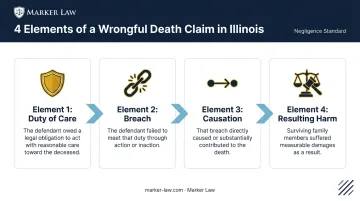
Emotional distress damages are layered on top of the negligence claim, not filed separately. A weak liability case makes emotional distress recovery harder, regardless of how well-documented the suffering is.
Step 2: Seek and Document Mental Health Treatment
Professional mental health treatment is among the most persuasive forms of proof available. Therapy, psychiatry, and counseling records signal that the distress was severe enough to require intervention — something insurers can't easily dismiss.
Records that matter most:
- Initial intake assessments and diagnoses
- Ongoing session notes documenting symptoms and progress
- Prescribed medications with dates and dosages
- Duration and frequency of treatment
- Referral letters between providers
Treatment isn't legally required to prove distress. Defense attorneys, however, routinely argue that untreated grief wasn't severe enough to warrant damages. Seeking prompt care protects both the family's wellbeing and the legal record at the same time.
Step 3: Compile Personal and Witness Testimony
Family members can testify directly about the relationship with the deceased, the role that person played in daily life, and how things changed after the death. Courts want specifics — not generalizations about grief, but concrete descriptions of what was lost and how it altered everyday routines.
Witness testimony from outside the immediate family adds independent corroboration. People who observed behavioral changes firsthand — withdrawal, inability to function, mood deterioration — reinforce the family's account in ways that are hard to dispute. Useful outside witnesses include:
- Close friends who noticed social withdrawal
- Coworkers who observed changes in job performance
- Neighbors who saw shifts in daily routines
- Religious community members who witnessed the family's grief directly
Step 4: Document the Disruption to Daily Life
Concrete, observable evidence of how distress has changed a survivor's life is often what moves juries. Relevant documentation includes:
- Lost wages or inability to maintain employment
- Withdrawal from activities and social relationships
- Physical symptoms such as insomnia or significant weight changes
- Changes in parenting or caregiving capacity
- Personal journals or diaries kept since the loss
Personal journals deserve special mention. They provide an authentic, timestamped record of suffering over time — something that's difficult to fabricate or dispute. Families should begin documenting immediately after the loss, preserving entries without editing or altering them.
Types of Evidence That Carry the Most Weight
Not all evidence has equal impact. These categories consistently carry the most weight in Illinois wrongful death emotional distress claims.
Medical and Mental Health Records
Documented diagnoses from licensed professionals — PTSD, major depressive disorder, generalized anxiety disorder — carry the highest evidentiary value. They're objective, professional, and hard for defense counsel to dismiss. Gather:
- Intake assessments and formal diagnoses
- Therapy session notes
- Prescription records
- Any referral letters or specialist consultations
Note that Illinois law under 740 ILCS 110 protects mental health record confidentiality, but records can be disclosed when a claimant introduces mental condition as an element of their claim — subject to court review for relevance and admissibility.
Expert Witness Testimony
In high-stakes cases, a retained psychologist or psychiatrist can testify about:
- The severity and nature of the diagnosed condition
- Long-term prognosis and expected duration of suffering
- The direct causal link between the wrongful death and the psychological harm
This testimony translates clinical findings into terms juries understand and trust. It's particularly valuable when the defense challenges whether the distress rises above ordinary grief.
Personal Testimony
Firsthand survivor testimony describing the relationship, the void left behind, and daily struggles often moves juries more than clinical records alone. Prepare this testimony carefully with legal counsel — detail matters.
Physical Symptom Evidence
Emotional distress frequently manifests in the body. When a physician links physical symptoms to grief or stress, those medical records reinforce the psychological harm claim. Common documented symptoms include:
- Insomnia or disrupted sleep patterns
- Chronic headaches or migraines
- Gastrointestinal issues
- Weakened immune response
This connection between physical and psychological harm makes the distress harder to dismiss as subjective.
Personal Writings and Digital Communications
Journals, personal letters, texts, and social media posts that capture emotional state over time serve as powerful corroborating evidence. Their timestamped nature makes them difficult to dispute. Preserve everything: do not edit or delete any communications that reflect your emotional state after the loss.
Factors That Influence How Much You Can Recover
Emotional distress damages are non-economic, meaning no fixed formula calculates them. Illinois does not currently cap non-economic damages in most wrongful death cases — juries have significant discretion, which makes the quality of evidence especially consequential.
Several factors consistently shape how much a jury awards — or what an insurer is willing to settle for:
| Factor | Why It Matters |
|---|---|
| Severity and duration of psychological suffering | Longer, more intense distress supports higher awards |
| Closeness of the relationship | Spouse and dependent children typically recover more than distant relatives |
| Whether the death was sudden or traumatic | Unexpected deaths are more likely to cause acute psychological harm |
| Age of survivor and deceased | Younger survivors and victims often affect the analysis of long-term loss |
| Strength of documented evidence | Comprehensive documentation substantially increases credibility |
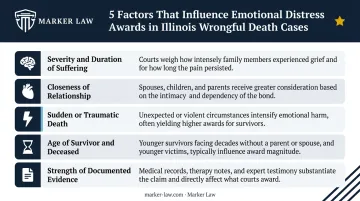
Attorneys sometimes use a multiplier method to estimate non-economic damages — adding up economic losses and multiplying by a factor between 1.5 and 5 depending on severity. This is a negotiation tool, not a court formula. What moves the number — in court or at the settlement table — is the strength of evidence behind each of those factors.
Common Mistakes That Weaken Emotional Distress Claims
Delaying Mental Health Treatment
Waiting weeks or months before seeking professional support gives defense attorneys a straightforward argument: the distress wasn't severe enough to prompt care. Families should seek treatment promptly — both for their own recovery and because every entry in a treatment record becomes evidence.
Underestimating Insurance Company Tactics
Insurers routinely argue that emotional distress claims are exaggerated, unverifiable, or no different from ordinary grief. They know how to identify gaps in documentation, inconsistencies in testimony, and the absence of professional diagnosis.
This is where having an attorney who has worked on the defense side matters. Jason Marker of Marker Law spent three years early in his career representing insurance carriers before transitioning exclusively to plaintiff advocacy. That background means he knows the arguments insurers build — and how to counter them before they gain traction.
Building a Claim on Testimony Alone
A claim supported only by family accounts — without medical records, expert support, or documented behavioral changes — is far more vulnerable to dismissal or lowball settlement offers.
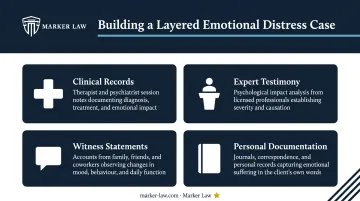
The strongest emotional distress cases layer multiple evidence types into a cohesive, mutually reinforcing record:
- Clinical records from treating therapists or psychiatrists
- Expert testimony on the psychological impact of the loss
- Witness statements from family, friends, or coworkers
- Personal documentation such as journals or correspondence
Frequently Asked Questions
What evidence is needed to prove emotional distress in a wrongful death lawsuit?
Courts look for a combination of mental health records, personal and witness testimony, expert opinions, documentation of life disruption, and personal writings. No single piece is sufficient — the strongest claims layer multiple evidence types that corroborate each other.
What is the average settlement for emotional distress in a wrongful death lawsuit?
There's no fixed average — awards vary widely based on distress severity, relationship to the deceased, quality of evidence, and jurisdiction. Illinois doesn't cap most non-economic wrongful death damages. Consult an attorney for a case-specific evaluation.
How hard is it to prove emotional distress in a wrongful death lawsuit?
Harder than economic damages — suffering is subjective and invisible. Success depends on three things: documenting your case early, securing professional diagnosis and expert testimony, and working with an attorney experienced in Illinois wrongful death litigation.
Who can file a wrongful death claim for emotional distress in Illinois?
Claims are filed by the personal representative of the deceased's estate on behalf of surviving family members — typically a spouse, children, or other next of kin. Compensation is distributed based on the relationship and how dependent each family member was on the deceased.
Do you need a therapist or doctor to prove emotional distress?
Professional treatment isn't legally required, but it significantly strengthens a claim. Without formal records, defense attorneys have more room to dispute your distress — documented care closes that door.
How long do you have to file a wrongful death lawsuit in Illinois?
Illinois generally allows two years from the date of death to file. Waiting risks losing the right to pursue compensation entirely. Contact an attorney as soon as possible to preserve evidence and meet all deadlines.