
Many injury victims leave this compensation on the table, not because it doesn't exist, but because nobody told them to ask for it.
Illinois recognizes loss of a normal life as a distinct category of non-economic damages that courts and juries can award alongside medical expenses and lost wages. According to IDOT's 2024 Crash Facts report, there were 63,109 injury crashes in Illinois last year — and countless victims of those crashes, plus workplace accidents, falls, and other incidents, are entitled to recover for the life they've lost, not just the bills they've accumulated.
This article explains what loss of a normal life means legally, how Illinois calculates it, how to prove it, and how insurers try to suppress it.
TL;DR
- Illinois law recognizes loss of a normal life as a separate, compensable non-economic damage — distinct from pain and suffering
- There is no fixed formula; courts use evidence, jury judgment, and case-specific facts
- Proof typically requires medical records, personal testimony, third-party witnesses, and expert evaluations
- Insurance companies will challenge these claims — particularly if you have any prior injuries on record
- Illinois has a 2-year statute of limitations: delay and you may lose your right to recover
What Is Loss of a Normal Life in a Personal Injury Case?
Illinois Pattern Civil Jury Instruction (IPI) 30.04.02 defines this damage as the temporary or permanent diminished ability to enjoy life, including the inability to pursue the pleasurable aspects of life that previously gave it meaning. Physical pain is covered separately. This category addresses the specific experiences, relationships, and pursuits the injury has taken from you.
For Chicagoland residents, that might look like:
- No longer coaching your child's youth league baseball or soccer team
- Losing the ability to work in a hands-on trade you spent 20 years building
- Being unable to tend the garden you've maintained for a decade
- Skipping family gatherings because you can't stand, sit, or travel comfortably
- No longer attending church or community events that anchored your week
- Missing the fishing trips, woodworking sessions, or runs that kept you sane
- Watching a date night with your spouse become logistically impossible

How It Differs from Pain and Suffering
These two categories are related but legally distinct. IPI 30.05 lists pain and suffering separately from loss of a normal life, and Illinois courts treat them as separate damage elements when the evidence supports both.
- Pain and suffering captures the physical sensation of injury and the emotional anguish tied to it
- Loss of a normal life captures the specific activities, relationships, and experiences the injury has blocked
Both can be awarded in the same case; they don't cancel each other out. What Illinois courts prevent is double-counting the same harm under two different labels.
The Luye v. Schopper decision from the Illinois Appellate Court, First District, clarifies exactly where that boundary sits: aggravation of a pre-existing condition isn't a separate line item because it already overlaps with these existing damage elements.
That boundary also applies to how the claim is structured. Loss of a normal life isn't a standalone lawsuit — it's one component of a broader personal injury claim, pursued alongside economic damages (medical bills, lost wages) and other non-economic damages as part of a single case against the at-fault party.
Injuries and Accidents That Commonly Support These Claims
Not every injury justifies a significant loss of a normal life claim. The key factors are severity and permanence. A sprained ankle that fully heals in six weeks rarely moves the needle. A herniated disc causing permanent nerve damage that ends someone's ability to work their trade or play the sport they've loved for 30 years is a different matter entirely — that's when substantial non-economic damages come into play.
Injury Types That Carry the Strongest Claims
- Traumatic brain injuries — affecting cognition, mood, memory, and personality. The Illinois Department of Public Health reported 29,697 TBI cases in Illinois in 2021, with falls and motor-vehicle crashes among the leading causes
- Spinal cord injuries — paralysis, chronic pain, and restricted mobility that permanently alter daily function
- Severe soft tissue injuries — particularly those that don't resolve and limit mobility long-term
- Loss of hearing or vision — with cascading effects on work, relationships, and independence
- Disfigurement and scarring — especially when it affects how someone moves through the world socially
- Chronic pain conditions — where every activity comes with a cost the person never had to pay before
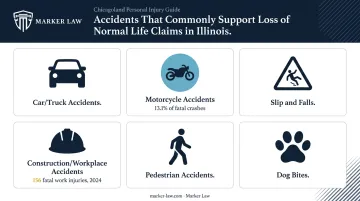
Common Accident Types in the Chicagoland Area
- Car and truck accidents across Cook, DuPage, Will, Kane, and Kendall counties
- Motorcycle accidents (motorcycles account for 13.1% of fatal crashes in Illinois despite being just 1.1% of all crashes)
- Slip and falls — including the kind that look minor at the scene but produce head injuries with lasting effects
- Construction site and workplace accidents (Illinois recorded 156 fatal work injuries in 2024, with construction accounting for 26 of them)
- Pedestrian accidents
- Dog bites with significant physical trauma
Even accidents that appear minor at the scene can produce permanent limitations. The injury itself matters less than what it takes away — and that's exactly what a loss of enjoyment claim is designed to address.
How Loss of a Normal Life Is Calculated in Illinois
Illinois does not use a fixed formula. Unlike a medical bill with a specific dollar amount, there's no receipt for the joy of coaching youth soccer or hiking with your kids. IPI 30.01 instructs juries to fix an amount that reasonably and fairly compensates for the damage elements proved by the evidence — case by case, person by person.
That said, two methods often serve as starting points in negotiations and litigation.
The Multiplier Method
An attorney or insurer takes total economic damages (medical expenses plus lost wages) and multiplies that figure by a number reflecting injury severity. A more severe, permanent, or catastrophically life-altering injury commands a higher multiplier.
Example: $30,000 in economic damages multiplied by 3 produces $90,000 in non-economic damages. Illinois courts don't mandate any specific multiplier range, and no reliable Illinois-specific published range data exists.
The Per Diem Method
A daily dollar value is assigned to the person's suffering and lost enjoyment, then multiplied by the number of days they're expected to experience those limitations. For catastrophic injuries, that can mean the remainder of the person's life expectancy.
Important caveat: the Illinois Supreme Court's decision in Caley v. Manicke rejected rigid per diem mathematical formulas for subjective harms. This method requires careful expert support and is not a simple arithmetic exercise.
Factors That Drive Value Up or Down
Illinois juries have broad discretion in weighing these factors:
- Age: A 35-year-old faces a much longer horizon of lost enjoyment than a 70-year-old
- Permanence: Temporary limitations carry less weight than irreversible ones
- Losing a career you spent 20 years building differs sharply from losing an occasional hobby
- An active person's loss carries different weight than that of someone already largely sedentary
- How the injury has changed relationships and mental health factors into the overall picture

Insurance companies default to the lowest defensible figure. A skilled attorney builds the strongest case by documenting who this person was before the accident, what specifically they've lost, and how long those losses will last — then using that full picture to push back on lowball valuations.
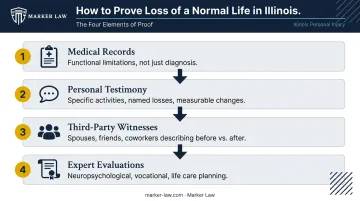
How to Prove Your Loss of a Normal Life Claim
Evidence is everything. Illinois courts don't accept vague assertions that life has gotten harder. Here's what actually moves the needle.
Medical Records That Capture Function, Not Just Diagnosis
Standard clinical notes often document diagnoses ("herniated disc at L4-L5") without connecting them to daily life. An experienced attorney works with treating physicians to ensure records also capture functional limitations — notes stating "patient cannot stand for more than 15 minutes," "unable to lift objects over 10 lbs," or "no longer able to drive due to seizures." That bridge between diagnosis and daily life is what makes the claim.
Your Own Testimony — Specific, Not General
Vague testimony ("I can't do things I used to do") doesn't persuade juries. What works is specificity:
"Before the accident, I coached my daughter's travel softball team every weekend and ran a 5K each spring. Since the accident, I cannot stand for more than 20 minutes or walk more than one block without severe pain."
Concrete details, named activities, and measurable changes — that's what makes personal testimony credible.
Third-Party Witnesses
Spouses, siblings, coworkers, and longtime friends who knew the victim before and after the accident carry significant weight. They can describe the contrast in personality, energy, family engagement, and participation in the activities that once defined the person. This testimony is typically harder for defense attorneys to attack than the claimant's own account.
A Daily Journal: Start Immediately
Document not just pain levels, but:
- Specific events missed (a child's game, a family dinner, a work opportunity)
- Activities attempted and failed
- Emotional low points and moments when the loss is most acute
Under Illinois Rules of Evidence 803(3) and 803(5), statements of then-existing physical condition and recorded recollections may be admissible when properly authenticated. A real-time journal is difficult for defense attorneys to dismiss: it's contemporaneous, specific, and impossible to fabricate after the fact.
Pre-accident photos and videos from social media or family archives — showing the person actively engaged in activities they can no longer do — carry equal weight.
Expert Evaluations
For serious cases, Marker Law works with medical and economic experts to document the full scope of damages. This can include:
- Neuropsychological evaluations documenting cognitive and emotional changes
- Vocational expert testimony on lost career opportunities
- Life care planners projecting long-term impacts of permanent injuries
Illinois Rule of Evidence 702 governs expert testimony — these witnesses must be qualified and their opinions tied to the specific facts of your case. When these elements are properly assembled, they tell a complete, documented story that is far harder for insurers and defense attorneys to minimize or dismiss.
How Insurance Companies Try to Minimize These Claims
Insurers have a clear financial incentive to suppress non-economic damages. Knowing their tactics in advance lets your attorney build a case that holds up under pressure.
The Pre-Existing Condition Argument
If you had a back issue five years ago, the insurer will argue your current inability to work in construction is just a flare-up, not accident-related. The Luye v. Schopper decision confirms that aggravation of a pre-existing condition is already folded into pain, suffering, and loss of a normal life — it doesn't disqualify the claim. The counter-strategy is establishing a clear pre-accident baseline and documenting the sharp, specific change in function caused by the injury.
Surveillance and Social Media Monitoring
A single photo of a claimant smiling at a birthday party or carrying groceries can be used to undermine an otherwise legitimate claim. Insurance investigators monitor social media and may conduct physical surveillance. Be deliberate about your online presence during litigation — follow your attorney's guidance closely. Illinois courts recognize social media as potentially admissible evidence once properly authenticated.
The Value of Insider Knowledge
Attorney Jason Marker spent three years on the defense side representing insurance carriers and employers before dedicating his practice exclusively to injured victims. He puts it plainly: "I learned their playbook."
That experience directly shapes how Marker Law builds cases:
- Anticipates defense arguments before they're raised
- Builds documentation that holds up to insurer scrutiny from the start
- Prepares every case as if it's going to trial
That insider foundation matters when insurers are actively working to reduce what you recover. Marker Law operates on a contingency fee basis — no upfront costs, no fees unless compensation is recovered. Call for a free initial consultation to discuss your situation with no obligation.
Frequently Asked Questions
Can you sue for loss of a normal life in an Illinois personal injury lawsuit?
Yes. Illinois recognizes loss of a normal life as a distinct non-economic damage under IPI 30.04.02. It's pursued as part of a broader personal injury claim — not as a standalone suit — and can be recovered through settlement or a jury verdict.
How is loss of a normal life calculated, and how much can I recover?
Illinois has no fixed formula. Attorneys and insurers use the multiplier method or per diem method as starting points, but the value depends on injury severity, permanence, the plaintiff's age, and what specifically has been lost.
What's a red flag in a settlement offer involving these damages?
Any offer that addresses only medical bills and lost wages — without accounting for non-economic damages — is incomplete. A fair offer should reflect a reasonable valuation of loss of a normal life, pain and suffering, and other non-economic harms. If non-economic damages aren't addressed, the offer likely undervalues your claim.
Is loss of a normal life different from pain and suffering?
Yes. Pain and suffering addresses the physical sensation of injury and emotional anguish. Loss of a normal life addresses the specific activities, hobbies, relationships, and experiences the injury has prevented you from participating in. Illinois treats them as separate compensable elements under IPI 30.04.02 and IPI 30.05.
How long do I have to file a personal injury claim in Illinois?
Under 735 ILCS 5/13-202, Illinois imposes a 2-year statute of limitations on personal injury claims, generally starting from the date of the accident. Waiting risks losing the right to recover any compensation — including non-economic damages. Special tolling rules apply for minors and individuals under legal disability.
What evidence do I need for a loss of a normal life claim?
Core evidence includes a daily journal of pain and missed activities, medical records noting functional limitations, testimony from people who knew you before and after the injury, pre-accident photos or videos, and expert evaluations (psychological, vocational, or life care planning).