
These intangible losses are called pain and suffering damages. In many Illinois personal injury cases, they represent the largest portion of total compensation — and the portion insurers fight hardest to minimize. Understanding how they work, how they're calculated, and how to protect them can make a significant difference in what you actually recover.
TLDR
- Pain and suffering covers the physical and emotional toll of an injury — it has no fixed dollar value
- Illinois courts use two main approaches: the multiplier method and the per diem method
- Strong documentation (medical records, personal journals, witness accounts) is the foundation of any credible claim
- Insurance companies actively challenge non-economic damages; their tactics are predictable and counterable
- Illinois caps don't apply to pain and suffering in standard injury cases, but the 51% comparative fault rule can reduce or eliminate recovery
What Are Pain and Suffering Damages?
Pain and suffering falls under non-economic damages — compensation for the intangible consequences of an injury rather than out-of-pocket costs. Illinois Pattern Jury Instruction IPI Civil 30.05 identifies pain and suffering as a compensable element, covering both what a victim has already experienced and what they are "reasonably certain to experience in the future."
The distinction matters because a medical bill proves a financial loss. Pain and suffering proves a human one, and that requires a different kind of evidence.
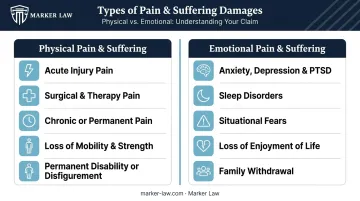
Physical Pain and Suffering
Physical pain and suffering covers the bodily experience of injury across its full arc:
- Acute pain during the initial injury and hospital treatment
- Ongoing pain through surgeries, physical therapy, and recovery
- Chronic or permanent pain that persists after maximum recovery
- Loss of physical function, mobility, or strength
- Permanent disability or disfigurement
In Chicagoland personal injury cases, the injury types that most commonly produce significant physical pain and suffering claims include spinal cord injuries, traumatic brain injuries, severe fractures, burn injuries, and soft tissue injuries with prolonged recovery timelines. Cases involving catastrophic injuries (those that alter someone's physical capacity permanently) carry the highest non-economic damage potential.
Emotional Pain and Suffering
Emotional pain and suffering encompasses the psychological consequences that often persist long after physical wounds heal:
- Anxiety, depression, and PTSD
- Sleep disorders and chronic fatigue
- Fear of driving, public spaces, or specific situations related to the accident
- Loss of enjoyment of life — inability to pursue hobbies, sports, or activities that defined the victim's identity
- Emotional withdrawal from family relationships
Illinois courts recognize emotional suffering as a distinct compensable element. IPI Civil 30.05.01 covers emotional distress, and IPI Civil 30.04.02 addresses loss of a normal life — defined as a "temporary or permanent diminished ability to enjoy life." Both are real, documented losses that juries are directly instructed to compensate.
How Pain and Suffering Differs from Other Damages
Economic damages — medical bills, lost wages, future medical costs, property damage — come with receipts and pay stubs. A jury can add them up. Non-economic damages don't work that way, which creates both a challenge and an opportunity.
The challenge: because pain and suffering can't be verified on a spreadsheet, insurance adjusters treat it as a negotiating variable rather than a fixed debt. They know that vague claims without strong documentation are easy to contest.
The opportunity: a well-documented pain and suffering claim can significantly increase total recovery — often exceeding the economic damages in cases involving serious or permanent injury.
Illinois Damage Caps: What You Need to Know
That opportunity is wider in Illinois than in many other states. Illinois does not have an active statutory cap on pain and suffering damages in standard personal injury cases. In Best v. Taylor Machine Works, 179 Ill. 2d 367 (1997), the Illinois Supreme Court struck down a legislative cap on non-economic damages as an unconstitutional "legislative remittitur" that violated separation of powers.
A separate cap on non-economic damages in medical malpractice cases was similarly struck down in Lebron v. Gottlieb Memorial Hospital (2010) — but that ruling applies specifically to malpractice, not standard personal injury claims.
The practical result: in Illinois car accident, truck accident, slip and fall, and construction injury cases, there is no ceiling on what a jury can award for pain and suffering. The value of the claim depends entirely on the evidence presented — not a statutory limit.
How Pain and Suffering Is Calculated in Illinois
Illinois law doesn't prescribe a formula. IPI Civil 30.01 (the Illinois Pattern Jury Instruction governing damages) instructs juries to determine an amount that will "reasonably compensate" the plaintiff based on the "nature, extent and duration of the injury" — which leaves considerable room for interpretation and advocacy.
In practice, two methods dominate settlement negotiations and litigation strategy.
The Multiplier Method
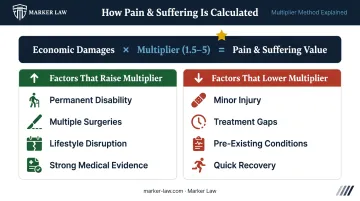
The multiplier method takes total economic damages and multiplies by a number — typically between 1.5 and 5 — to produce a pain and suffering figure.
Example: $30,000 in medical bills and lost wages × a multiplier of 3 = $90,000 in pain and suffering damages.
What drives the multiplier up or down:
| Factor | Effect on Multiplier |
|---|---|
| Permanent disability or disfigurement | Higher |
| Multiple surgeries, long recovery | Higher |
| Significant lifestyle disruption | Higher |
| Objective medical evidence | Higher |
| Minor injury, quick recovery | Lower |
| Gaps in treatment | Lower |
| Pre-existing conditions | Lower |
The Per Diem Method
The per diem method assigns a daily dollar value to pain and suffering, then multiplies by the number of days from the accident to maximum medical improvement (MMI) — the point at which a doctor determines the victim has reached the best recovery they can expect.
Example: $150/day × 300 days = $45,000 in pain and suffering damages.
One important note: Illinois courts have historically been cautious about per diem formula arguments. A DePaul Law Review article discussing Caley v. Manicke reports that the Illinois Supreme Court reversed a verdict where counsel used a per diem formula in closing argument.
The per diem approach still has legitimate use in settlement negotiations — but how and when to deploy it requires an attorney's judgment, not a calculator.
Key Factors That Drive the Final Number
Both methods produce a starting point, not a guaranteed result. Whether the number holds up depends on the underlying facts of the case. Adjusters, judges, and juries all weigh the same core factors:
- Severity and permanence of the injury
- Victim's age and pre-injury health
- Type and duration of medical treatment
- Whether the injury caused permanent disability or disfigurement
- Consistency between reported pain and documented treatment
- Impact on the victim's ability to work, parent, socialize, and function
Building a Strong Pain and Suffering Claim
Because pain and suffering is subjective, the strength of a claim depends entirely on documentation quality. Gaps in the record are the most common reason insurers successfully reduce these damages.
Medical Records and Treatment Consistency
Treatment notes from physicians, surgeons, physical therapists, and mental health professionals form the backbone of any pain and suffering claim. They establish what the victim experienced, how long it lasted, and what treatment was required.
Consistency matters more than almost anything else in these claims. If a victim reports severe, ongoing pain but the medical record shows months of missed appointments, insurers will use that gap as evidence of exaggeration. Regular follow-up with providers, aligned with reported symptoms, is one of the most protective steps a victim can take.
Under Illinois Supreme Court Rule 213, treating physicians can be disclosed as opinion witnesses, and their testimony about causal relationship and future pain — when properly documented — carries significant weight.
Personal Injury Journals
A daily or near-daily written record of pain levels, emotional state, sleep disruption, and specific activities missed or altered is difficult for insurers to dismiss. Courts recognize statements about physical and mental condition under Illinois Rule of Evidence 803(3), which provides a hearsay exception for a declarant's then-existing physical or emotional condition.
What to record:
- Pain levels (1–10 scale, specific locations)
- Sleep quality and disruptions
- Activities you couldn't do or modified because of the injury
- Emotional state and any anxiety, depression, or distress
- Specific events missed — a family gathering, a work obligation, a physical activity
Third-Party Testimony
Journals capture your experience from the inside. Third-party witnesses capture it from the outside. Family members, coworkers, friends, and neighbors who observed you before and after the accident can testify to visible changes in behavior, mood, physical capacity, and quality of life. That lay-witness corroboration adds something medical records alone can't provide — a picture of the injury's impact on a real life.
How Insurance Companies Challenge Pain and Suffering Claims
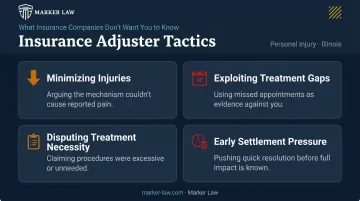
Insurance adjusters are trained to treat non-economic damages as negotiable. Common tactics include:
- Characterizing injuries as "minor" — arguing that the mechanism of injury couldn't have caused the reported pain
- Pointing to treatment gaps — using any period without medical visits as evidence the victim exaggerated or recovered faster than claimed
- Challenging treatment necessity — arguing that some procedures or follow-ups were excessive relative to the injury
- Early settlement pressure — pushing for a quick settlement before the full scope of long-term or permanent impact is clear
Social Media and Surveillance
According to research published in the NAIC Journal of Insurance Regulation, investigators hired by defendants immediately scan claimants' social media profiles, scraping them for evidence to confirm or impeach bodily injury claims. A single photo posted during a "good day" — appearing at a birthday party, carrying groceries, attending an event — can be used to argue that reported limitations are overstated.
The same logic applies to physical surveillance. Investigators record ordinary moments — loading a car, walking to the mailbox — and present them stripped of context. Assume you are being watched, and treat everything you post publicly as potential evidence against your claim.
The Value of Defense-Side Knowledge
Attorney Jason Marker of Marker Law spent the early years of his career on the defense side, representing insurers and employers in the City of Chicago's Torts Division. He knows how adjusters evaluate claims, where documentation gaps get exploited, and exactly what makes a plaintiff's case hard to attack. That insider perspective directly informs how Marker Law builds and argues pain and suffering claims for injured clients across DuPage, Will, Cook, Kane, and Kendall counties.
Frequently Asked Questions
Is there a cap on pain and suffering damages in Illinois personal injury cases?
No. The Illinois Supreme Court struck down legislative caps on non-economic damages in standard personal injury cases in Best v. Taylor Machine Works (1997), finding them unconstitutional. Medical malpractice cases operate under different rules, but for car accidents, slip and falls, truck accidents, and similar claims, there is no statutory ceiling.
Can I recover pain and suffering damages if I was partially at fault?
Yes, as long as your share of fault doesn't exceed 50%. Under 735 ILCS 5/2-1116, Illinois follows a modified comparative fault rule: your total award is reduced proportionally by your fault percentage, and recovery is barred entirely at 51% or more.
Does pain and suffering compensation cover future symptoms and ongoing distress?
Yes. IPI Civil 30.05 explicitly allows compensation for pain and suffering "reasonably certain to be experienced in the future." Both anticipated chronic pain and long-term emotional distress can be claimed, provided medical evidence or expert testimony supports the ongoing impact.
What's the difference between the multiplier and per diem methods?
The multiplier method multiplies total economic damages by a factor (typically 1.5–5) based on injury severity. The per diem method assigns a daily dollar value multiplied by the recovery period, and works best for injuries with a clear endpoint. In Illinois litigation, per diem arguments require supporting evidence to withstand judicial scrutiny.
How long do I have to file a personal injury claim in Illinois?
Under 735 ILCS 5/13-202, most personal injury claims must be filed within two years from the date of injury. Missing this deadline typically eliminates recovery entirely. Claims against local government entities carry a shorter one-year window.
What is MMI and why does it matter?
Maximum Medical Improvement (MMI) is the point at which a doctor determines a patient has reached the best recovery they're expected to achieve. It matters because it establishes injury permanence, a key factor in pain and suffering valuation, and marks the practical endpoint for calculating ongoing damages in settlement negotiations.