Most injured people spend that critical window focused on getting back on their feet. Reasonable. But insurance companies spend it differently: building a file designed to pay you as little as possible. They have experienced adjusters, legal teams, and decades of data on which tactics work.
You don't have to be outmatched. The tips below are drawn from real litigation experience — including time spent on the defense side, learning exactly how carriers evaluate and challenge claims. Whether you were hurt in a car accident in Naperville, injured on a job site in Cook County, or suffered a slip and fall anywhere in the Chicagoland area, these 10 strategies can protect the value of your claim from day one.
TL;DR
- Seek medical care immediately — gaps in treatment give insurers grounds to dispute your claim
- Document everything: photos, witness contacts, daily pain levels, and every medical receipt
- Know your full damages; current bills are only part of what you're owed
- Never give a recorded statement to the other party's insurer without an attorney present
- Don't accept the first offer — it's almost always made before your full costs are known
Tips 1–3: Protect Your Case from Day One
The hours and days after an accident are your highest-stakes window. Evidence disappears fast — surveillance footage gets overwritten, skid marks fade, and witnesses become hard to locate. Anything you say or fail to do in this period can be used against you later.
Tip 1: Get Medical Care Immediately — Even If You Feel Fine
Most people skip this step for an understandable reason: if nothing hurts, nothing's wrong. That logic doesn't hold for several common accident injuries.
The CDC notes that concussion signs and symptoms "may take hours or days to appear or be noticed." A 2022 peer-reviewed whiplash study published in PMC documented delayed onset of headache and neck pain after impact. Internal abdominal injuries can cause complications weeks after blunt trauma.
The medical record created at your first visit does two things simultaneously: it documents your condition and it timestamps the connection between your injury and the accident. Without that record, an adjuster's argument writes itself — if you were hurt, why didn't you go to a doctor?
Wait even 24–48 hours and you've given the insurer a usable argument. Go immediately, even if the exam turns up nothing serious.
Tip 2: Gather and Preserve Evidence at the Scene
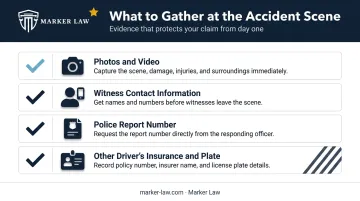
If your condition allows, collect the following before leaving:
- Photos and video of the vehicles, road conditions, skid marks, traffic signs, and any visible injuries
- Names and contact information of all witnesses
- The police report number or a copy of the incident report
- The other driver's insurance information and license plate
If you can't do this yourself, ask someone with you to help. Once you leave the scene, that window closes. Surveillance footage from nearby businesses typically gets overwritten within 24–72 hours. At Marker Law, one of the first steps after taking a case is moving quickly to preserve exactly this kind of evidence before it's gone.
Tip 3: Build a Documentation System from Day One
Your claim has two categories of damages: economic (bills, lost wages) and non-economic (pain, emotional impact, lost enjoyment of life). Economic damages are easier to prove with receipts. Non-economic damages require something else: consistent records created at the time — not reconstructed later.
A pain journal is one of the most underused tools in personal injury cases. Write in it daily — pain levels on a 1–10 scale, activities you couldn't do, sleep disruption, emotional effects. A journal written in real time carries far more weight than anything you piece together months later.
Alongside the journal, maintain a dedicated folder (physical or digital) containing:
- Every medical bill and insurance statement
- Prescription receipts
- Written documentation from your employer confirming missed workdays and lost wages
- Notes from every medical appointment
Non-economic damages are where many claimants leave the most money on the table. Thorough records give your attorney the foundation to argue for the full amount you're owed.
Tips 4–5: Know the Full Value of What You're Owed
The most common reason injury victims accept inadequate settlements isn't that they were pressured — it's that they didn't know what their claim was actually worth. Most people only think about current medical bills. A fair settlement must account for far more.
Tip 4: Calculate All Economic Damages — Including Future Costs
Economic damages are the quantifiable financial losses tied to your injury. These include:
- Current medical expenses (ER, surgery, imaging, physical therapy)
- Lost wages for time already missed from work
- Future medical treatment and rehabilitation costs
- Reduced earning capacity if the injury affects your ability to work long-term
- Out-of-pocket costs: transportation to appointments, prescription medications, medical equipment
The future costs piece is where early settlements most often undervalue claims. If you settle before your treatment plan is complete — or before a doctor has assessed permanent impairment — you're accepting a number that doesn't reflect your actual financial exposure. Once you sign a release, you generally cannot go back for more.
The CDC estimated traumatic brain injury economic costs at $76.5 billion in 2010, including $11.5 billion in direct medical costs and $64.8 billion in indirect costs. For serious injuries, the gap between what an early settlement offers and what long-term care actually costs can be enormous.
Tip 5: Never Overlook Non-Economic Damages
Economic damages tell part of the story. The other part — often the larger part in serious cases — is non-economic. These damages don't come with a receipt, but they're real and compensable under Illinois law. They include:
- Pain and suffering
- Emotional distress
- Loss of enjoyment of life
- Permanent disfigurement or disability
- Loss of companionship (for spouses or family members)
Attorneys and courts use two methods to calculate these damages:
| Method | How It Works |
|---|---|
| Multiplier Method | Total medical costs multiplied by a factor (typically 1.5–5) based on injury severity |
| Per Diem Method | A daily rate multiplied by the number of days you were impacted |
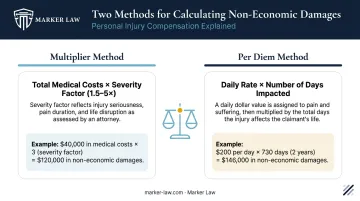
Illinois courts have addressed both approaches — the Illinois Supreme Court examined the per diem formula in Caley v. Manicke, 24 Ill.2d 390 (1962), and Illinois Pattern Jury Instructions (IPI 30.00) cover damages for injury to person and related losses.
Insurers don't automatically calculate these damages for you. If you don't specifically document and claim non-economic losses, they won't be included. This is why the pain journal from Tip 3 matters so much — it's the evidence base for these claims.
Tips 6–7: Handle Insurance Companies Strategically
Insurance adjusters aren't adversarial in an obvious way. They're often pleasant, fast to call, and framed as being there to help. But their job is to close claims for as little as possible. Understanding how that works changes how you respond.
Tip 6: Never Give a Recorded Statement Without Legal Counsel
After an accident, the at-fault party's insurer will often contact you quickly — sometimes within 24 hours — and ask for a recorded statement. This is presented as a routine step. It isn't.
Common traps in recorded statements:
- Saying "I'm okay" or "I feel fine" — even casually — can be used to argue your injuries aren't serious
- Speculating about fault or describing the sequence of events in a way that gets used against you
- Understating pain levels because you don't want to seem dramatic
Under Illinois law, you are not required to provide a recorded statement to the other party's insurer. Decline and consult an attorney first. The Illinois Department of Insurance confirms that injured parties have options when dealing with another driver's carrier — speaking to a lawyer before making any recorded statement is one of the most protective steps you can take.
Tip 7: Don't Accept the First Settlement Offer
First offers from insurance companies are low by design. They're issued before the full extent of your injuries is known, before your treatment is complete, and before you've had time to calculate future costs. They're also a test of whether you understand what your claim is actually worth.
That low number often gets pushed even lower by Illinois's modified comparative negligence rule (735 ILCS 5/2-1116). If an insurer can argue you were partially at fault, they'll use it to shrink the offer. Your recovery is reduced proportionally to your share of fault — and you're barred entirely if your fault exceeds 50%.
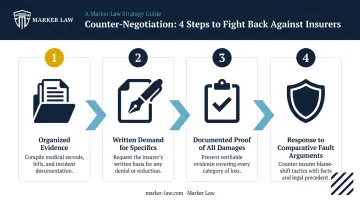
Effective counter-negotiation requires:
- Organized evidence — medical records, bills, lost wage documentation, the pain journal
- A written demand for specifics — require the insurer to explain any low offer in detail, not generalities
- Documented proof of all damages, including future costs
- A prepared response to comparative fault arguments the insurer is likely to raise
Tips 8–9: Avoid These Costly Mistakes
Tip 8: Stay Off Social Media for the Duration of Your Case
Defense teams routinely monitor claimants' social media. It doesn't take an obviously incriminating post. A photo of you at a family gathering — smiling, carrying a bag — can be pulled out of context and presented as evidence that your injuries aren't as severe as claimed.
Practical steps:
- Set all profiles to private immediately
- Don't post about the accident, your treatment, or your recovery
- Ask family and friends not to tag you in photos or check-ins
- Treat every post as potentially discoverable evidence
The ABA has confirmed that parties in litigation are entitled to discovery of relevant social media content, and courts have ordered access to private social media accounts in personal injury cases. Defense attorneys use this routinely — not occasionally.
Tip 9: Don't Allow Gaps in Medical Treatment
Consistency in treatment affects both your health and your claim. If you stop going to appointments or delay follow-up care, insurers will argue one of two things:
- Your injury healed (which reduces claim value)
- You made it worse through non-compliance (which shifts blame onto you)
Follow every prescribed treatment plan and attend every appointment. If cost is a barrier, talk to an attorney before you stop treatment.
Under the Illinois Health Care Services Lien Act, providers can treat patients under a lien arrangement — payment comes from the eventual settlement, and total liens cannot exceed 40% of the recovery. Many providers in the Chicagoland area work this way. Marker Law can connect clients with trusted providers who document injuries thoroughly and hold up under scrutiny from the other side.
Tip 10: Work With a Personal Injury Attorney Who Knows Both Sides
The Insurance Research Council found that attorney involvement among auto bodily injury claimants reached 50% by 2012 — a rise driven by claimants recognizing that represented parties consistently recover more than those who negotiate alone.
But attorney selection matters beyond just having one. An attorney who spent time on the defense side understands exactly how insurers evaluate and challenge claims — before those tactics are deployed against you.
Jason Marker, founder of Marker Law, began his career clerking in the City of Chicago's Torts Division and spent three years representing employers and insurance carriers before transitioning exclusively to plaintiff advocacy. His words: "I learned their playbook."
That background shapes how Marker Law builds cases from day one:
- Anticipates defense arguments before they're deployed
- Connects clients with medical providers whose documentation holds up under scrutiny
- Counters fault-shifting tactics with targeted evidence
- Structures the case record with the insurer's evaluation process in mind

That level of preparation raises an obvious question: what does it cost? Personal injury attorneys work on contingency: no upfront fees, no payment unless compensation is recovered. At Marker Law, the standard contingency fee for personal injury cases is approximately one-third of the recovery, with any advanced case costs reimbursed from the settlement. Free consultations are available by phone, Zoom, or in-person — 24/7 — for anyone in the Naperville and Chicagoland area.
Frequently Asked Questions
How do you get the most money out of a bodily injury claim?
Seek medical care immediately, document everything from day one, and avoid early settlement offers before your full treatment costs are known. Attorneys who can accurately value economic and non-economic damages — and negotiate from organized evidence — consistently produce better outcomes than self-representation.
What should I avoid saying in an injury claim?
Never say "I'm fine," "I feel okay," or anything that could be interpreted as minimizing your injuries. Avoid speculating about fault or describing the accident sequence in ways that could shift blame onto you. Most critically, don't give a recorded statement to the other party's insurer without speaking to an attorney first.
How much compensation can you get for fibromyalgia after an accident?
Fibromyalgia is compensable in personal injury claims, but recovery depends on documented medical treatment, evidence linking the condition to the accident, and demonstrated impact on daily life and work capacity. These cases hinge on records that establish onset date, functional limitations, and lost earning capacity.
How long do I have to file a personal injury claim in Illinois?
Illinois law (735 ILCS 5/13-202) gives injured parties two years from the date of injury to file a personal injury lawsuit. Missing this deadline typically bars recovery entirely. Note that claims against local government entities may carry a shorter one-year window under separate statutes.
How is pain and suffering calculated in a personal injury case?
Two methods are commonly used: the multiplier method (total medical costs multiplied by a factor based on injury severity) and the per diem method (a daily rate multiplied by the number of days affected). Consistent documentation — particularly a contemporaneous pain journal — directly strengthens these calculations and makes them harder for insurers to dispute.
Do I need an attorney for a personal injury claim?
You're not legally required to have one, but represented claimants consistently recover more than those who negotiate alone. Since personal injury attorneys work on contingency with no upfront cost, the financial barrier to getting counsel is effectively zero. A free consultation costs nothing and gives you a clear picture of what your claim is worth.