
Despite how common it is, many victims have no idea what their case is actually worth. Some settle for whatever the insurer first offers. Others wait too long and lose their right to claim entirely.
Whiplash settlements in Illinois range from a few thousand dollars to well over six figures. The gap between a weak claim and a strong one isn't luck — it's documentation, legal strategy, and understanding exactly how these cases are valued. This article covers all of it.
TL;DR
- Settlement amounts range from a few thousand dollars for mild cases up to six figures for severe injuries involving chronic pain, nerve damage, or surgery
- Pain and suffering is typically the largest portion of a whiplash settlement — not just your medical bills
- Strong documentation, clear liability, prolonged symptoms, and impact on work and daily life all increase your payout
- Illinois operates under modified comparative fault — if you're more than 50% at fault, you recover nothing; partial fault below that threshold reduces your payout proportionally
- The two-year statute of limitations under Illinois law starts from the accident date — missing it forfeits your right to any compensation
Whiplash Settlement Amounts: What Car Accident Victims Can Expect
No fixed or minimum payout exists for whiplash. Every case turns on its own facts — the injury severity, the treatment course, the documentation, the liability picture, and the insurance coverage available. Ranges published online vary widely, and no government or insurance industry dataset provides verified national medians broken down by mild, moderate, and severe whiplash specifically.
The financial stakes are real: a peer-reviewed PMC study citing NHTSA data puts the annual economic cost of whiplash injuries at over $9 billion, reflecting both the volume of claims and the genuine harm these injuries cause.
That cost isn't evenly distributed — severity drives everything. Here's how outcomes typically break down.
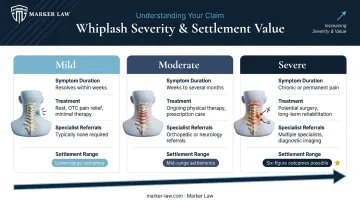
Mild Whiplash
Mild cases involve temporary neck pain, stiffness, and discomfort that resolves within a few weeks. Treatment is typically minimal — rest, over-the-counter medication, and possibly a few physical therapy sessions.
These claims tend to:
- Settle relatively quickly without prolonged negotiation
- Cover emergency or urgent care visits, a handful of follow-up appointments, and brief lost wages if applicable
- Be most vulnerable to insurer pushback, since there's rarely imaging evidence to support the injury
Because these cases resolve fast and involve limited treatment, settlement values stay in the lower range. The absence of objective imaging doesn't mean the injury isn't real — but it does mean documentation of every symptom and every treatment visit matters even more.
Moderate Whiplash
Moderate cases involve symptoms that persist for weeks to months and require ongoing care — physical therapy, chiropractic treatment, specialist referrals, or pain management. Some include facet joint involvement or early disc findings.
These claims require more from the victim:
- Consistent, well-documented treatment records
- Specialist notes that connect symptoms to the crash mechanism
- Evidence of how pain affected work, sleep, and daily function
Insurers don't simply add up medical bills here. They scrutinize gaps in treatment, question whether certain care was necessary, and challenge pain and suffering valuations. Settlement negotiations take longer — and outcomes hinge on whether the records tell a complete, gap-free story from the crash date forward.
Severe Whiplash
Severe cases are where six-figure outcomes become realistic. These involve:
- Chronic pain lasting months or years
- Nerve damage, herniated discs, or restricted mobility
- Psychological effects such as anxiety or PTSD
- Surgical intervention
One publicly available Illinois plaintiff verdict from VerdictSearch illustrates the range: a rear-end crash resulting in a cervical disc bulge produced a $735,546.24 plaintiff verdict. That's a single data point, not a benchmark — but it shows how dramatically a complex cervical injury can shift the outcome compared to a soft-tissue-only claim.
Severe cases rarely settle quickly. They require expert medical testimony, documented evidence of long-term impact on earning capacity and quality of life, and an attorney willing to litigate if the insurer's offer doesn't reflect the full picture.
Key Factors That Determine Your Whiplash Settlement Value
Settlement value isn't a formula. Medical evidence, legal positioning, and practical factors all shape the final number — and knowing which factors matter most helps victims avoid leaving money on the table.
Injury Severity and Medical Documentation
Whiplash frequently doesn't appear on X-rays. That creates an opening for insurers to dispute or minimize the injury. MRI and CT imaging, specialist diagnoses, nerve study results, and consistent treatment records over time undercut that argument — the harder it becomes to claim the injury wasn't serious, wasn't caused by the crash, or has already resolved.
Duration and Course of Treatment
Longer treatment timelines correspond to higher settlement values — not because more treatment automatically means more money, but because it demonstrates the injury's persistence and seriousness.
Gaps in treatment are a significant liability. Insurers treat any period without documented care as evidence that the victim wasn't actually hurt, or that the injury had resolved. Consistent, medically necessary treatment protects the claim.
Impact on Work and Daily Life
Economic and non-economic damages both increase when the injury disrupts the victim's life beyond doctor visits:
- Missed workdays and documented lost income
- Reduced earning capacity if the victim can't return to the same role
- Inability to perform household tasks, childcare, or regular activities
- Sleep disruption, mood changes, or relationship strain tied to chronic pain
Each of these needs documentation — employer letters, pay stubs, personal journals, and statements from people who observed the limitations firsthand.
Fault and Illinois Law
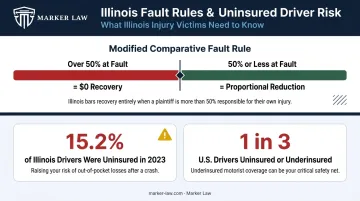
Under 735 ILCS 5/2-1116, Illinois uses modified comparative fault:
- If the injured party is more than 50% at fault, they recover nothing
- If the injured party is 50% or less at fault, their recovery is reduced proportionally to their fault percentage
Insurers routinely attempt to assign partial blame to reduce payouts — even in cases where liability appears clear-cut. A recorded statement given without counsel can hand them exactly the ammunition they need to do that.
Illinois also imposes a two-year statute of limitations for personal injury claims, starting from the accident date. Missing that deadline eliminates the right to any compensation.
Insurance Policy Limits
Illinois minimum liability coverage is $25,000 per person / $50,000 per crash for bodily injury under 625 ILCS 5/7-203. In moderate to severe whiplash cases, those minimums can be exhausted quickly.
When damages exceed policy limits, the victim may need to turn to their own uninsured/underinsured motorist (UM/UIM) coverage. Illinois law requires UM coverage on every policy issued in the state.
That matters more than most drivers realize. Roughly 15.2% of Illinois drivers were uninsured in 2023, and approximately 1 in 3 U.S. drivers were either uninsured or underinsured that same year. Having adequate UM/UIM limits isn't optional — it's a direct factor in how much is actually collectible.
How Whiplash Settlements Are Calculated
A whiplash settlement isn't just a reimbursement of medical bills. It combines three categories of damages, each requiring documentation and advocacy to maximize.
Medical Expenses
This covers all past and anticipated future costs:
- Emergency room visits and imaging
- Physician consultations and specialist care
- Physical therapy and chiropractic treatment
- Medications and pain management
- Projected future treatment if the injury is ongoing
Future medical expenses require a physician's documented prognosis — and insurers consistently contest them. Without that documentation, future care may not factor into the settlement at all.
Lost Wages and Earning Capacity
Compensation for income lost during recovery, plus reduced future earning capacity in more serious cases. Documentation requirements include:
- Pay stubs and employer letters confirming missed time
- Tax returns for self-employed claimants
- Vocational expert testimony when permanent limitations affect earning potential
Pain and Suffering
This is typically the largest component of a whiplash settlement — often exceeding the total of economic damages in moderate to severe cases.
Two methods are commonly used to calculate it:
| Method | How It Works |
|---|---|
| Multiplier | Economic damages multiplied by a factor of 1.5x to 5x, depending on severity, fault clarity, and life impact |
| Per diem | A daily dollar amount assigned for each day of pain until maximum recovery |
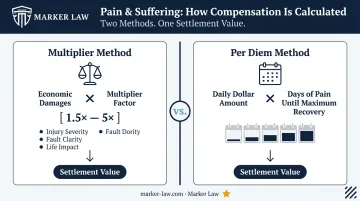
The multiplier applied depends on how persuasively the case is built — the credibility of the victim's account, the consistency of the medical record, and the skill of the attorney presenting it.
Attorney skill matters most here because insurers evaluate pain and suffering through a specific internal lens — one that Jason Marker of Marker Law knows firsthand. Before representing injured victims, he spent three years on the defense side working for insurance carriers. That experience revealed exactly how adjusters assess pain claims, what documentation gaps they exploit, and how to structure a case that closes those gaps before negotiations begin.
Mistakes That Can Reduce Your Whiplash Settlement
Delaying or Skipping Medical Treatment
Every day without documented treatment is used against the victim during negotiations. Insurers argue that if the injury were serious, the victim would have sought care immediately. Delayed treatment also creates the appearance that injuries may be unrelated to the crash or were pre-existing.
Seek care as soon as possible after the accident. Don't stop treatment until your doctor clears you.
Giving a Recorded Statement to the At-Fault Insurer
According to Nolo, an injured person has no legal obligation to talk to the other driver's insurer or provide a written or recorded statement. These statements are used to lock in inconsistencies, create admissions, or establish partial fault — all of which reduce the claim's value.
Decline politely. Consult an attorney before any communication with the opposing insurer.
Accepting the First Settlement Offer
Initial offers from insurance companies are almost never fair value. They're opening positions designed to close the claim cheaply before the full extent of the injury is known.
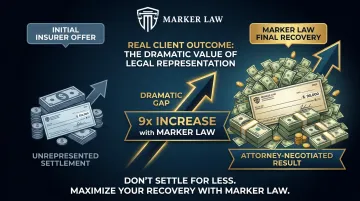
A real-world example from Marker Law's work: one client was initially offered $10,000, yet the firm recovered $90,000. That gap isn't unusual when claims are properly developed and negotiated.
Before accepting anything, it's worth having an attorney review the offer. Marker Law handles whiplash cases on a contingency fee basis (no fee unless compensation is recovered) and offers free consultations, so getting a professional evaluation costs you nothing.
Frequently Asked Questions
What is the average compensation for whiplash injuries in a car accident?
There's no single average that applies reliably. Mild cases settle in the lower range; moderate cases with ongoing treatment land higher; severe cases involving disc injury, nerve damage, or surgery can reach six figures. Every case depends on its own medical facts, fault picture, and available coverage.
How much of a settlement do I get to keep after attorney fees and expenses?
Personal injury attorneys typically charge a contingency fee — commonly around 33% of the settlement. Case expenses such as medical record retrieval, expert fees, and filing costs may also be deducted. Marker Law walks through its fee structure in the initial consultation — clients owe nothing if there's no recovery.
Is it worth suing for whiplash?
Filing suit — or credibly threatening to — often pushes settlement offers up, signaling the insurer can't lowball indefinitely. With a contingency fee arrangement, there's no upfront financial risk. Whether litigation makes sense depends on the documentation, clarity of liability, and the gap between the insurer's offer and the case's actual value.
How long does a whiplash settlement typically take to resolve?
Minor cases with clear liability may settle in weeks to a few months. Moderate to severe cases often take six months to over a year, particularly when treatment is ongoing or litigation becomes necessary — cases shouldn't settle until the full scope of injury, including future treatment needs, is known.
Can I still recover compensation if I had a pre-existing neck condition?
Yes — Illinois law allows recovery for aggravated pre-existing conditions, a principle supported by appellate case law including Compton v. Ubilluz. The key is showing through medical records how the crash specifically worsened the prior condition, not merely that it existed.
What is the deadline to file a whiplash injury claim in Illinois?
Illinois imposes a two-year statute of limitations for personal injury claims, running from the date of the accident under 735 ILCS 5/13-202. Missing this deadline forfeits the right to any compensation. If the injured party is a minor or under legal disability at the time of the accident, modified deadlines may apply under 735 ILCS 5/13-211 — but prompt action is always the safer course.