That assumption is wrong.
Pedestrian accident lawyers in Illinois work on a contingency fee basis, meaning you pay nothing unless they recover money for you. According to IDOT's 2024 Crash Facts, pedestrian crashes accounted for nearly 20% of all fatal crashes in Illinois despite being just 1.6% of total crashes — these are serious, life-altering cases that deserve serious legal help, and the fee structure is designed to make that accessible.
This guide covers how contingency fees work, what percentage range to expect, the difference between attorney fees and case costs, and what to verify before signing a fee agreement.
TL;DR
- Pedestrian accident lawyers typically charge between one-third and 40% of the total recovery
- The percentage is not fixed — it rises if the case requires a lawsuit or trial
- Attorney fees and case costs (court filings, expert witnesses, records) are separate deductions
- You owe no attorney fees if no compensation is recovered
- Severe injuries and multiple defendants in pedestrian cases often push fees toward the 40% end
What Is a Contingency Fee for a Pedestrian Accident Case?
A contingency fee means your attorney gets paid only if they win money for you. There's no hourly rate, no retainer, no invoice in the mail each month. The payment is a pre-agreed percentage of whatever settlement or court award is recovered.
This model exists for a practical reason. Pedestrian accident survivors often face catastrophic injuries, mounting medical debt, and lost income simultaneously. Billing at several hundred dollars per hour would put legal help out of reach for most people.
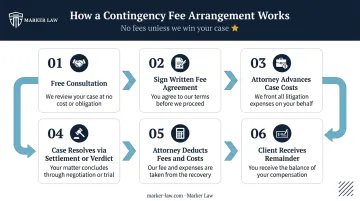
How It Works, Step by Step
- Free consultation — you meet with the attorney at no charge
- Sign a written fee agreement — Illinois law requires this agreement to be in writing and signed before representation begins, specifying the percentage, how costs are handled, and whether the percentage changes at different case stages
- Attorney advances all case costs — court filings, medical records, expert witnesses, and other expenses come out of the firm's pocket while the case is active
- Case resolves — through settlement or jury verdict
- Attorney deducts fees and advanced costs from the total recovery
- You receive the remainder
What "No Win, No Fee" Actually Means
If the case produces no recovery, you owe zero in attorney fees. The attorney absorbs the cost of their time.
Case costs — court filing fees, deposition transcripts, expert witness fees — are handled separately. The American Bar Association notes that clients may still be responsible for these expenses even under a contingency arrangement, depending on what the agreement states. Ask this directly during your consultation — it matters.
The percentage structure has a practical effect on strategy: because the attorney earns more from a larger recovery, they have a concrete reason to push back on low early settlement offers rather than closing a case quickly at your expense.
What Percentage Do Pedestrian Accident Lawyers Charge in Illinois?
Illinois does not impose a statutory cap on personal injury contingency fees. The ABA identifies one-third as a commonly used benchmark, and fees at different case stages must be spelled out in the written agreement. The actual percentage depends on how far the case must go.
Pre-Lawsuit Settlement
Cases resolved through negotiation before a formal lawsuit is filed carry the lowest fee — typically around one-third (33.3%). This applies to straightforward cases where liability is clear and the insurance company engages in good-faith settlement discussions.
Post-Lawsuit and Trial
When the insurer refuses a fair offer and the attorney must file suit, attend depositions, and prepare for trial, the fee typically increases. The workload multiplies and the financial risk to the attorney rises substantially.
Illinois Rule of Professional Conduct 1.5(c) specifically requires the fee agreement to state the percentage that applies at each stage — settlement, trial, and appeal — precisely because these numbers differ.
Why Pedestrian Cases Can Push Toward the Higher End
Pedestrian cases are typically more complex than standard car accident claims:
- Injuries tend to be severe — traumatic brain injuries, spinal cord damage, and permanent disability demand extensive medical documentation and specialist experts
- Liability often extends beyond the driver — municipalities, property owners, and vehicle manufacturers may all share fault
- Expert costs run high, with neurologists, life-care planners, and accident reconstruction specialists commonly required in serious cases
On a $300,000 settlement, a 33.3% fee leaves the client with roughly $200,000 before costs. At 40%, the attorney's share is $120,000, leaving the client $180,000 before costs.
That $20,000 gap sounds significant — until you consider that a more experienced attorney who commands 40% may recover $500,000 on that same case, netting the client far more even after the higher percentage.
What Factors Affect the Contingency Fee Percentage?
No two pedestrian accident cases are identical — the contingency fee percentage reflects the risk an attorney takes on and the resources required to win.
Severity and Type of Injuries
Cases involving traumatic brain injury, spinal cord damage, amputation, or long-term disability require more documentation, higher-cost experts, and longer timelines. At Marker Law, attorney Jason Marker works with medical and economic experts to fully account for long-term care needs, lost earning capacity, and loss of independence — a comprehensive damage assessment that serious injuries require.
Number of Liable Parties
Each additional defendant adds investigation, separate legal theories, and more complex motion practice. A pedestrian hit at a poorly lit intersection may have claims against the driver, the municipality responsible for lighting, and potentially a property owner — three separate tracks running simultaneously.
Stage at Which the Case Resolves
This is the single biggest driver of the percentage. The earlier a case settles, the less time and expense the attorney invests. Most personal injury cases settle before trial — Bureau of Justice Statistics data from large-county tort cases found that roughly 73% of tort cases resolved through settlement or voluntary dismissal, with only about 3% reaching a jury verdict.
Attorney Experience and Track Record
More experienced attorneys may charge at the higher end of the range. An attorney with 25 years of litigation experience and insider knowledge of insurance defense tactics — like Jason Marker, who spent three years on the defense side before exclusively representing injured plaintiffs — often recovers substantially more than a less seasoned alternative. Net recovery matters more than fee percentage.
Attorney Fees vs. Case Costs: What's Actually Deducted from Your Settlement
The contingency fee and case costs are two distinct deductions — both come out of your settlement, but calculated differently. Most clients don't realize this until they're reviewing the numbers at the end.
Typical Case Costs in a Pedestrian Accident Claim
- Court filing fees (Cook County charges $388 to file a new personal injury case; Will County's fee for damages over $50K is $364)
- Medical record retrieval (Illinois 2026 rates: $36.68 handling charge plus per-page fees)
- Accident reconstruction specialists
- Expert witness fees (industry benchmarks show expert time commonly runs $350–$480/hour)
- Deposition transcript costs
- Investigator fees
In complex pedestrian cases with severe injuries and multiple defendants, these costs can add up to meaningful sums. Ask your attorney upfront how costs are tracked and whether you'll receive an itemized accounting.
The "Off the Top vs. Off the Bottom" Distinction
Illinois Rule 1.5(c) requires the fee agreement to specify whether costs are deducted before or after the attorney's percentage is calculated. This affects what you receive.
Example with a $300,000 settlement and $30,000 in costs:
| Method | Math | Client Receives |
|---|---|---|
| Costs deducted first ("off the top") | Attorney's 33.3% × $270,000 = $89,910 fee | $180,090 |
| Fee calculated first ("off the bottom") | Attorney's 33.3% × $300,000 = $99,900 fee; costs then deducted | $170,100 |
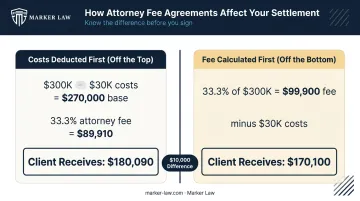
A $10,000 difference from a single calculation question. Confirm which method applies before you sign the fee agreement.
What If the Case Is Lost?
Some attorneys absorb advanced costs if there's no recovery. Others expect reimbursement regardless of outcome. Ask this question specifically before signing any agreement. In a case that costs $20,000–$30,000 to litigate, the answer matters.
What to Look for Before Signing a Contingency Fee Agreement
Under Illinois Rule 1.5(c), any contingency fee agreement must be in writing and signed by you. Before you sign, verify these provisions:
- The exact percentage — and whether it changes at pre-suit, post-filing, and trial stages
- How costs are handled — deducted before or after the attorney's fee is calculated
- Cost responsibility if the case is lost — does the client owe anything?
- Scope of representation — what exactly is the attorney agreeing to handle?
- Closing statement requirement — Illinois rules require the attorney to provide a written statement at the conclusion showing the outcome, the remittance to the client, and the method of calculation
At Marker Law, Jason Marker walks every client through the fee agreement line by line, answers questions in plain language, and offers a free initial consultation with no obligation. If you were injured as a pedestrian in Naperville or anywhere in the Chicagoland area, call 331-295-8005 to get clear answers before you commit to anything.
What Most Pedestrian Accident Victims Get Wrong About Legal Fees
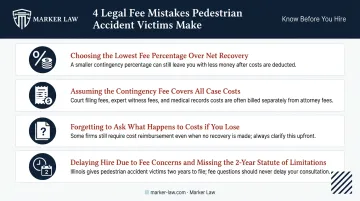
Four mistakes show up repeatedly when pedestrian accident victims evaluate their legal options:
Net recovery beats the lowest percentage. A 33% fee on a $150,000 settlement puts $100,000 in your pocket. A 40% fee on a $400,000 settlement puts $240,000 in yours. Choose based on experience and results — not the smallest number on the fee agreement.
The contingency fee doesn't cover all costs. Expert witnesses, court filings, and investigation expenses are separate line items. Clients who miss this distinction often see unexpected deductions taken from their settlement check.
Forgetting to ask what happens to costs if you lose. Most clients skip this question at the consultation. It can create real financial exposure. Ask it directly before signing anything.
Delaying hiring because of fee concerns. Under 735 ILCS 5/13-202, Illinois personal injury claims must be filed within two years of the date the cause of action accrued. Missing that deadline bars recovery entirely — far more costly than any attorney's percentage. Waiting also risks lost evidence, unavailable witnesses, and surveillance footage that gets deleted within days of the accident.
Frequently Asked Questions
What percentage do most personal injury lawyers charge?
The standard contingency fee for personal injury cases, including pedestrian accidents, is typically one-third. Fees increase when a case requires filing a lawsuit or going to trial, and any staged percentages must be spelled out in the written fee agreement.
Do I owe anything if my pedestrian accident case is lost?
Under a contingency fee arrangement, you owe no attorney fees if no compensation is recovered. Whether you must reimburse advanced case costs (court filings, expert fees, medical records) depends on your specific agreement — ask this question before signing.
What additional costs are deducted beyond the attorney's fee?
Common case costs advanced by the attorney include:
- Court filing fees
- Medical record retrieval
- Accident reconstruction specialists
- Expert witness fees
- Deposition transcripts
These are reimbursed from the settlement separately from the attorney's percentage.
Can I negotiate the contingency fee?
Yes — Illinois imposes no statutory cap on personal injury contingency fees, making them negotiable. Highly experienced attorneys with strong track records may be less flexible on their standard rate, and focusing on net recovery matters more than negotiating the percentage down.
Does it cost anything to consult a pedestrian accident lawyer?
Most personal injury attorneys, including Marker Law, offer free initial consultations with no obligation. You get a full case evaluation — and at Marker Law, that means speaking directly with attorney Jason Marker, not a paralegal screening call.
Why might a pedestrian accident case have a higher fee than a car accident case?
Pedestrian cases frequently involve more severe injuries, multiple potentially liable parties (driver, municipality, property owner), and higher-cost expert witnesses — all of which increase case complexity and justify a fee toward the higher end of the standard range.