

According to the CDC, 1 in 5 falls causes a serious injury such as broken bones or a head injury, and more than 800,000 patients are hospitalized annually because of fall-related injuries. The financial and physical toll is real — and so is the legal complexity.
Illinois premises liability law gives injured victims a path to compensation, but the outcome depends heavily on understanding what you must prove, what evidence exists, and how insurance companies will fight back. This guide walks through everything you need to know before your first attorney consultation.
TL;DR
- Illinois premises liability law requires proving four elements: duty, notice, causation, and damages
- Notice — what the property owner knew or should have known — is where most cases are won or lost
- Shared fault above 50% eliminates your recovery under Illinois's modified comparative fault rule
- You have two years to file under 735 ILCS 5/13-202 — only one year against government entities
- Act quickly: surveillance footage and incident reports can vanish within days
How Illinois Premises Liability Law Applies to Slip and Fall Cases
Slip and fall claims fall under Illinois premises liability law, which holds property owners, businesses, and landlords responsible for maintaining reasonably safe conditions for visitors.
Visitor Status Under Illinois Law
Under 740 ILCS 130, Illinois abolished the old common-law distinction between invitees and licensees. Both categories of lawful visitors are now owed "reasonable care under the circumstances regarding the state of the premises." Trespassers stand apart — property owners generally owe them no duty except to avoid willful and wanton conduct.
Most viable slip and fall claims involve lawful visitors. That includes:
- Customers in retail stores and restaurants
- Tenants on residential or commercial property
- Guests at open businesses
- Members of the public on commercial premises
If you were on the property legally when you fell, Illinois law likely extends you the full duty of reasonable care.
The Natural Accumulation Rule
Illinois follows a natural accumulation rule for weather-related hazards. Under this rule, property owners have no duty to remove natural accumulations of snow, ice, or meltwater. The Illinois Supreme Court applied this rule even against the Chicago Transit Authority in Krywin v. Chicago Transit Authority.
The exception is critical: liability can arise when the property owner created or worsened the icy condition. A leaking downspout that channels meltwater across a walkway, where it refreezes into a sheet of ice, is not a natural accumulation — it's an unnatural one caused by the property's design or maintenance. Documenting the source of the hazard — a drain, a gutter, a design flaw — is often what separates a recoverable claim from one that gets dismissed on this rule alone.
The 4 Elements You Must Prove in an Illinois Slip and Fall Case
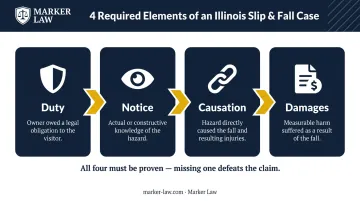
Illinois Pattern Jury Instructions (IPI Civil 120.08) lay out what a plaintiff must establish. Miss any one of these four elements, and the case fails.
Duty
The property owner must have owed you a legal obligation to maintain safe conditions. For lawful visitors — customers, tenants, guests of open businesses — this means the owner must exercise reasonable care regarding the condition of the premises.
Notice
Notice is where most slip and fall cases are decided. You must show the owner either:
- Had actual notice — they knew about the hazard directly (an employee reported it, a manager saw it), or
- Had constructive notice — the hazard existed long enough that a reasonable inspection should have caught it
Evidence that establishes notice includes surveillance video, inspection and sweep logs, prior incident reports about the same area, and witness statements from people who saw the condition before the fall.
This is why Marker Law moves immediately upon being retained: spills get cleaned up, surveillance footage gets overwritten, and hazardous conditions get repaired fast after an accident.
Causation
Causation requires showing that the specific hazardous condition — not your footwear, not a pre-existing medical condition, not something unrelated — directly caused both the fall and the resulting injuries. Insurance carriers will challenge this element, particularly when the injured person has any prior injury history.
Damages
Damages require measurable harm. Illinois allows recovery for:
- Medical bills (past and projected future costs)
- Lost wages and reduced earning capacity
- Pain and suffering
- Loss of normal life and daily activities
- Emotional distress
Both economic and non-economic damages are recoverable. The severity of injury — whether surgery was required, whether the condition is permanent — directly shapes total damages.
Illinois Modified Comparative Fault
Proving all four elements gets you to the damages table — but Illinois law adds one more variable that can reduce or eliminate your recovery entirely. Under 735 ILCS 5/2-1116, the state uses a modified comparative fault system with a 51% bar:
- If a jury finds you more than 50% responsible, you recover nothing
- If you're 50% or less at fault, your damages are reduced by your fault percentage
Insurance adjusters push comparative fault arguments aggressively — arguing you were distracted, wearing poor footwear, or ignored a visible warning sign. Jason Marker spent three years on the defense side learning exactly how that playbook works, which informs how he builds and defends cases for injured clients today.
What Factors Determine Your Slip and Fall Settlement Amount
No single number defines what a case is worth. Settlement value is built from multiple overlapping factors.
Injury Severity
This is the dominant factor. Soft tissue injuries and minor sprains with no surgery produce lower settlements than cases involving:
- Surgical procedures
- Spinal cord injuries (estimated lifetime costs range from $700,000 to $2.5 million according to a 2024 systematic review)
- Traumatic brain injuries
- Permanent disability or chronic pain
More serious injuries generate higher medical bills, longer recovery periods, and far greater non-economic damages.
Medical Expenses
Past and projected future medical costs anchor the settlement calculation. Compensable expenses include:
- Emergency room care and hospitalization
- Surgery and post-operative care
- Physical therapy and rehabilitation
- Assistive devices and home modifications
- Future treatment costs for permanent conditions
Lost Wages and Earning Capacity
Victims who miss work during recovery are entitled to those lost wages. If the injury results in permanent restrictions — inability to stand for long periods, limited lifting capacity, reduced mobility — the long-term impact on earning capacity can add substantially to total settlement value.
Pain, Suffering, and Non-Economic Damages
Economic losses tell only part of the story. In serious cases, non-economic damages often exceed the medical bills — Illinois juries can compensate for loss of normal activities, emotional distress, and the lasting inability to do things you did before the fall. Quantifying these damages is one of the most contested aspects of settlement negotiations.
Strength of Liability Evidence
The strength of your evidence directly shapes what an insurance company is willing to offer. A case backed by strong documentation carries real leverage — while one without it becomes easy to undervalue. Key evidence that moves settlements higher includes:
- Surveillance footage showing an unaddressed hazard
- Sweep or inspection logs that were never filled out
- Prior complaints about the same condition
- Incident reports created at the scene
- Witness statements corroborating the dangerous condition

Without this documentation, the defense will push comparative fault arguments hard and open the door to low offers.
Realistic Slip and Fall Settlement Ranges in Illinois
Honest answer: public authoritative settlement ranges for Illinois slip and fall cases by injury severity are not readily available without subscription access to resources like the Illinois Jury Verdict Reporter, which has collected more than 55,000 Illinois case summaries over 60+ years. Any specific dollar figures you see on general websites are typically not drawn from verified Illinois verdict data.
Settlement value generally tracks injury severity:
- Minor injuries (sprains, bruises, no surgery, short recovery) tend to produce lower settlements
- Moderate injuries (fractures, extended physical therapy, significant missed work) fall in a higher range
- Severe injuries (spinal injuries, TBI, surgery, permanent disability) can reach six or seven figures depending on the evidence, the defendant, and the jurisdiction
Cook County vs. Suburban Counties
Venue matters. Cook County juries historically return higher verdicts than those in more rural Illinois counties, and where a case is filed can influence settlement dynamics. Jason Marker has practiced across DuPage, Will, Cook, Kane, and Kendall counties for over 25 years, with direct knowledge of local court tendencies, judges, and how cases actually play out in each jurisdiction.
That said, no attorney can guarantee a settlement number at an initial consultation. Value depends on comparative fault exposure, available insurance coverage, and the specific facts of the case. What an experienced attorney can do is evaluate those factors honestly and position the case to maximize recovery.
What to Do After a Slip and Fall Accident to Protect Your Claim
The steps you take in the hours after a fall matter enormously.
At the Scene
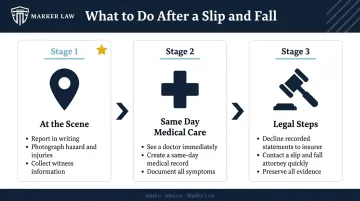
- Report the fall in writing — notify a manager before leaving and request a copy of the incident report
- Photograph everything — the hazard itself, the surrounding area, the presence or absence of warning signs, and your injuries
- Collect witness information — names and contact details from anyone who saw what happened
Seek Medical Care Immediately
Go to a doctor the same day, even if you feel mostly fine. Adrenaline masks pain. Concussions, herniated discs, and hip fractures may not present fully until hours later.
A same-day medical record is one of the most critical pieces of evidence in any premises liability case. Gaps in treatment give insurance companies room to argue the injury wasn't serious.
Don't Give a Recorded Statement
The property owner's insurer will likely contact you quickly. Do not give a recorded statement before speaking with an attorney.
Adjusters are trained to ask questions that elicit statements reducing liability or minimizing injury severity. Anything you say can be used to push a comparative fault argument.
Contact an Illinois Slip and Fall Attorney Quickly
That's exactly why retaining an attorney quickly matters. The statute of limitations under 735 ILCS 5/13-202 gives you two years for most personal injury claims — but only one year if the property is owned by a government entity. Evidence disappears fast:
- Surveillance footage is often overwritten within days
- Hazards get repaired before they can be documented
- Witnesses become harder to locate over time
Marker Law offers a free consultation and works on contingency — no fee unless compensation is recovered. Attorney Jason Marker's background representing insurance carriers before switching to plaintiff work gives him direct insight into how insurers evaluate and attempt to devalue these claims. The firm serves clients across DuPage, Will, Cook, Kane, and Kendall counties and moves immediately to preserve evidence upon being retained.
Frequently Asked Questions
What is the average settlement for a personal injury case in Illinois?
Illinois personal injury settlements vary widely based on injury severity, liability clarity, and jurisdiction. Minor injury cases often settle in the tens of thousands; serious injuries can reach six or seven figures. No formula applies — the facts of your specific case determine the range.
How likely are you to win a slip and fall case?
Success depends on whether all four elements — duty, notice, causation, and damages — can be proven with evidence. Cases with clear surveillance footage, documented notice, and well-documented injuries have stronger outcomes. Cases lacking notice evidence are the hardest to win.
What are the 4 things you must prove in a slip and fall negligence case?
The four required elements are: duty (the owner owed you a legal obligation), notice (they knew or should have known about the hazard), causation (the hazard directly caused your fall and injuries), and damages (you suffered measurable harm). All four must be proven under Illinois premises liability law.
How long do I have to file a slip and fall lawsuit in Illinois?
Illinois gives you two years from the date of the fall under 735 ILCS 5/13-202. Claims against government entities carry a shorter one-year deadline. Evidence — surveillance footage, incident reports, witness recollections — disappears well before either deadline, so acting quickly matters.
Does comparative negligence affect my slip and fall settlement in Illinois?
Yes. Illinois follows modified comparative fault with a 51% bar — if you're found more than 50% at fault, you recover nothing. If 50% or less, your damages are reduced proportionally. Insurance companies routinely argue victim fault to shrink payouts — disputing those claims early, with documentation, is where cases are often won or lost.
What should I do immediately after a slip and fall accident?
Report the fall in writing before leaving, photograph the hazard and your injuries, and collect witness contact information. Seek medical care the same day. Do not give a recorded statement to the property owner's insurer before consulting an attorney. Contact a slip and fall lawyer as soon as possible to preserve evidence.