Many victims accept far less than they deserve, or nothing at all, because they don't understand how these claims work in Illinois. The rules matter here: what you do in the hours and days after a fall can determine whether you walk away with full compensation or nothing.
This guide covers everything you need — from proving negligence under Illinois premises liability law, to calculating your damages, to the specific steps that separate winning claims from losing ones.
TLDR
- A valid Illinois slip and fall claim requires proving the property owner's negligence caused your injuries.
- Compensation covers medical costs, lost wages, pain and suffering, and future expenses — Illinois places no cap on non-economic damages in premises liability cases.
- Illinois's modified comparative fault rule bars recovery entirely if you're 50% or more at fault.
- You have two years to file a personal injury claim — but claims against government entities have a shorter one-year deadline.
- Don't give a recorded statement to any insurer before speaking with an attorney.
What Makes a Slip and Fall Claim Valid in Illinois
Not every fall on someone else's property creates a legal claim. Illinois premises liability law holds property owners accountable for maintaining safe conditions — but only when you can prove they were negligent.
The Four Elements You Must Prove
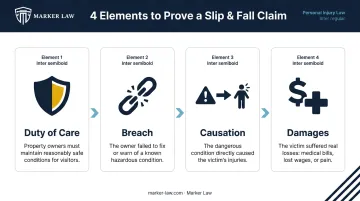
To win a slip and fall case, you need to establish all four:
- Duty of care — The property owner owed you a legal duty to maintain safe premises
- Breach — They failed that duty by allowing or ignoring a hazardous condition
- Causation — That hazard directly caused your fall and injuries
- Damages — You suffered real, compensable harm as a result
Illinois abolished the old legal distinction between invitees and licensees under 740 ILCS 130/2. Lawful visitors — whether you're a customer at Fox Valley Mall or a social guest at a neighbor's home — are all owed reasonable care under the circumstances. Trespassers remain a separate category with limited protections.
The "Knew or Should Have Known" Standard
The property owner doesn't need to have created the hazard themselves. Illinois law requires proof that they had actual or constructive notice — meaning they either knew about the danger, or it existed long enough that a reasonable inspection would have caught it.
Common examples that satisfy this standard:
- A spill left unattended for hours in a grocery aisle along Route 59
- A broken step reported to building management but never repaired
- Icy walkways outside a Naperville retail location that weren't salted after a storm
The 7th Circuit's Zuppardi v. Wal-Mart decision makes this concrete: without evidence of how long a hazard existed, constructive notice fails. Document the scene immediately and gather anything that shows when the condition began — photos, timestamps, witness accounts, store logs.
Filing Deadlines You Cannot Ignore
- Private property falls: Two years from the date of injury under 735 ILCS 5/13-202
- Government property falls (municipal sidewalks, park district trails, public buildings): One year under 745 ILCS 10/8-101
Miss either deadline and you permanently forfeit the right to compensation. If your fall happened on City of Naperville property, a park district trail, or any government-owned premises, contact an attorney immediately — government claims carry additional notice requirements and shorter windows that can bar recovery before you've even filed suit.
What Compensation Can You Recover from a Slip and Fall Case
Illinois law recognizes two broad categories of damages: economic losses you can measure in dollars, and non-economic losses that are harder to quantify but equally real.
Economic Damages
Medical expenses — Past and anticipated future costs tied directly to the fall, including:
- Emergency room visits and surgery
- Physical therapy and rehabilitation
- Prescription medications and assistive devices
- Long-term care if the injury causes lasting impairment
Never settle before your doctors have a clear picture of your full prognosis. Signing a release too early eliminates your right to pursue future medical costs, no matter what happens after.
Lost income and diminished earning capacity — This covers wages lost during recovery and any long-term reduction in your earning potential. The calculation varies by worker type:
- Salaried and hourly employees: documented pay stubs and employer records
- Self-employed individuals: tax returns, invoices, and business records
- Permanently limited workers: economic expert projections of lost career earnings
Non-Economic Damages
Illinois Pattern Jury Instructions recognize compensation for:
- Physical pain and ongoing discomfort
- Emotional distress, anxiety, depression, and PTSD
- Loss of enjoyment of life and inability to do things you previously could
- Disfigurement and disability
Two methods are commonly used to calculate these damages. The multiplier method multiplies your total economic damages by a factor (typically 1.5 to 5) based on injury severity. The per diem approach assigns a daily dollar value to your suffering and multiplies it by the expected duration.

There is no statutory cap on non-economic damages in Illinois premises liability cases — the Illinois Supreme Court struck a prior legislative attempt to impose limits as unconstitutional.
A note on punitive damages: These are rare in slip and fall cases and require conduct beyond ordinary negligence — something outrageous or driven by reckless indifference. If a property owner knew about a dangerous condition and deliberately concealed it, that's the kind of conduct that opens the door.
Key Factors That Determine Your Settlement Amount
Injury Severity
The more serious and permanent the injury, the higher the potential recovery. Spinal cord damage, traumatic brain injuries, multiple fractures, and permanent disability drive up every category of damages — larger medical bills, longer income loss, and greater human toll. Minor injuries with fast recoveries produce significantly lower settlements.
For a reference point: Bureau of Justice Statistics data from national premises liability trials showed a $98,000 median award for plaintiff winners — but that's trial-only data from 2005, not a current Illinois settlement average. Real case values depend entirely on the specific facts.
Illinois's Comparative Fault Rule
Under 735 ILCS 5/2-1116, your compensation is reduced proportionally by your percentage of fault. If you're 30% responsible, you recover 70% of your damages. If you're 51% or more at fault, you recover nothing.
Insurers lean heavily on this rule. Expect arguments that you were distracted by your phone, ignored warning signs, wore inappropriate footwear, or were walking in an area clearly marked as restricted. How you behaved before and after the fall matters. Avoid any statement that could be read as accepting partial responsibility — even a casual apology at the scene can be used against you.
Strength of Evidence
Settlement offers track the quality of your evidence. Strong documentation creates real negotiating leverage:
- Surveillance footage capturing the hazard and the fall
- Photographs taken at the scene immediately afterward
- Witness names and contact information
- An incident report filed with the property owner
- Maintenance logs showing the hazard was known and ignored
Weak evidence invites lowball offers. Insurers know that without proof, juries struggle to assign liability. Surveillance footage is your strongest asset, but it disappears fast. Commercial systems at high-traffic locations routinely overwrite recordings within 24 to 48 hours, and most retention periods don't exceed 30 days.
Insurance Policy Limits
Evidence strength only tells half the story — available coverage determines what you can actually collect. Large commercial defendants like grocery chains and shopping centers typically carry higher policy limits than small private property owners. An attorney can investigate available coverage and identify whether multiple parties share liability, which may open additional recovery sources.
Steps to Take Immediately After a Slip and Fall in Illinois
What you do in the first hours matters as much as what happened in the fall itself.
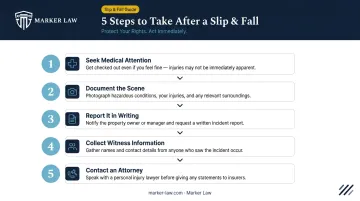
Seek medical attention immediately. Even if you feel okay, get evaluated. Adrenaline masks pain, and delayed treatment gives insurers an easy argument that the injuries weren't serious. A same-day medical record links the accident to the injury in a way no later documentation can replicate.
Document the scene before leaving. Photograph the exact hazard — the wet floor, broken pavement, or icy walkway — along with the surrounding area, any warning signs (or their absence), and your visible injuries. The more specific, the better.
Report it in writing. Tell the property owner or manager what happened and request a written incident report. Keep statements factual and brief — avoid any language that could be read as accepting blame.
Collect witness information. Anyone who saw the fall or can speak to how long the hazard existed is valuable. Get names and phone numbers before they leave.
Contact an attorney before talking to any insurer. Insurance companies move quickly — often calling within days to request a recorded statement or push a fast settlement. An attorney can advise on what to say, what not to sign, and how to protect the full value of your claim. Marker Law acts fast on this front: the team visits the scene, secures surveillance footage before it's overwritten, and pulls maintenance records before conditions change or get repaired.
How Insurance Companies Fight Slip and Fall Claims
Understanding defense tactics is half the battle. Insurers use several consistent strategies to reduce or eliminate slip and fall payouts:
- Disputing the hazard — claim the condition was minor, didn't exist, or was "open and obvious" and should have been avoided
- Pushing comparative fault — argue you were distracted, ignoring posted warnings, or otherwise responsible for the fall
- Challenging causation — assert your injury was pre-existing and unrelated to the incident
- Early settlement pressure — reaching out before you've seen a doctor, offering a quick payment to close the claim before you know its real value
Knowing these tactics exists is useful. Knowing how to dismantle them is something else. Jason Marker spent three years early in his career on the defense side, representing employers and insurance carriers before transitioning to representing injured victims exclusively. That background means he recognizes these arguments before they're made — and where the holes in them are.
Three mistakes that cost claimants the most:
- Giving a recorded statement to an insurer without attorney guidance
- Signing any release or settlement agreement without legal review
- Waiting too long to consult a lawyer — evidence disappears, witnesses become unreachable, and deadlines approach fast
How an Experienced Slip and Fall Attorney Builds a Winning Case
Investigation and Evidence Preservation
Waiting on evidence is a losing strategy. At Marker Law, building the case starts immediately:
- Visiting the scene independently to document conditions firsthand
- Subpoenaing surveillance footage before retention periods expire
- Obtaining maintenance and inspection logs that may show the owner was aware of the hazard
- Retaining medical and liability experts when the facts require it
- Calculating the full economic and non-economic damage picture, including long-term care needs and lost earning capacity

That groundwork — gathered before evidence disappears — is what gives the case its foundation. How that foundation gets used depends on what comes next.
Settlement vs. Trial
The vast majority of personal injury cases resolve before trial — BJS data shows roughly 4% of tort cases actually reach a courtroom. But that statistic cuts both ways: insurers know most attorneys settle, and they negotiate accordingly.
The credible threat of trial changes the math. Marker Law prepares every case as if it's going to court, not because most cases need to, but because that preparation is exactly what creates leverage in negotiations. Insurers offer more when they know the attorney on the other side can and will litigate.
Jason Marker's AV Preeminent rating from Martindale-Hubbell and Super Lawyers recognition, held for over a decade, isn't just a credential. It signals to opposing counsel and adjusters that a settlement demand comes with real consequences if ignored.
Contingency Fee Representation
Marker Law handles slip and fall cases on a contingency fee basis: no upfront costs, no fees unless compensation is recovered. For victims in Naperville, Aurora, Wheaton, Bolingbrook, and across DuPage, Will, Cook, Kane, and Kendall counties, that means quality legal representation carries no financial risk. A free initial consultation is the starting point.
Frequently Asked Questions
How much can I get from a slip and fall lawsuit?
Settlement amounts vary based on injury severity, liability evidence, and insurance coverage. National trial data from 2005 showed a $98,000 median award for plaintiff winners, though that's not a reliable settlement estimate for any individual case. An attorney can evaluate your specific facts and give you a meaningful range.
How long do I have to file a slip and fall claim in Illinois?
Generally two years from the date of injury under Illinois law. Falls involving government entities — city sidewalks, park district property, public buildings — have a shorter one-year filing deadline. Missing either deadline permanently ends your claim, so early legal consultation is essential.
What do I need to prove to win a slip and fall case?
You must establish four elements: the owner owed you a duty of care, they breached it by failing to fix or warn about a hazard, that breach caused your injuries, and you suffered actual damages. Proving the owner knew or should have known about the danger is typically the central challenge.
Will my compensation be reduced if I was partly at fault?
Yes. Under Illinois's modified comparative fault rule, your recovery is reduced proportionally by your share of fault. If you're found 30% responsible, you recover 70% of your damages. If you're 50% or more at fault, you recover nothing.
Do I need a lawyer for a slip and fall claim?
You're not legally required to hire one, but unrepresented claimants routinely accept less than their claims are worth, often without realizing it until after they've signed a release. Contingency-fee representation means no upfront cost and no fee unless you recover.