No two grocery store slip and fall cases settle for the same amount. But settlement values aren't random — they follow recognizable patterns tied to injury severity, the quality of available evidence, and how clearly a store's negligence can be established. This article breaks down realistic settlement ranges, the factors that push numbers up or down, and what Illinois victims specifically need to know before accepting any offer.
TL;DR
- Settlements range from a few thousand dollars for minor injuries to six or seven figures for severe or catastrophic harm.
- Value depends on documented medical costs, lost wages, and the strength of your negligence evidence.
- Illinois's modified comparative fault law can reduce — or eliminate — your recovery depending on assigned fault percentages.
- Acting fast after a fall — reporting it, getting care, preserving evidence — directly affects your settlement value.
What Is the Average Grocery Store Slip and Fall Settlement?
There is no single "average" settlement figure. Values fall into tiers based on injury severity, and understanding those tiers helps victims assess their situation before an insurance adjuster calls.
That call often comes fast. Insurers make early offers before the full extent of injuries is clear, and many victims accept before reaching maximum medical improvement — without realizing that non-economic damages like pain and suffering weren't factored in. Once you sign a settlement agreement, the claim is closed permanently.
Minor Injuries
What qualifies: Sprains, bruises, soft tissue injuries, and minor cuts that resolve within weeks with minimal treatment.
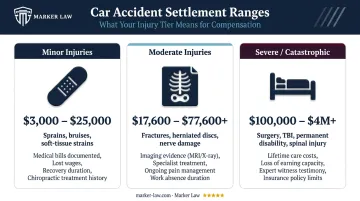
These cases often settle quickly — which is exactly when insurers make their lowest offers. A general personal injury survey from Nolo found that 58% of personal injury claimants received between $3,000 and $25,000, with 16% receiving under $3,000. Minor grocery store falls tend to land in this lower portion of the range, particularly when medical treatment was brief and well-documented.
Victims without legal representation are most likely to accept these early offers — often without realizing what they're leaving on the table.
Several factors push minor-tier settlements toward the lower end of that range:
- Limited medical documentation or gaps in treatment
- Injuries that appear resolved before a lawyer is consulted
- No lost wages or minimal out-of-pocket costs
- Early recorded statements given to the insurer
Moderate Injuries
What qualifies: Non-surgical fractures, concussions, torn ligaments, herniated discs, and injuries requiring physical therapy over weeks or months.
These cases are more complex. The gap between what an unrepresented claimant receives and what an attorney-represented claimant recovers is most pronounced at this tier. The same Nolo survey found that represented claimants averaged $77,600 versus $17,600 for those without legal help — nearly four times more, even after accounting for a standard contingency fee.
Marker Law works with medical and economic experts to document the full scope of damages in these cases, including future therapy costs and reduced earning capacity.
Severe and Catastrophic Injuries
What qualifies: Surgical fractures, spinal injuries, traumatic brain injuries, permanent disability, and wrongful death.
These cases can reach six and seven figures when negligence is clearly documented. Major grocery chains carry substantial commercial liability coverage: Kroger's most recently available memorandum of insurance lists $2 million per occurrence in general liability coverage with a $15 million aggregate, while Walmart discloses a $50 million per occurrence excess liability self-insured retention.
A 2022 California verdict shows what catastrophic cases can reach. A Kern County jury ordered Albertsons to pay $4.3 million to a man who slipped on water in the meat department — he suffered a broken nose, a subdural hematoma, surgery, and permanent loss of smell and taste. The fall happened in 2016; the verdict came six years later.
Key Factors That Drive Your Settlement Value
Two people can fall in the same grocery store aisle under nearly identical circumstances and receive vastly different settlements. The difference comes down to specific, documentable factors.
Severity and Documentation of Injuries
Medical records are the financial backbone of every settlement. ER visit records, imaging results, specialist referrals, surgical notes, and physical therapy documentation all establish the baseline for calculating economic and non-economic damages.
Gaps in treatment work against you. Skipping appointments or delaying follow-up care gives insurers room to argue the injury wasn't serious — or wasn't caused by the fall at all.
Strength of Evidence of Negligence
A strong settlement requires proving the store knew or should have known about the hazard. Strong evidence looks like:
- Surveillance footage showing a spill sitting unaddressed for an extended period
- Maintenance logs with no recorded inspections during the relevant window
- Incident reports that contradict the store's later narrative
- Witness statements from shoppers or employees
Evidence preservation is time-sensitive. Security industry sources indicate retail stores typically retain surveillance footage for 30 to 90 days before overwriting it. Marker Law moves immediately after being retained — visiting the scene, pulling maintenance records, and securing witness statements before evidence disappears. Sending a formal spoliation letter to the store demanding retention of footage and records is one of the first steps taken.
Lost Wages and Earning Capacity
Documented lost income — pay stubs, employer letters, and tax returns — adds directly to settlement value. For injuries causing long-term impairment, vocational assessments and economic expert testimony can significantly increase the damages calculation.
Marker Law works with medical and economic experts to project future earning capacity losses, making sure every dollar of impact is accounted for.
Pain and Suffering Calculation Methods
Beyond economic losses, pain and suffering adds a separate layer of compensation. Two methods are commonly used to calculate it:
- Multiplier method: Takes your total economic damages (medical bills, lost wages) and multiplies them by a factor — typically 1.5x to 5x — based on injury severity and duration.
- Per diem method: Assigns a daily dollar value for each day you experience pain and disruption.
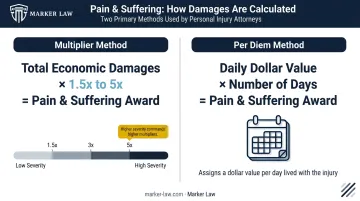
More serious, longer-lasting injuries command higher multipliers. An attorney who understands how the defense values pain and suffering can negotiate more effectively than someone without that perspective — which is why this number often differs significantly between represented and unrepresented claims.
Comparative Fault Assigned to the Victim
Illinois's modified comparative fault rule under 735 ILCS 5/2-1116 works as follows:
- If you are found more than 50% at fault, you cannot recover anything.
- If you are found 50% or less at fault, your recovery is reduced proportionally.
Grocery stores and their insurers routinely argue that victims were distracted by phones, wearing improper footwear, or ignored an "open and obvious" hazard. Jason Marker spent three years on the defense side representing employers and insurance carriers — he knows their playbook and understands how these fault arguments are built, which changes how he builds the case from day one.
Types of Compensation You Can Recover
A slip and fall settlement is designed to make you whole — covering both out-of-pocket losses and the harder-to-quantify human costs.
Economic Damages
These are calculated directly from bills and records:
- Emergency room and hospital costs
- Surgery and related procedures
- Physical therapy and rehabilitation
- Prescription medications and medical equipment
- Lost wages for time missed from work
- Future medical expenses when ongoing treatment is anticipated
Non-Economic Damages
These don't come with a receipt, but Illinois courts recognize them as real and compensable:
- Pain and suffering
- Emotional distress
- Loss of enjoyment of life
- Loss of consortium
In moderate-to-severe cases, non-economic damages frequently represent the largest portion of a settlement. Calculating them accurately means anticipating how the defense will challenge them, then countering with strong medical documentation and expert testimony.
Proving the Grocery Store's Negligence Under Illinois Premises Liability Law
To recover any settlement, you must establish that the grocery store was legally negligent. Under the Illinois Premises Liability Act (740 ILCS 130), property owners owe customers a duty of reasonable care regarding the condition of their premises.
The Four Elements of Negligence
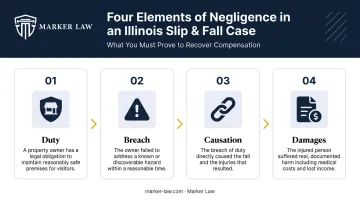
All four must be proven:
- Duty — The grocery store owed customers a legal duty to maintain reasonably safe premises.
- Breach — The store failed that duty (leaving a spill unaddressed, failing to post warning signs, ignoring a known hazard).
- Causation — The store's breach directly caused the fall and the resulting injuries.
- Damages — The victim suffered actual, documentable harm.
The "Knew or Should Have Known" Standard
A store doesn't have to have personally caused a hazard to be liable. If a dangerous condition existed long enough that a reasonable inspection would have caught it, the store can still be held responsible.
The Illinois appellate court addressed this directly in Pavlik v. Wal-Mart Stores, confirming that liability attaches when a store has actual or constructive notice of a foreign substance. A spill that occurred seconds before a fall is much harder to attribute to negligence. A puddle sitting for 40 minutes with no cleanup and no warning sign is a stronger case — and maintenance logs, inspection records, and incident reports are where that proof lives.
Common Causes That Establish Store Liability
The most frequently litigated negligence scenarios in Illinois grocery stores:
- Wet or recently mopped floors without warning signs
- Food or liquid spills left unaddressed for an extended period
- Leaking refrigeration or freezer units
- Damaged or uneven flooring
- Poor lighting in aisles or entrances
- Cluttered walkways
Illinois Statute of Limitations
Under 735 ILCS 5/13-202, Illinois generally allows two years from the date of injury to file a personal injury lawsuit. Waiting too long risks losing the right to sue entirely — but the practical deadline is much earlier than two years. Evidence disappears quickly after a fall:
- Surveillance footage gets overwritten within days or weeks
- Witnesses' recollections fade
- Maintenance and inspection records cycle out
Contacting an attorney as soon as possible after the incident protects access to the evidence that proves your case.
How Grocery Stores Minimize Payouts — and How to Fight Back
Major grocery chains and their insurers have experienced claims teams whose primary job is to reduce settlements. Their most common tactics:
- Arguing the hazard was "open and obvious" and the victim should have seen it
- Claiming the victim was distracted or wearing improper footwear
- Attributing injuries to pre-existing conditions unrelated to the fall
- Delaying negotiations to wear down claimants financially
- Making a fast lowball offer before the victim understands the full scope of injuries
- Failing to preserve — or destroying — surveillance footage
Knowing these tactics in advance changes everything. Jason Marker spent three years working inside this system before switching exclusively to plaintiff representation. He knows how insurers evaluate claims, what documentation they scrutinize, and which arguments they build their defenses around. That background shapes how Marker Law approaches cases from day one — positioning clients ahead of the defense rather than catching up to it.
Practical countermeasures for victims:
- Decline recorded statements to the store's insurer until you've spoken with an attorney — adjusters are trained to use your own words against your claim
- Send a spoliation letter early, formally demanding the store preserve surveillance footage and maintenance records before they're deleted
- Document everything independently and don't rely on the store's incident report as your only record
What to Do Immediately After a Grocery Store Slip and Fall
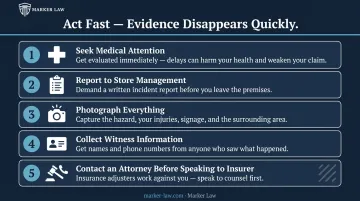
The steps you take in the first hours and days after a fall directly affect what your case is worth.
- Seek medical attention immediately, even if symptoms seem minor. Adrenaline masks pain — concussions and internal bleeding may not be obvious right away. A documented visit creates a timestamp linking the fall to your injury.
- Report the accident to store management and request a copy of the incident report.
- Photograph everything — the hazard, surrounding area, any visible injuries, and the footwear you were wearing.
- Collect witness information — names and contact details from anyone who saw the fall.
- Contact an attorney before speaking to the store's insurer — Marker Law offers free consultations and is available 24/7.
What not to do:
- Don't minimize the injury in conversations with store staff or adjusters.
- Don't delay medical treatment — gaps in care are used to undercut claim value.
- Avoid posting about the accident or your injuries on social media.
Frequently Asked Questions
How much compensation do you get for a slip and fall at a grocery store?
Compensation depends on injury severity, medical costs, lost wages, and the strength of your negligence evidence. Minor injuries may settle for several thousand dollars; cases involving surgery, permanent injury, or significant lost wages can reach six or seven figures.
How much of a $25,000 settlement will I get?
Attorney fees in contingency-fee cases typically run 33%–40% of the settlement, and medical liens or health insurance reimbursements may reduce the proceeds further. On a $25,000 settlement, your net amount will vary based on those deductions — ask your attorney for a written breakdown before signing.
What are the 4 proofs of negligence?
Duty (the store owed a legal duty of care), breach (the store failed that duty), causation (the breach caused your injury), and damages (you suffered actual harm). All four must be established to succeed.
How long do I have to file a slip and fall lawsuit in Illinois?
Illinois generally allows two years from the date of injury under 735 ILCS 5/13-202. However, acting well before that deadline matters because surveillance footage and maintenance records don't last two years.
Can I still recover compensation if I was partly at fault?
Under Illinois's modified comparative fault rule, you can recover as long as you are found 50% or less at fault — but your award is reduced proportionally by your share of fault. Insurers routinely push to inflate that percentage, so documenting the hazard and your injuries early is critical.