
If you've been hurt in a fall, you're probably wondering what your case is worth. The honest answer: it depends. Two people can slip on the same wet floor, sustain superficially similar injuries, and walk away with settlements that differ by hundreds of thousands of dollars. Illinois-specific legal rules, the quality of your evidence, and how the property owner's insurer approaches your claim all play a role.
This article breaks down realistic settlement ranges, the damages available under Illinois law, the factors that push values up or down, and what you can do right now to protect your claim's full value.
TL;DR
- Illinois slip and fall settlements range from roughly $10,000 for minor injuries to well over $200,000 for severe or permanent harm, with catastrophic cases reaching into the millions
- Injury severity, documented medical costs, lost wages, and clear proof of negligence are the biggest value drivers
- Illinois's modified comparative fault rule reduces your payout by your share of fault and bars recovery entirely if you're 51% or more at fault
- Strong evidence and experienced legal representation are the two factors most within your control
What Are Average Slip and Fall Settlement Amounts in Illinois?
There is no fixed average. Illinois courts have produced slip and fall outcomes ranging from five figures to eight figures, and the gap between them comes down to specific circumstances — not general trends.
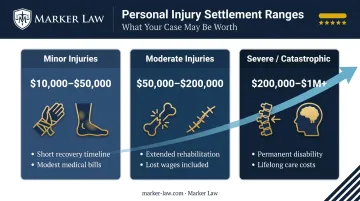
Minor Injury Range: $10,000 – $50,000
These cases typically involve sprains, bruises, and minor fractures that resolve with limited medical care. Key characteristics:
- Short recovery period with no lasting impairment
- Medical bills are relatively modest
- Lost wages are minimal or nonexistent
- Insurers settle more readily because liability is easier to manage
Soft-tissue injuries that heal fully within weeks generally land in this tier, even when the property owner was clearly at fault.
Moderate Injury Range: $50,000 – $200,000
Broken bones, torn ligaments, and head injuries requiring surgery or extended rehabilitation push settlements into this range. What changes:
- Lost wages become a significant component, especially for physically demanding jobs
- Pain and suffering damages increase meaningfully once recovery extends past a few months
- Liability clarity matters — when negligence is well-documented, insurers have less room to argue
A Cook County premises liability case can clear $100,000 when a property owner's failure to address a known hazard is backed by incident reports and witness statements.
Severe and Catastrophic Injury Range: $200,000 – $1,000,000+
Spinal cord injuries, traumatic brain injuries, permanent disability, and injuries requiring lifelong care occupy this tier. Illinois courts have delivered outcomes that reflect this: a Cook County jury ordered ExxonMobil to pay $32 million to a plaintiff who slipped on spilled oil, landed on her hand, and developed complex regional pain syndrome. A 2024 Illinois verdict database entry for Biancalana v. First Arm Invest. Grp. — a premises liability trip-and-fall case — came in at over $18 million.
Verdicts this size are uncommon, but they reflect a pattern: permanent injuries plus clear liability equals maximum insurer exposure.
Trial vs. Settlement: Why Case Preparation Determines Value
Cases that go to trial can produce higher awards, but they take significantly longer. Most slip and fall cases resolve before a verdict. Settlement value reflects what both sides believe a jury would award — so the stronger the liability evidence and damage documentation, the less room an insurer has to push back at the negotiating table.
Key Factors That Affect Your Slip and Fall Settlement Amount
No single variable determines what your case is worth. Settlement value is the product of several overlapping factors.
Severity of Injuries and Medical Costs
Medical expenses set the floor for settlement negotiations. Higher bills — emergency care, surgery, physical therapy, medications, in-home assistance — mean a higher baseline. Future costs carry equal weight.
When an injury is permanent or requires ongoing treatment, medical and economic experts project the full cost of future care — rehabilitation, assistive devices, and long-term needs. Marker Law works with these experts to ensure nothing gets left out of your claim.
A case involving a 45-year-old with a spinal injury and 30 years of projected care costs carries a fundamentally different value than one involving a fully healed ankle sprain.
Strength of Evidence and Proof of Negligence
Illinois premises liability law requires showing the property owner knew or should have known about the hazard and failed to correct it. The strength of that proof directly affects settlement value.
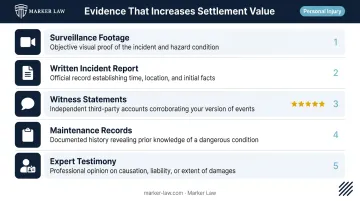
Cases with the following evidence settle for substantially more:
- Surveillance footage showing the hazard existed before your fall
- A written incident report filed at the scene
- Witness statements confirming the dangerous condition
- Maintenance records showing the property owner ignored a known problem
- Expert testimony establishing industry standards for property upkeep
Weak or absent evidence is the single most common reason insurers successfully lowball victims. Adjusters know a case without documentation is hard to prove at trial, and they price their offers accordingly.
Comparative Fault Under Illinois Law
That evidence picture also shapes how fault gets divided. Under 735 ILCS 5/2-1116, Illinois follows modified comparative negligence with a 51% bar. Here's how it works in practice:
- If you're 50% or less at fault, you recover damages reduced by your percentage of fault
- If you're 51% or more at fault, you recover nothing
A concrete example: if a jury finds your claim worth $100,000 but assigns you 25% of the fault, you recover $75,000. If they assign you 55%, you get zero.
Insurers understand this rule well. Pushing victim fault above 50% is a routine defense strategy — which is why what you say at the scene, and what physical evidence exists, matters so much from the very first minutes after a fall.
Impact on Life and Earning Capacity
A hand injury that ends a surgeon's career carries more value than the same injury sustained by someone already retired. Settlements account for how the harm actually changes the victim's life, including:
- Permanent cognitive impairment or physical disability
- Chronic pain affecting daily functioning
- Loss of an active lifestyle or hobbies
- Wheelchair confinement or dependence on others
Age also matters. Younger victims with long-term injuries recover more because the harm persists over a greater portion of their lives.
Available Insurance Coverage
Even a strong case is constrained by the defendant's insurance policy limits or assets. Commercial properties (grocery stores, apartment complexes, shopping centers) typically carry commercial general liability policies, often with $1 million per occurrence limits or higher. Private homeowners generally carry far less, with standard liability limits starting around $100,000.
When the defendant's coverage is inadequate, recovery becomes a practical challenge even when liability is clear.
Types of Damages You Can Claim in an Illinois Slip and Fall Case
Illinois allows recovery of both economic (calculable) and non-economic (subjective) damages. Understanding what each covers explains why two cases with similar injuries can have different settlement values.
Medical Expenses
Covers all verifiable costs, including:
- Emergency room visits and hospitalization
- Surgery, diagnostics, and physical therapy
- Prescription medications and in-home care
- Projected future treatment when injuries are permanent
Complete documentation is what makes this category defensible. Every bill, receipt, explanation of benefits, and treatment note matters — gaps give insurers room to argue costs were unrelated to the fall or medically unnecessary.
Lost Wages and Earning Capacity
Includes income lost during recovery and, if the injury is permanent, the long-term reduction in earning ability. Calculations typically account for:
- Daily earnings × missed workdays
- Career trajectory and anticipated promotions
- Pension contributions affected by early exit from the workforce
Self-employed victims face more complex calculations — there's no W-2 to reference — but the claim is still valid. Tax returns, client invoices, and business records substitute for traditional employment documentation.
Pain and Suffering and Non-Economic Damages
Compensates for physical pain, emotional distress, PTSD, disfigurement, and loss of enjoyment of life. Two negotiation methods are commonly discussed:
- Multiplier method: Total economic damages multiplied by a factor (typically 1.5 to 5) based on injury severity
- Per diem method: A daily dollar value assigned to suffering, multiplied by the number of days affected

Neither is a legally mandated formula in Illinois — both are negotiation tools. Because pain and suffering is subjective, insurers routinely push back hard on these figures — making documentation of how the injury affects daily life critical to maximizing this portion of your claim.
Punitive Damages
Punitive damages are not standard in most slip and fall settlements. Under Loitz v. Remington Arms Co., 138 Ill. 2d 404 (1990), Illinois courts reserve them for cases involving fraud, actual malice, deliberate violence, or conduct showing wanton disregard for others' rights.
That said, if punitive damages are plausibly at issue — for example, a property owner who concealed a known hazard repeatedly — that possibility can push settlement negotiations upward even if punitive damages never reach a jury.
What Illinois Law Says About Slip and Fall Claims
2-Year Statute of Limitations
Under 735 ILCS 5/13-202, personal injury claims must be filed within 2 years of the accident date. Missing this deadline extinguishes your right to compensation permanently.
One critical exception: claims against government entities — a city-owned sidewalk, a public school, a county-operated building — are governed by 745 ILCS 10/8-101, which sets a 1-year deadline to file. Anyone injured on government-owned property should contact an attorney immediately — the shorter window leaves little margin for delay.
No Cap on Non-Economic Damages
Illinois does not have a legal ceiling on pain and suffering awards. The Illinois Supreme Court's decision in Lebron v. Gottlieb Memorial Hospital, 237 Ill. 2d 217 (2010), struck down a noneconomic damages cap as unconstitutional. Under Illinois law, juries — not legislators — determine what a victim's suffering is worth.
For severely injured victims, this means there is no statutory limit on what a jury can award for pain, disfigurement, or loss of enjoyment of life.
Modified Comparative Negligence (51% Bar)
Illinois is stricter than pure comparative negligence states, where victims can recover even if they're 99% at fault. Here, recovery is cut off entirely once you're found 51% or more responsible. Insurers know this rule and routinely use it to minimize payouts.
Solid scene documentation is your direct defense against fault-shifting. At minimum, gather:
- Photos of the hazard and your injuries
- Names and contact info for any witnesses
- A formal incident report from the property owner or manager
- Medical records tied directly to the fall
What Most People Get Wrong That Hurts Their Settlement
Three mistakes consistently reduce — or eliminate — slip and fall settlements. Avoiding them starts the moment you leave the scene.
Skipping or Delaying Medical Treatment
Gaps in treatment are one of an adjuster's favorite arguments: if the injury were serious, why did you wait three weeks to see a doctor? Seeing a physician the same day or within 24 hours creates the medical record that anchors the entire claim. It also establishes causation — connecting the fall directly to your injury, not to something that happened later.
Talking to the Property Owner's Insurer Without an Attorney
Adjusters are trained to ask questions that establish comparative fault or minimize injury severity. Even casual statements — "I'm okay," "I should have been more careful," "I wasn't looking where I was going" — can be used against you. Direct all insurer communication through your attorney from the first contact.
Waiting Too Long to Act
Commercial surveillance footage is overwritten on cycles ranging from 7 to 90 days depending on the system. Hazards get repaired. Witnesses move or forget details. The sooner Marker Law gets involved, the sooner the team can visit the scene, secure footage, pull maintenance records, and lock down witness statements — before that evidence is gone for good.
How to Maximize Your Slip and Fall Settlement in Illinois
These are the actions you control that directly influence your recovery amount.
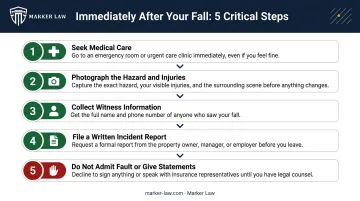
Immediately after the fall:
- Call 911 or seek emergency care — get the injury documented by a medical professional
- Photograph the hazard, your injuries, and the surrounding area before anything changes
- Get names and contact information for any witnesses
- File a written incident report with the property owner or manager and request a copy
- Do not apologize, speculate about fault, or give a recorded statement
During your recovery:
- Keep a daily journal documenting pain levels, activity limitations, missed events, and emotional impact
- Save every medical bill, receipt, and pay stub showing missed work
- Follow your doctor's treatment plan completely — insurers monitor for missed appointments
Why Representation Changes the Outcome
Insurers representing property owners have defense attorneys and experienced adjusters whose job is minimizing payouts. Jason Marker spent three years on the defense side representing insurance carriers before transitioning exclusively to plaintiff work. He knows the playbook: which arguments adjusters use to push fault onto victims, which evidence gaps they exploit, and how they structure lowball offers to appear reasonable.
Marker Law handles slip and fall cases throughout Naperville, DuPage County, Will County, and the broader Chicagoland area on a contingency fee basis. No fee unless compensation is recovered.
Frequently Asked Questions
What is the average personal injury settlement in Illinois?
Illinois personal injury settlements vary too widely for a single average to be meaningful. Severe injury cases regularly settle in the six-to-seven figure range, while minor injury claims may resolve in the low five figures. No publicly available data captures individual case value reliably.
Is there a cap on pain and suffering in Illinois?
No. The Illinois Supreme Court struck down noneconomic damage caps as unconstitutional in 2010. Juries and settlement negotiations are not legally limited in what they can award for pain, suffering, disfigurement, or loss of enjoyment of life.
What is the statute of limitations for a slip and fall in Illinois?
Generally, 2 years from the accident date under 735 ILCS 5/13-202. Claims against government entities may have a 1-year deadline under 745 ILCS 10/8-101. Missing either deadline permanently bars recovery.
How does Illinois's comparative negligence rule affect my settlement?
If you're 50% or less at fault, you recover damages reduced by your fault percentage. At 51% or more, you recover nothing. Insurers routinely argue shared fault to reduce or eliminate payouts — strong scene documentation is your primary defense.
How long does a slip and fall case take to settle in Illinois?
Simple cases can settle in a few months; complex cases involving severe injuries or disputed liability can take several years. Avoid settling before reaching maximum medical improvement, as doing so risks permanently undervaluing future care costs.
Should I talk to the insurance company after a slip and fall?
No — not without an attorney. Anything you say can be used to reduce your claim's value. Direct all insurer communications through legal counsel from the start.