The honest answer: you probably do. But what that case is worth depends on factors that vary dramatically from one victim to the next.
Restaurant slip and fall settlements in Illinois range from roughly $10,000 for minor injuries to well over $1 million for catastrophic harm. A sprained wrist and a traumatic brain injury both qualify as "restaurant slip and falls" — they have almost nothing in common when it comes to settlement value. Understanding what actually drives that range matters far more than chasing an "average" number that doesn't apply to your situation.
TL;DR
- Most settlements fall between $10,000 for minor injuries and $500,000+ for severe or permanent harm — catastrophic cases can reach seven figures
- Injury severity, negligence evidence, and total documented damages are the biggest factors driving settlement value
- Illinois's modified comparative negligence law (735 ILCS 5/2-1116) cuts or eliminates recovery if you're found more than 50% at fault
- First offers rarely cover future medical costs or full pain and suffering — get legal counsel before accepting anything
How Much Are Restaurant Slip and Fall Settlements Worth?
There's no published tier chart that reliably predicts what an Illinois restaurant slip and fall case is worth. Practitioners evaluate cases using venue-specific verdict databases — tools like the Law Bulletin Media Jury Verdict Reporter, which contains over 55,000 Illinois case summaries and has tracked Cook County verdicts since 1959. Those databases show that outcomes depend heavily on injury facts, venue, judge, and the specific damages proved at trial.
What the public record does confirm: the range is enormous, and the severity of your injuries is the single biggest factor driving where your case lands.
What Minor, Moderate, and Severe Cases Typically Look Like
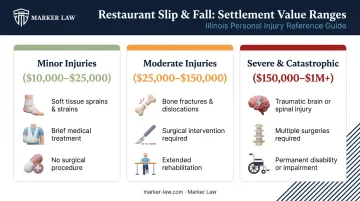
Minor Injuries ($10,000–$25,000)
These cases settle at the lower end when liability is clear but recovery was straightforward:
- Soft tissue injuries, minor sprains, or small lacerations
- Brief treatment with no surgery required
- Minimal or no lost wages
Moderate Injuries ($25,000–$150,000)
Documented disruption to work and daily life pushes values into this range:
- Fractures, dislocations, or injuries requiring surgery
- Physical rehabilitation and meaningful time away from work
- Evidence of how the injury affected everyday activities
Severe and Catastrophic Injuries ($150,000–$1M+)
Permanent injuries with extensive documentation produce the largest settlements:
- Traumatic brain injuries, spinal cord damage, or permanent disability
- Multiple surgeries and long-term care needs
- As a public example: Farah & Farah documented a $1.275 million settlement in a fast-food restaurant fall involving a leaking soda machine, a severe knee injury, and a total knee replacement — the kind of outcome that only follows when injuries are permanent and thoroughly documented.
Not every case settles for anything. In Michael Gassman v. Nano's Pizza, Inc. (Cook County, 2017), a plaintiff who alleged a pizzeria puddle caused a fall and sought $106,035 received a defense verdict — zero recovery — because liability and causation weren't proved. Strong facts on negligence aren't optional.
What Factors Determine Your Restaurant Slip and Fall Settlement Value?
Settlement value sits at the intersection of injury severity, proof of negligence, documented losses, and the legal case built around all three.
Severity and Permanence of the Injury
Injuries requiring surgery, long recoveries, or permanent limitations generate larger economic damages and more compelling non-economic claims. Chronic pain, reduced mobility, and lasting disability reach beyond immediate medical bills into future care costs, earning capacity, and quality of life.
Proof of the Restaurant's Negligence
Illinois's Premises Liability Act (740 ILCS 130) requires that property owners owed to entrants (other than trespassers) reasonable care under the circumstances. For foreign substances, the Illinois Supreme Court's Donoho v. O'Connell's, Inc. (1958) established that liability attaches when the restaurant placed the substance there negligently, had actual notice of it, or when it was present long enough that ordinary care should have discovered it.
Common restaurant hazards that support negligence claims:
- Wet floors from spills or mopping without wet floor signage
- Grease tracked from kitchen areas into dining spaces
- Broken, uneven, or poorly maintained flooring
- Inadequate lighting in walkways or near exits
- Cluttered aisles or obstruction near service areas
Stronger evidence translates directly into settlement leverage. Surveillance footage, employee records showing prior complaints, and maintenance logs all affect how much pressure you can apply during negotiations.
Newsom-Bogan v. Wendy's (Ill. App. 2011) shows how this works in practice: a restaurant's own inspection protocol (required every 15 minutes) became a fact question on constructive notice when no inspection was observed during a 20-minute window before a fall.
Economic and Non-Economic Damages
Economic damages form the objective floor of any settlement:
- All past medical expenses (ER, surgery, rehab, medications, equipment)
- Future medical costs, calculated at present cash value under Illinois Pattern Jury Instruction 30.06
- Lost wages during recovery
- Reduced earning capacity for long-term or permanent injuries
Non-economic damages (pain and suffering, emotional distress, loss of enjoyment of life, disfigurement) are calculated through negotiation using either a multiplier on economic damages or a per diem approach. Illinois courts don't formally endorse either method as a calculation rule (Caley v. Manicke, Ill. 1962); both are negotiation tools, not formulas.
Well-documented non-economic harm, supported by medical records, mental health treatment notes, and personal journals, can substantially increase what insurers will offer to settle.
Illinois Modified Comparative Negligence
Under 735 ILCS 5/2-1116, your fault percentage directly affects what you can recover:
- More than 50% at fault: You recover nothing
- 50% or less at fault: Your damages reduce proportionally to your fault percentage
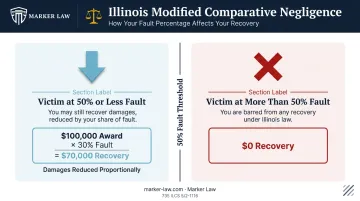
Restaurants and their insurers routinely argue victim fault, pointing to footwear, phone distraction, or a visible wet floor sign, specifically to shift the fault percentage. Every percentage point they move toward you reduces what they owe.
What Damages Are Included in a Restaurant Slip and Fall Settlement?
A settlement should cover all categories of harm. Knowing what qualifies — and documenting it fully — is what separates an adequate offer from a complete one.
Economic (Special) Damages
| Category | What's Included |
|---|---|
| Past medical expenses | ER visits, surgery, rehab, medications, medical equipment |
| Future medical costs | Present cash value of reasonably certain future care |
| Lost wages | All income lost during recovery period |
| Lost earning capacity | Reduced future income if injury prevents returning to prior work |
For severe injuries, Marker Law works with medical and economic experts to build out the full demand: rehabilitation costs, assistive devices, and long-term care projections that insurers routinely undervalue or ignore.
Non-Economic (General) Damages
- Physical pain and suffering (past and future)
- Emotional distress, anxiety, PTSD, or depression
- Loss of enjoyment of life — inability to pursue hobbies or activities you previously could
- Disfigurement or scarring where applicable
Insurance Policy Limits and Multiple Defendants
Available compensation is often constrained by the restaurant's commercial general liability (CGL) policy. In franchise situations — fast food chains, casual dining franchises common throughout the Chicago suburbs — both the franchisee and the corporate franchisor may carry separate policies. Under Illinois Supreme Court Rule 201(b)(2), insurance policy information is discoverable in litigation. Identifying every liable party and every available policy early determines the ceiling on what can actually be recovered.
What Can Reduce Your Settlement — and How to Avoid It
Strong cases get undervalued when victims make predictable, avoidable mistakes in the days after the accident.
Documentation Gaps and Delayed Medical Care
The most common ways claims get damaged early:
- Not reporting the incident to management before leaving — no incident report, no contemporaneous record
- Skipping or delaying medical treatment — gaps between the fall and first treatment give adjusters grounds to argue the fall didn't cause your injuries
- Inconsistent follow-up care — missing appointments suggests the injury isn't as serious as claimed
- No photographs of the hazard before it's cleaned up
Social Media and Recorded Statements
Two traps that catch even cautious claimants:
- Social media monitoring — insurers routinely scan posts for photos or activity that contradict claimed limitations
- Recorded statements to the restaurant's insurer — you have no obligation to give one, and doing so without counsel can inadvertently minimize injury severity or admit partial fault
Pre-Existing Conditions and Comparative Fault
Insurers routinely attribute injuries to prior conditions rather than the fall. The counter is thorough medical documentation that clearly distinguishes what existed before from what the fall caused or aggravated.
Under Illinois law, aggravating a pre-existing condition is compensable, but proving it requires the right medical evidence from the start. Jason Marker's years on the defense side taught him exactly how carriers build these arguments — which means he builds cases that anticipate and neutralize them.
How to Maximize Your Restaurant Slip and Fall Settlement
What you do in the first hours and weeks after the fall shapes everything that follows.
Act Immediately at the Scene
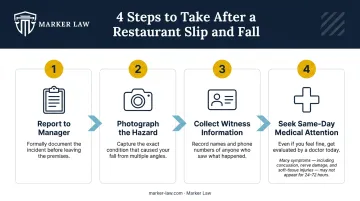
- Report the incident to the restaurant manager and ask for a written incident report before you leave
- Photograph the hazard — the wet floor, missing sign, broken tile, or whatever caused the fall
- Collect witness information — names and phone numbers from anyone who saw what happened
- Seek medical attention the same day — even if symptoms seem minor; TBIs and soft tissue injuries often manifest over 24–72 hours
Build a Complete Evidence Record
- Restaurants' surveillance systems overwrite on varying schedules — preservation letters should go out as soon as possible
- Gather all medical records and bills from every provider, including follow-up care
- Keep a personal injury journal documenting daily pain levels and limitations
- Save employment records — pay stubs, employer letters, documentation of missed work
Marker Law moves quickly on evidence preservation: the firm visits scenes, secures witness statements, and pulls maintenance records before the evidence disappears. Illinois recognizes negligent spoliation under ordinary negligence principles (Boyd v. Travelers, Ill. 1995), and preservation letters establish notice on the record.
Do Not Accept the First Settlement Offer
Early offers from insurance companies almost never include:
- Future medical costs
- Long-term lost wages
- Full pain and suffering
Once you accept a settlement, all future claims are closed — permanently. Unrepresented claimants are especially vulnerable to lowball initial offers because adjusters know they lack the legal knowledge to calculate full damages or threaten credible litigation.
Work With an Attorney Who Understands How the Other Side Thinks
Jason Marker began his career clerking in the City of Chicago's Torts Division, then spent three years on the defense side representing employers and insurance carriers before switching exclusively to plaintiff work. His words: "I learned their playbook. I quickly changed paths to represent injured victims, my true passion, which I have been doing ever since."
That defense background shapes how Marker Law builds restaurant slip and fall cases. Adjusters follow a recognizable playbook: dispute injury severity, push early settlement, build comparative fault arguments, monitor social media. Knowing those moves before they're deployed changes how a case is structured and how demands are positioned from day one.

Marker Law handles cases throughout DuPage, Cook, Will, Kane, and Kendall counties on a contingency fee basis — no upfront costs, no attorney fee unless compensation is recovered. Initial consultations are free.
Frequently Asked Questions
What is the average settlement for a slip and fall lawsuit at a restaurant?
Settlement amounts vary significantly — roughly $10,000 for minor injuries with quick recovery to well over $1 million for catastrophic or permanent harm. The "average" matters less than your specific injury severity, negligence evidence, and documented damages combined.
How long do I have to file a slip and fall claim against a restaurant in Illinois?
Illinois generally allows two years from the date of injury to file a personal injury lawsuit under 735 ILCS 5/13-202. Waiting risks losing all rights to compensation and allows critical evidence — including surveillance footage — to disappear well before the deadline arrives.
Can I still recover compensation if I was partially at fault?
Yes, if your fault is 50% or less. Illinois's modified comparative negligence rule reduces your damages proportionally to your fault percentage. If you're found more than 50% at fault, you recover nothing — which is why insurers work hard to inflate the victim's fault percentage.
What evidence do I need to prove a restaurant was negligent?
Core evidence includes photos of the hazard, an incident report, witness statements, and medical records connecting the fall to your injuries. An attorney can also subpoena maintenance logs and employee records showing prior notice of the hazard — often the strongest proof of negligence.
How long does a restaurant slip and fall settlement typically take?
Most cases resolve within several months to a year. Complex cases — disputed liability, severe injuries, or multiple defendants — can take longer. Building a thorough case before sending the demand letter is the clearest path to avoiding trial.
Do I need a lawyer to settle a restaurant slip and fall claim in Illinois?
Unrepresented claimants consistently receive lower offers because they can't accurately calculate full damages, push back against adjuster tactics, or credibly threaten litigation. Most personal injury attorneys serving the Chicagoland area, including Marker Law, work on a contingency basis — meaning there's no upfront cost and no fee unless you recover.