A contingency fee arrangement changes that. Under this structure, the attorney only gets paid if they recover compensation — no hourly billing, no retainers, no upfront costs. If the case fails, the attorney earns nothing.
This guide is written for Illinois families navigating the aftermath of a wrongful death. It covers how contingency fees work step by step, what factors shape the percentage, how attorney fees differ from case costs, and which misconceptions to avoid before signing anything.
TL;DR
- Illinois wrongful death attorneys work on contingency — no recovery means no attorney fees
- Fees are a percentage of what's recovered; the exact rate depends on case complexity and how far litigation progresses
- Attorney fees and case costs are separate line items, and the order they're deducted from your settlement affects your net payout
- Under Illinois Rule 1.5, the fee percentage, cost treatment, and expense responsibility must all appear in a written, signed agreement
- A free consultation is the clearest way to understand which fee structure applies to your case
What Is a Wrongful Death Attorney Contingency Fee?
A contingency fee is a payment arrangement where the attorney earns compensation only if they recover money for the client. Instead of billing by the hour, the lawyer takes a pre-agreed percentage of the final settlement or court award — with no fee owed if the case doesn't result in recovery.
Families dealing with funeral arrangements, lost household income, and medical debt shouldn't have to choose between paying rent and hiring a lawyer. The contingency model makes legal representation accessible regardless of financial circumstances.
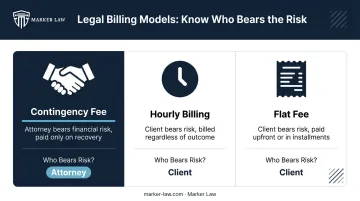
How It Differs From Other Billing Models
| Billing Model | Who Bears Financial Risk | Payment Trigger |
|---|---|---|
| Contingency fee | Attorney | Only if compensation is recovered |
| Hourly billing | Client | Billed regardless of outcome |
| Flat fee | Client | Paid upfront or in installments |
In wrongful death cases, hourly billing is out of reach for most families. A contested liability case can involve hundreds of attorney hours before a resolution. The contingency model shifts that financial risk entirely onto the lawyer. They invest their time and resources with no guarantee of payment.
According to ABA public guidance, contingent fees are primarily used in personal injury cases and often involve a fixed percentage of the recovery. This is the standard billing model for plaintiff-side injury litigation across the country.
Why Wrongful Death Cases Use Contingency Fees
The financial pressure following a wrongful death is immediate and substantial. The NFDA reports that the 2023 national median cost of a funeral with viewing and burial was $8,300, with cremation running $6,280. That's before accounting for lost wages or any outstanding medical bills from the final hospitalization.
Requiring families to also pay attorney fees upfront — potentially thousands of dollars before a single deposition is taken — would make legal representation impossible for most people.
What Wrongful Death Litigation Actually Costs to Run
Running a wrongful death case requires significant out-of-pocket investment. Attorneys pursuing these claims routinely advance:
- Court filing fees and jury demand fees
- Expert witness fees (accident reconstruction, medical professionals, economists)
- Court reporter and deposition transcript costs
- Medical records retrieval
- Investigation and evidence gathering expenses
Under a contingency arrangement, the attorney fronts all of these costs. Families pay nothing during the active case. The attorney recoups those expenses only if the case resolves successfully.
The Governing Rule in Illinois
Illinois Rule of Professional Conduct 1.5 controls how contingency fees must be structured and disclosed. Rule 1.5(a) bars unreasonable fees and unreasonable expenses; Rule 1.5(d)(2) requires the contingency fee agreement to be in writing and signed by the client.
The Illinois Wrongful Death Act (740 ILCS 180) governs the civil claim itself but does not set a specific attorney fee percentage cap for ordinary wrongful death cases — fees are governed by the Rule 1.5 reasonableness standard.
Illinois medical malpractice cases operate under a separate fee-cap statute (735 ILCS 5/2-1114). Standard wrongful death claims arising from car accidents, truck accidents, construction fatalities, and workplace deaths are not subject to that cap.
How the Contingency Fee Structure Works, Step by Step
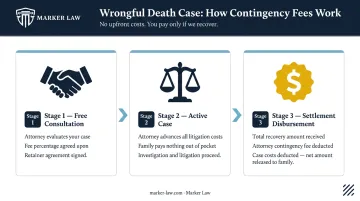
The process begins at the free consultation and ends when settlement funds are disbursed. No money changes hands at any point during the case.
Step 1: The Free Consultation and Case Evaluation
The first meeting costs nothing. The attorney evaluates:
- Whether the facts support a viable wrongful death claim
- Who the liable parties are and how strong the evidence is
- Whether the case is appropriate to pursue on contingency
- What fee percentage would apply and why
At Marker Law, attorney Jason Marker provides direct access from the first conversation — clients aren't handed off to staff. His 25-year litigation background, including three years spent on the defense side representing insurance carriers, means he evaluates cases with a clear understanding of how the opposition will respond.
Step 2: Signing the Contingency Fee Agreement
Illinois Rule 1.5(d)(2) requires this agreement to be in writing and signed by the client. The document must specifically state:
- The percentage the attorney earns at settlement, trial, or appeal
- All litigation expenses to be deducted from the recovery
- Whether expenses are deducted before or after the attorney fee is calculated
- What the client owes for expenses if the case is unsuccessful
Read this document carefully before signing. The difference between "costs deducted before fee calculation" and "costs deducted after" meaningfully affects how much money you take home (more on this below). Ask questions about anything unclear — a reputable attorney will welcome them.
Step 3: Case Investigation, Filing, and Resolution
During the active case, the family pays nothing. The attorney invests time and advances all costs. Once the case resolves (through settlement or verdict), the attorney prepares a written disbursement statement showing:
- The total recovery amount
- The attorney fee deduction (the agreed percentage)
- Itemized case cost deductions
- The net amount the family receives
Illinois Rule 1.5 requires this final accounting in writing. The client reviews and approves the disbursement before any funds are released — funds are held in a separate client trust account under Illinois Rule 1.15 until that approval is given.
What Factors Affect the Contingency Fee Percentage?
ABA guidance states that contingent fees in personal injury cases are often around one-third of the recovery. ISBA ethics opinions use a 33% figure as a standard hypothetical. In practice, percentages vary and must be reasonable under Rule 1.5(a) — the rule lists specific factors for evaluating reasonableness, including:
- Time and labor required
- Novelty and difficulty of the issues
- Skill required to handle the case properly
- Customary fee in the local legal community
- Amount involved and results obtained
- Attorney experience, reputation, and ability
- Whether the fee is fixed or contingent
Here's how those factors translate in real wrongful death cases:
Case complexity — A car accident wrongful death where liability is clear involves far less litigation investment than a product liability or construction fatality claim requiring multiple expert disciplines.
Liability clarity — Disputed fault means more investigation, more depositions, and more preparation. That increased attorney risk is sometimes reflected in the percentage.
Stage of resolution — Illinois Rule 1.5(d)(2) requires disclosure of separate percentages for settlement, trial, and appeal. Cases that resolve before a lawsuit is filed carry less attorney investment than cases that go through full trial preparation. Most agreements set a lower percentage for pre-lawsuit settlement and a higher one if the case proceeds to trial.
Resources required — Wrongful death claims against corporations, municipalities, or institutions with aggressive legal defense teams require significant upfront investment in experts, depositions, and discovery. The attorney carries that risk.
Attorney experience — Jason Marker holds an AV Preeminent rating from Martindale-Hubbell (the highest peer rating for legal ability and ethical standards) and has been recognized by Super Lawyers for over a decade. An attorney with that track record and 25+ years of litigation experience may charge a percentage toward the higher end of the range.
What matters most is net recovery. A higher percentage on a larger settlement produces a better outcome for the family than a lower percentage on a smaller one.
Attorney Fees vs. Case Costs: A Critical Distinction
Attorney fees and case costs are not the same thing — and the difference directly affects how much your family takes home. Many families sign fee agreements without understanding this distinction, which can lead to surprises at settlement.
Attorney fees = the lawyer's percentage of the recovery for their legal work Case costs = the actual out-of-pocket expenses incurred to build and litigate the case
Common case costs in wrongful death claims include:
- Court filing fees
- Deposition and court reporter fees
- Expert witness fees
- Medical records retrieval
- Investigation costs
Why the Order of Deduction Matters
The sequence in which costs are deducted affects the family's net payout. Here's a concrete example using a $500,000 settlement with $20,000 in case costs and a 33% attorney fee:
| Deduction Order | Calculation | Net to Family |
|---|---|---|
| Costs deducted before fee | Fee = 33% × $480,000 = $158,400. Net = $500K − $158,400 − $20K | $321,600 |
| Costs deducted after fee | Fee = 33% × $500,000 = $165,000. Net = $500K − $165,000 − $20K | $315,000 |
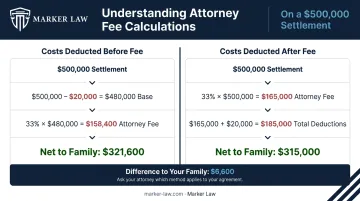
The difference is $6,600 — real money for a grieving family.
Illinois Rule 1.5(d)(2) requires the fee agreement to state which method applies. Before signing, get clear answers to these two questions:
- Are case costs deducted before or after your fee percentage is calculated?
- If the case is unsuccessful, who is responsible for costs already incurred?
If either answer isn't in writing, ask for the agreement to be revised before you sign.
Common Misconceptions About Wrongful Death Contingency Fees
"The Attorney Takes Most of the Money"
The percentage sounds large in isolation. What it doesn't capture is that the attorney invested potentially years of time, advanced all costs, and took on complete financial risk with no guarantee of payment. An experienced attorney also typically recovers substantially more than a family negotiating alone against insurance adjusters who do this professionally every day.
The relevant comparison isn't fee versus no fee — it's net recovery with counsel versus whatever the insurance company's first offer was.
"All Contingency Fee Arrangements Are the Same"
They aren't. Fee percentages, how costs are handled, tiered trial percentages, and expense responsibility in unsuccessful cases all vary by firm. A lower percentage on paper means nothing if the attorney lacks the trial experience or resources to actually take the case to court. Insurance adjusters settle higher when they know opposing counsel will actually try the case.
"A Contingency Arrangement Pushes Attorneys Toward Quick Settlements"
The opposite is true when the agreement is structured correctly. The attorney earns a percentage of the recovery — a larger recovery produces a larger fee. That alignment of interests motivates pursuing maximum compensation, not the fastest exit.
If the case is unsuccessful, the attorney collects nothing. The only path to payment is winning, which is exactly why a well-structured contingency arrangement works in the family's favor.
Frequently Asked Questions
What is a typical contingency fee percentage?
In wrongful death and personal injury cases, contingency fees are often around one-third of the recovery per ABA guidance, with percentages varying based on case complexity and litigation stage. Illinois has no fixed statutory cap for ordinary wrongful death cases, but fees must be reasonable under Rule 1.5 and disclosed in a written agreement.
What is the 80/20 rule for lawyers?
The 80/20 rule in legal contexts refers to the Pareto Principle: roughly 80% of case value comes from 20% of the legal work. For clients, this means an experienced attorney who identifies the right evidence, experts, and negotiation leverage matters far more than one who simply logs hours.
What two types of cases cannot be taken on a contingency basis?
Under Illinois Rule 1.5(e), contingency fees are prohibited in criminal defense cases and domestic relations matters where payment is contingent on securing a divorce or on the amount of support or property settlement. Wrongful death civil claims are not restricted and are among the most common case types handled on contingency.
Do I owe attorney fees if my wrongful death case is not successful?
Under a standard contingency agreement, no attorney fees are owed if there is no recovery. How case costs are handled in that scenario — whether the attorney absorbs them or the client remains responsible — varies by firm and must be confirmed in writing before you sign anything.
How are case costs different from attorney fees in a wrongful death claim?
Attorney fees are the percentage of the recovery the lawyer earns for their legal work. Case costs are separate out-of-pocket expenses to investigate and litigate the claim, such as filing fees, depositions, and expert witnesses. Both are typically deducted from the final settlement and should each be clearly identified in the fee agreement.
Does the contingency fee percentage change if my wrongful death case goes to trial?
Most attorneys charge a higher percentage if the case proceeds to trial, reflecting the significant increase in preparation time, court appearances, and resources required. Illinois Rule 1.5(d)(2) requires the fee agreement to disclose separate percentages for settlement, trial, and appeal — all of which should be confirmed in writing before the case begins.
Marker Law handles wrongful death cases throughout DuPage, Will, Cook, Kane, and Kendall counties on a contingency fee basis — no upfront costs, no fees unless compensation is recovered. To discuss your case and understand exactly what fee structure would apply, contact Marker Law for a free consultation at 331-295-8005.