
The reality is different. Most dog bite attorneys in Illinois work on a contingency fee basis, which means no upfront cost and no fee unless money is recovered. But the percentage, what it covers, and what gets deducted separately are details few victims understand before signing anything.
This article breaks down exactly how contingency fees work in Illinois dog bite cases, what percentage range to expect, how case expenses differ from attorney fees, and what your net recovery actually looks like after everything is deducted.
TL;DR
- Contingency fees for Illinois dog bite cases typically range from 33% to 40% of the settlement or award — nothing is owed if the case is unsuccessful
- Attorney fees and case expenses are two separate deductions from your settlement
- The fee percentage often increases if the case goes to trial rather than settling early
- Illinois's strict liability law (510 ILCS 5/16) holds dog owners liable regardless of prior bite history, simplifying how fault is established
- Victims who hire an attorney typically recover more money than those who negotiate directly with insurers, even after fees are deducted
What Is a Dog Bite Attorney Contingency Fee?
A contingency fee is a payment arrangement where the attorney earns nothing unless the client receives a settlement or court award. The fee is a pre-agreed percentage of that recovery — not an hourly charge, not a retainer.
This arrangement is formalized in a written representation agreement signed at the start of the case. Under Illinois Rule of Professional Conduct 1.5, that agreement must clearly state:
- The percentage that applies at settlement, trial, or appeal
- Which expenses will be deducted from the recovery
- Whether expenses are deducted before or after the fee is calculated
- Any expenses the client owes regardless of outcome
The same rule prohibits unreasonable fees and requires the attorney to provide a written closing statement at the end of the matter — showing the outcome, the client's net payment, and exactly how it was calculated.
Dog bite victims get access to experienced legal representation without any financial risk upfront. Because the attorney only gets paid when the client does, their incentive is directly tied to maximizing the recovery.
What Do Dog Bite Attorney Contingency Fees Cost?
There's no single fixed percentage. Fees vary based on case complexity, how far the case progresses, and the attorney's fee structure. That said, a predictable range exists in practice.
Pre-Settlement (Early Resolution)
Cases resolved through direct negotiation with the insurance company — before a formal lawsuit is filed — typically carry a lower contingency fee. The ABA's public guidance describes contingency fees as "often one-third to 40 percent," with the lower end applying to pre-litigation settlements.
For dog bite claims, around 33% is a common pre-suit benchmark. Cases with clear liability — an identified dog owner, witnesses, documented injuries, and available homeowner's insurance — are more likely to settle at this stage, which means lower fees and faster recovery.
If Litigation Is Required
Filing a formal lawsuit changes the economics. Once the case enters discovery, depositions begin, or trial preparation starts, the attorney's time and risk increase significantly. Fees at this stage commonly reach 40% or more.
Before signing any agreement, confirm how your fee structure is organized. Key milestones that commonly trigger escalation include:
- Filing the formal complaint and entering litigation
- Beginning depositions or formal discovery
- Proceeding to trial preparation or trial itself
Jason Marker spent three years on the defense side before representing injury victims — which means he understands how insurers calculate risk and exposure at each of these stages. That context informs how Marker Law structures its contingency agreements for dog bite clients across Naperville and the Chicagoland area.
Attorney Fees vs. Case Expenses: Two Different Costs
This is the distinction most victims miss. The contingency fee covers the attorney's professional services. Case expenses (the hard costs of building and filing the claim) are a separate line item, also deducted from the settlement.
Marker Law advances case expenses on behalf of clients throughout the process. No money comes out of pocket during the case. At settlement, those advances are repaid from the proceeds before the client receives their portion.
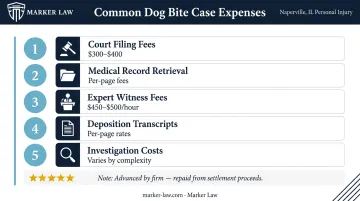
Common case expenses in a dog bite claim include:
- Court filing fees — ranging from roughly $300–$400 in Cook, DuPage, and Will County courts for personal injury matters
- Medical record retrieval — Illinois law allows providers to charge per-page fees, so records from multiple treatment facilities add up
- Expert witness fees — medical professionals to address injury severity and future care needs; potentially animal behavior specialists to establish the owner's knowledge of the dog's dangerous tendencies. National data from a 2024 SEAK expert witness fee survey puts median file-review fees at $450/hour and deposition testimony at $500/hour
- Deposition transcript costs — court reporter fees, with transcript rates running several dollars per page depending on turnaround time
- Gathering witness statements and retrieving animal control records (investigation costs that vary by case complexity)
Those expenses only matter if the case resolves in your favor — but what happens if it doesn't? At Marker Law, advanced costs are absorbed if there's no recovery. Not every firm operates this way. The representation agreement must explicitly address what happens to advanced expenses if there is no recovery. Read that clause carefully before signing.
Key Factors That Affect Your Contingency Fee Percentage
Case Complexity and Liability Clarity
Straightforward cases resolve faster and cheaper. When there's an identified dog owner, witnesses, documented injuries, and an active homeowner's insurance policy, the case is more likely to settle pre-suit at the lower fee tier.
Disputed liability, severe injuries requiring expert testimony, or an uninsured owner all push the case toward litigation — and push the fee percentage higher.
Attorney Experience
Attorneys with deep dog bite litigation experience and knowledge of insurer tactics may charge at the higher end of the range. A 35% fee with a $150,000 settlement yields more than a 33% fee with a $90,000 settlement. What matters is total net recovery, not just the percentage.
Jason Marker spent three years on the defense side representing insurance carriers before transitioning to representing injury victims exclusively. That background gives him direct insight into how insurers evaluate claims and where they're likely to undervalue them — particularly with unrepresented claimants.
Illinois Strict Liability
Illinois follows strict liability for dog bites under 510 ILCS 5/16. Dog owners are liable for attacks regardless of whether the dog has bitten anyone before — there's no "one free bite" protection here.
To establish liability, a victim must show:
- The defendant owned the animal
- The animal caused the injury
- The victim was not provoking the dog
- The victim was behaving peaceably in a location where they had a legal right to be
This shifts the legal burden compared to "one bite rule" states and can simplify the liability argument — potentially reducing the work required to build the case.
How Settlement Disbursement Works
Once a settlement is reached, the gross amount is deposited into the attorney's escrow account. Disbursement follows a set sequence:
- Attorney contingency fee is deducted first (the agreed percentage of gross recovery)
- Case expenses are reimbursed (all costs advanced by the firm)
- Medical liens are resolved — amounts owed to health insurers or providers who covered treatment. Illinois law caps total health care liens at 40% of the recovery under the Health Care Services Lien Act
- Net balance is disbursed to the client
A simplified example:
| Item | Amount |
|---|---|
| Gross settlement | $75,000 |
| Attorney fee (33%) | −$24,750 |
| Case expenses | −$5,000 |
| Medical lien | −$8,000 |
| Client net recovery | $37,250 |
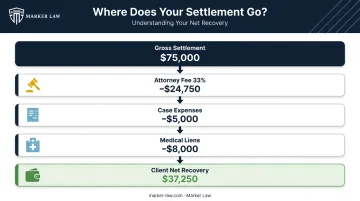
Your attorney must provide a written closing statement at the end of the case showing every line item — so you always know exactly where the money went.
Insurers routinely offer low initial settlements to unrepresented claimants who don't know the full value of their claim. According to 2024 national insurance data from the NAIC, U.S. insurers paid an average of roughly $69,000 per dog-related injury claim. That average includes claims where attorneys pushed back on the initial offer. Unrepresented claimants rarely see numbers close to that figure.
What Most People Get Wrong About Dog Bite Legal Costs
Most dog bite victims focus on the wrong things when evaluating legal costs. Here are the three mistakes that most often lead to regret.
Focusing only on the contingency percentage
A 33% fee with uncapped or poorly managed case expenses may ultimately cost more than a 35% fee with disciplined cost control. Ask your attorney how expenses are estimated and managed throughout the case — not just what the percentage is.
Assuming faster always means better
Settling before the full extent of injuries is documented — future medical needs, scarring, long-term care, lost earning capacity — can leave significant money on the table. The legal costs saved by a quick settlement are often far less than the compensation you're giving up by closing too soon.
Understanding when to settle leads directly to the next question: are you working with the right attorney in the first place?
Not asking the right questions before signing
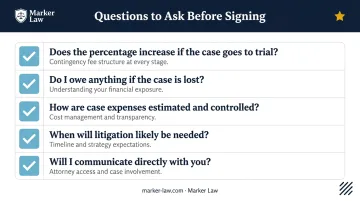
Before agreeing to representation, ask:
- Does the percentage increase if the case goes to trial?
- Do I owe anything if the case is lost, including case expenses?
- How are case expenses estimated and controlled?
- When will you have a clearer sense of whether litigation will be needed?
- Will I communicate directly with you, or primarily with staff?
Frequently Asked Questions
What percentage do most lawyers take as a contingency fee?
Most personal injury attorneys handling dog bite cases charge between 33% and 40%. The lower end typically applies to cases that settle before a lawsuit is filed; the higher end applies when litigation or trial preparation is required.
What is the average lawsuit settlement for a dog bite?
Settlement amounts vary widely based on injury severity, medical costs, lost wages, and liability. National insurance data shows the average dog-related injury claim paid by U.S. insurers runs around $69,000, though cases involving severe injuries, disfigurement, or nerve damage often result in substantially higher awards.
Do I owe attorney fees if my dog bite case is unsuccessful?
Under a true contingency fee arrangement, no attorney fee is owed if there's no recovery. However, confirm whether advanced case expenses (court costs, expert fees) are absorbed by the firm or remain your responsibility if the case is lost, as this varies by firm and should be spelled out in the representation agreement.
What is the difference between attorney fees and case expenses in a dog bite claim?
Attorney fees are the contingency percentage of the final recovery, covering the lawyer's time and expertise. Case expenses are separate out-of-pocket costs (filing fees, expert witnesses, medical records) that the firm advances and recoups from the settlement proceeds.
Does Illinois have strict liability for dog bites?
Yes. Under 510 ILCS 5/16, a dog owner can be held liable for a bite even if the dog had no prior history of aggression. This generally makes it easier to establish liability compared to "one bite rule" states, where prior dangerous behavior must typically be proven.
When does a dog bite attorney's contingency fee percentage increase?
Most fee agreements include escalating percentages tied to case milestones — a lower rate if the case settles before a lawsuit is filed, and a higher rate once litigation begins or the case proceeds to trial. This structure should be clearly outlined in the representation agreement before you sign.