
That fear stops a lot of motorcycle accident victims from getting help they're legally entitled to. According to the Legal Services Corporation's 2022 Justice Gap Report, 46% of low-income Americans who didn't seek legal help for civil problems cited cost concerns as the reason.
Here's what most riders don't know: motorcycle accident attorneys in Illinois work on a contingency fee basis. No upfront fees. No hourly billing. Nothing owed unless you recover compensation.
But "contingency fee" isn't one number — and the details of how fees and expenses are structured directly affect what you actually take home. This guide breaks down the fee ranges, what drives percentages up or down, how case expenses factor in, and how to calculate your real net recovery before agreeing to anything.
TL;DR
- Motorcycle accident attorneys typically charge 33%–40% of your recovery — no hourly billing, nothing upfront
- Pre-suit settlements generally land at ~33%; cases requiring litigation push toward 35%–40%
- Case expenses are separate from the attorney's fee and are also deducted from your settlement
- When expenses are deducted — before or after the fee percentage — can meaningfully shift your take-home amount
- No recovery = no attorney fee, period
How Much Does It Cost to Hire a Motorcycle Accident Attorney?
There is no flat fee and no hourly rate for motorcycle accident cases. The attorney's payment is tied entirely to your outcome — if you don't recover, they don't get paid.
Two things commonly go wrong when riders misunderstand this. First, they avoid hiring a lawyer altogether and accept a low insurance settlement. Second, they're surprised when case expenses reduce their take-home amount more than expected, because those costs are separate from the attorney's contingency fee and the deduction order matters.
Pre-Suit Settlement (~33%)
If your case resolves through insurance negotiations before a formal lawsuit is filed, most motorcycle accident attorneys charge approximately one-third of the total recovery.
This is the most common outcome for straightforward cases: fault is reasonably clear, injuries are well-documented, and the insurer makes an offer without requiring courtroom litigation. According to Bureau of Justice Statistics data, the majority of tort cases end in agreed settlement rather than trial verdict (though that figure dates to the early 1990s and should be read as general context).
Illinois Rule of Professional Conduct 1.5 doesn't mandate a fixed percentage. It requires that fees be reasonable and that the agreement be in writing, signed by the client.
Post-Filing / Litigation (35%–40%)
Once a lawsuit is formally filed, the fee percentage rises to reflect the substantially greater time, resources, and legal risk involved in taking a case to court. This is standard practice across plaintiff-side personal injury work.
Cases reach this stage when:
- The insurer disputes who was at fault
- The settlement offer is unreasonably low relative to your injuries
- Injuries are severe enough that expert testimony is needed to establish full damages
Appeals (~Additional 5%)
If a case is appealed after a verdict, many attorneys charge an additional percentage, often around 5%, for the extensive appellate briefing work involved. This is relatively uncommon, but worth confirming in your fee agreement before signing.
Key Factors That Affect Your Contingency Fee Percentage
The final percentage isn't determined by the size of your injury alone. It reflects the legal risk, complexity, and resources required to build a winning case.
Case Complexity and Disputed Liability
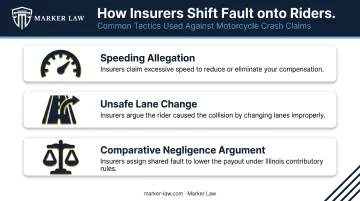
According to IIHS 2023 fatality data, 65% of motorcyclist deaths occurred in multiple-vehicle crashes — and in many of those crashes, insurers look for ways to shift fault onto the rider.
When an insurer argues the rider was speeding, changing lanes unsafely, or otherwise contributed to the crash, the attorney must invest significantly more resources to prove negligence. That investigative work — crash evidence, witness accounts, reconstruction experts — justifies a larger expense budget and sometimes a higher fee percentage.
Severity and Type of Injuries
Cases involving traumatic brain injury, spinal cord damage, or amputation require medical experts and life care planners to establish future damages. Those expert fees — covering ongoing care projections, lost earning capacity, and diminished quality of life — add up quickly and push total case expenses higher.
Straightforward fracture cases resolved without expert testimony typically land at the lower end of the fee range.
Number of Liable Parties
Claims involving multiple defendants become multi-track litigation fast. Common examples include:
- Another driver whose negligence caused the crash
- A vehicle manufacturer with a defective component
- A government entity responsible for dangerous road conditions
Each defendant brings separate counsel, separate insurance coverage, and separate legal arguments. More parties means more attorney time, more depositions, and more expense.
Attorney Experience and Track Record
An experienced attorney with a credible trial record typically charges within the standard 33%–40% range and delivers higher settlement values. Clients frequently net more after the fee than they would have recovered with a less experienced attorney charging less.
Jason Marker's 25+ years of Chicagoland litigation experience includes three years on the defense side, representing insurers before switching entirely to plaintiff advocacy. That background means he knows exactly how insurance companies evaluate motorcycle claims — and where they typically undervalue them. That insider knowledge consistently creates leverage during negotiations that generic plaintiff attorneys simply don't have.
Whether the Case Settles or Goes to Trial
The stage at which your case resolves directly determines your fee percentage. An experienced attorney who prepares every case as though it will go to trial — gathering the right evidence, securing expert opinions early — creates the kind of leverage that pushes insurers toward reasonable settlements without requiring formal litigation.
Attorney Fees vs. Case Expenses: Understanding the Full Cost
These are two separate line items, and mixing them up is one of the most common sources of surprise when a settlement is reached.
- Attorney's contingency fee = payment for legal work, calculated as a percentage of recovery
- Case expenses = out-of-pocket costs required to build and present your case
Both are deducted from your settlement. But they work differently, and the order of deductions changes your net recovery.
Common Case Expenses
Reputable firms advance these costs so clients never pay out of pocket during the case:
- Court filing fees: typically a few hundred dollars to initiate a lawsuit
- Medical record retrieval: hospitals and providers charge per-page fees; complex cases involve multiple facilities
- Expert witness fees: accident reconstruction specialists, treating physicians, vocational experts, and life care planners can each cost thousands
- Deposition and court reporter fees: required to preserve witness testimony formally
- Investigation costs: scene documentation, police reports, surveillance footage retrieval
Pre-suit cases typically involve modest expenses — mainly medical records and basic investigation. Cases that proceed to trial can involve substantially more, given the expert witness fees and deposition costs that contested litigation requires.
Knowing what expenses to expect is only half the picture. How they're deducted from your settlement affects your net recovery just as much.
The Order of Deductions Matters
Illinois Rule 1.5 requires that fee agreements state whether expenses are deducted before or after the contingency percentage is applied. The difference is real money.
Using a $100,000 settlement with a 33% fee and $5,000 in expenses:
| Method | Calculation | Client Net |
|---|---|---|
| Expenses deducted first | ($100,000 − $5,000) × 33% = $31,350 fee | $63,650 |
| Expenses deducted after | $100,000 × 33% = $33,000 fee, then − $5,000 | $62,000 |

That's a $1,650 difference on a relatively simple case. On a complex case with $25,000+ in trial expenses, the gap widens considerably. Always ask which method your fee agreement uses before signing.
How to Calculate What You'll Actually Take Home After Settlement
The headline settlement number isn't your paycheck. Your net recovery — after fees, expenses, and any medical liens — is what matters.
Sample Net Recovery: $50,000 Settlement
Here's how a hypothetical $50,000 settlement breaks down with a 33% fee, $3,000 in case expenses, and a medical lien:
| Deduction | Amount |
|---|---|
| Gross Settlement | $50,000 |
| Attorney's fee (33%) | − $16,500 |
| Case expenses | − $3,000 |
| Medical lien (example) | − $5,000 |
| Client Net Recovery | $25,500 |
Keep these factors in mind:
- Medical liens are governed by the Illinois Health Care Services Lien Act, which caps total health-care liens at 40% of the recovery
- Lien negotiation can meaningfully increase your net payout — reducing a $10,000 lien to $6,000 puts an extra $4,000 in your pocket
- The exact deduction order follows whatever your written fee agreement specifies
When Going to Trial Might Net You More — or Less
A trial verdict can be substantially higher than a settlement offer. But the higher fee percentage (potentially 40%) and significantly larger case expenses can narrow that advantage.
Before you decide whether to accept a settlement or push forward, an experienced attorney should walk you through this math — comparing projected net recovery under each scenario so you can make an informed decision.
Common Mistakes Injured Riders Make When Evaluating Attorney Fees
Most riders focus on one number: the contingency percentage. That's understandable — but it's only part of the picture. Three mistakes come up repeatedly when injured riders evaluate attorney fees.
Mistake 1: Focusing only on the percentage, not the expenses. A firm charging 33% but advancing $20,000 in litigation costs on a complex case can leave you with less than you expected. Always ask how expenses are handled — and who absorbs them if the case is lost.
Mistake 2: Assuming the lowest fee percentage is the best deal. Consider this scenario: Attorney A charges 30% and settles your case for $60,000. Attorney B charges 33% and settles for $90,000. After fees, you net $42,000 with Attorney A and $60,300 with Attorney B. The "cheaper" attorney cost you $18,000. Trial credibility and negotiating leverage affect settlement values — sometimes by tens of thousands of dollars.
Mistake 3: Not confirming what happens to expenses if you lose. Most reputable contingency firms absorb advanced case costs if they don't recover compensation for you. But not all do. Illinois Rule 1.8 permits — but does not require — attorneys to advance costs contingent on outcome. Get this confirmed in writing before signing anything.

Conclusion
Motorcycle accident attorney fees in Illinois work on a contingency basis — no upfront cost, no hourly billing, and no fee if there's no recovery. But how those fees and expenses are structured in your specific agreement directly affects what you walk away with.
That makes it worth having a direct conversation before signing anything. Riders in Naperville, Aurora, Wheaton, and throughout the Chicagoland area can contact Marker Law for a free consultation. With 25+ years of litigation experience on both sides of injury cases, Jason Marker can walk you through the fee structure, expense handling, and what a realistic net recovery looks like — before any agreement is signed. Call 331-295-8005 or reach out online to get started.
Frequently Asked Questions
What percentage do most motorcycle accident attorneys charge as a contingency fee?
Most motorcycle accident attorneys charge approximately 33% for cases that settle before a lawsuit is filed, and 35%–40% for cases that proceed to litigation or trial. The percentage is set in your written fee agreement and should reflect the case's complexity and likely litigation path.
How much will I receive from a $50,000 motorcycle accident settlement after attorney fees?
Subtract the attorney's contingency fee first (at 33%, that's $16,500), then deduct case expenses and any medical liens. On a $50,000 settlement with $3,000 in expenses and a $5,000 lien, the net recovery would be approximately $25,500. The exact amount depends on your specific deductions.
What should I not tell a motorcycle accident attorney?
Attorney-client communications are confidential — tell your attorney everything honestly. Avoid speculating about fault, minimizing your injuries, or withholding information about prior accidents or medical conditions. Your attorney can only build the strongest case with complete, accurate facts.
Are contingency fees negotiable in motorcycle accident cases?
Illinois Rule 1.5 requires fees to be reasonable but sets no fixed percentage, so they are technically negotiable. In practice, most experienced firms use standard tiered percentages, and a lower fee often signals less experienced representation — which typically costs far more through an undervalued settlement.
What happens to case expenses if I lose my motorcycle accident case?
Most reputable contingency firms absorb advanced case costs if they don't recover compensation, meaning you owe nothing. Illinois Rule 1.8 permits this arrangement, but it isn't universal — confirm this policy explicitly in your written fee agreement before signing.
Do I still owe attorney fees if my motorcycle accident case is dismissed or I recover nothing?
Under a true contingency fee arrangement, no recovery means no attorney fee. The attorney's payment is entirely contingent on winning. Verify that this is explicitly stated in your retainer agreement (not just implied) before you sign.