 for Your Claim](https://file-host.link/website/marker-law-pbnojs/assets/blog-images/1463392b-8f28-4ff5-a139-502b5334dd16/1780567210967304_5f019199482940b6949d967982452d22/360.webp)
Introduction
Motorcycle crashes produce some of the most severe injuries on the road — and the claims that follow are rarely simple. According to NHTSA, motorcyclists were nearly 27 times more likely than passenger-car occupants to die per vehicle mile traveled in 2024, and in Illinois alone, motorcycle crashes accounted for 13.1% of all fatal crashes while representing just 1.1% of total crashes statewide.
Those numbers translate directly to claim complexity. High-severity injuries mean higher payouts — and higher payouts mean insurers fight harder.
Insurance adjusters move fast after a crash. They request recorded statements and push early settlement offers before you know the full extent of your injuries — often while actively building a case to shift fault onto the rider. Injured motorcyclists navigating this alone — while also recovering physically — are at a serious disadvantage.
This article covers the concrete, practical benefits of hiring a motorcycle accident lawyer: what they actually do, how they change claim outcomes, and why Illinois's modified comparative fault rules make going it alone especially risky.
TL;DR
- A motorcycle accident lawyer handles all insurer communications, blocking adjuster tactics designed to minimize payouts
- Lawyers identify the full value of your claim — including future medical costs, lost earning capacity, and non-economic damages
- Illinois's 2-year filing deadline and comparative fault rules can quietly kill an unrepresented claim
- Marker Law works on contingency — no upfront cost, no fee unless compensation is recovered
- The sooner you involve an attorney, the stronger your claim — delays cost evidence
What Does a Motorcycle Accident Lawyer Actually Do?
A motorcycle accident lawyer manages the legal, investigative, and negotiation work required to pursue fair compensation — so the rider can focus on recovery instead of paperwork and insurer phone calls.
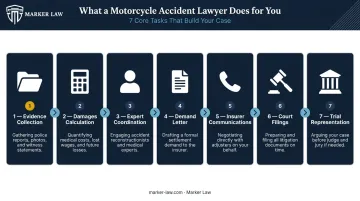
Core Tasks
The day-to-day work includes:
- Collecting police reports, medical records, and witness statements
- Calculating both current and long-term damages (medical costs, lost wages, future care needs)
- Working with accident reconstruction specialists and medical experts when needed
- Drafting and sending documented demand letters to insurance carriers
- Handling all communications with adjusters and opposing counsel
- Filing legal documents and meeting court deadlines
- Taking the case to trial if a fair settlement isn't reached
What This Means in Practice
The role isn't just administrative. An experienced attorney shapes how the entire claim is perceived — by adjusters, opposing counsel, and juries. They build the evidentiary record from the start, which determines what leverage exists at every stage.
At Marker Law, attorney Jason Marker spent three years early in his career on the defense side, representing insurance carriers. That background means he knows exactly how claims are evaluated internally — which evidence adjusters flag, which injuries they challenge, and where they look for openings to reduce payouts. Knowing those pressure points from the inside changes how a case gets built — and how hard it is to pick apart.
Benefit 1: Standing Up to Insurance Companies on Equal Footing
Insurance adjusters are professionals. Their job is to close claims for as little as possible, and they use well-practiced techniques against unrepresented claimants.
How Adjusters Approach Unrepresented Riders
Common tactics include:
- Early recorded statement requests — asking for a statement before the rider fully understands their injuries or rights
- Fast settlement offers — made before the full scope of injuries is diagnosed, locking in a low number permanently
- Fault-shifting questions — probing for admissions about speed, lane position, or gear to assign partial blame to the rider
- Delays — running down the clock on unrepresented claimants who may not know their legal deadlines
These tactics work. Against an unrepresented rider, adjusters use them routinely — and they tend to succeed.
How a Lawyer Changes the Dynamic
When an attorney is involved:
- All insurer communications are routed through the lawyer — adjusters can no longer speak directly to the rider
- Recorded statements are declined or carefully managed
- Early low offers are countered with documented demand packages that reflect the full value of the claim
- Fault-shifting arguments are met with evidence, not improvised responses
According to the Insurance Research Council, attorney representation reached 49% of bodily injury claimants in 2012 — a figure that has continued rising as more injured people recognize the disparity in outcomes between represented and unrepresented claimants.
Jason Marker spent three years on the defense side, representing insurance carriers before switching to plaintiff work. He knows these tactics from the inside. At Marker Law, that experience drives a straightforward approach: when insurers try to shift blame onto the rider, the firm comes back with evidence.
Benefit 2: Capturing the Full Financial Value of Your Claim
Motorcycle injuries are statistically more severe than those sustained in passenger vehicle crashes. IIHS notes that motorcycles offer none of the protective features — no airbags, no seatbelts, no steel frame — leaving riders exposed to traumatic brain injuries, spinal cord trauma, fractures, road rash, burns, and permanent disfigurement.
The true cost of serious injuries extends far beyond the initial ER bill. Most unrepresented riders undervalue their claims because they don't know what they're entitled to.
What a Full Damages Assessment Covers
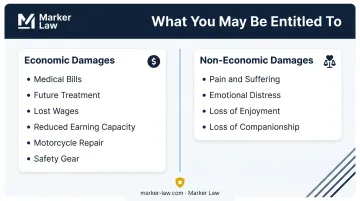
Economic damages:
- Current medical bills and future treatment costs
- Lost wages during recovery
- Reduced long-term earning capacity
- Motorcycle repair or replacement
- Safety gear and equipment
Non-economic damages:
- Pain and suffering
- Emotional distress
- Loss of enjoyment of life
- Loss of companionship (in wrongful death cases)
Why This Matters
Insurance companies calculate damages using their own formulas, and those formulas favor low payouts. They won't proactively tell you what you're entitled to. A lawyer builds a documented damages profile that counters those formulas, working with medical professionals and economic experts to project future care needs and lost earning capacity.
Marker Law works with medical and economic experts to ensure catastrophic injuries receive thorough damage assessments, including long-term care costs, income loss, and non-economic losses that are easy to overlook when negotiating alone.
Accepting an early settlement permanently closes the claim. Any future costs — additional surgeries, ongoing therapy, income loss — come entirely out of pocket. An attorney ensures you understand the full picture before signing anything.
Under Illinois comparative negligence rules, any fault assigned to the rider reduces the total recovery proportionally. That makes accurate, comprehensive damage documentation even more important — a lower fault percentage and a higher damages number both directly affect what you take home.
Benefit 3: Navigating Illinois Law and Protecting Your Legal Rights
Illinois has specific laws that directly affect motorcycle accident claims — and unrepresented riders often don't learn about them until it's too late.
The Two Key Legal Risks
Statute of limitations: Under 735 ILCS 5/13-202, personal injury claims in Illinois must be filed within 2 years of the accident date. Missing this deadline permanently eliminates the right to pursue compensation — regardless of how strong the underlying case is.
Modified comparative negligence: Under 735 ILCS 5/2-1116, a rider found more than 50% at fault is completely barred from recovery. If fault is 50% or less, damages are reduced in direct proportion to that percentage.
How a Lawyer Protects Against These Risks
Insurers know these rules well. They use delay tactics against unrepresented claimants and aggressively push fault arguments (citing the rider's speed, lane position, or gear) to push fault percentages toward or past the 50% threshold.
An attorney builds the evidentiary record to counter this from day one:
- Police reports, crash scene photos, and witness statements collected early
- Event data recorder information and surveillance footage secured before it disappears
- Medical documentation establishing the direct link between the crash and injuries
- Expert testimony from accident reconstructionists when liability is disputed
That evidence-building serves another purpose beyond fault percentages. Biker bias — the assumption that motorcyclists ride recklessly — shapes how adjusters and juries assess a case. Experienced attorneys anticipate this and structure the evidence to present a factual account of the crash, replacing assumption with documentation before stereotypes can fill the gaps.
What Happens When You Handle a Motorcycle Accident Claim Without a Lawyer
Most unrepresented riders don't realize how much ground they've lost until after they've settled.
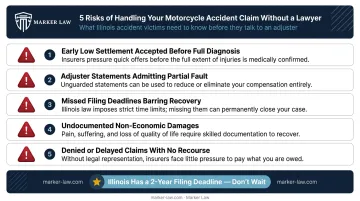
Common consequences include:
- Accepting a low settlement offer before all injuries are fully diagnosed
- Making statements to adjusters that inadvertently admit partial fault
- Missing filing deadlines that permanently bar recovery
- Failing to document non-economic damages, leaving significant compensation on the table
- Being unprepared when the insurer denies or delays the claim
Insurance companies respond differently to unrepresented claimants. The Illinois Department of Insurance confirms that insurers typically will not settle until a claimant signs a release — and the Illinois State Bar Association advises that injured people should understand the full nature and extent of their injuries before signing anything. Without legal counsel, that release often gets signed too early.
Getting legal help doesn't require money upfront. At Marker Law, the contingency fee structure means there are no upfront costs and no attorney fee unless compensation is recovered. A free consultation carries no obligation — so there's nothing standing between an injured rider and a straightforward conversation about their options.
Frequently Asked Questions
How much are most motorcycle accident settlements?
Settlement amounts vary widely based on injury severity, available insurance coverage, and how fault is allocated under Illinois law. A minor soft-tissue claim and a traumatic brain injury case have almost nothing in common financially, which makes a single "average" figure meaningless. Represented riders consistently recover more than those who handle claims on their own.
Is it worth it to hire an attorney for a motorcycle accident?
In most serious crash cases, yes. When injuries are significant, fault is disputed, or the insurer is making a lowball offer, legal representation makes a measurable difference. The contingency fee structure means you pay nothing unless compensation is recovered, which removes the financial risk entirely.
Do insurance companies like when you get a lawyer?
No. Insurers prefer unrepresented claimants because they're easier to settle with quickly and cheaply. Legal representation signals that the rider understands their rights and isn't going to accept the first number offered.
What not to say to an injury lawyer?
Don't exaggerate injuries, omit pre-existing conditions, or guess at details you're unsure about. Your attorney needs accurate information to build the strongest case — honesty is essential, and anything you withhold can become a problem later.
How long do I have to file a motorcycle accident claim in Illinois?
Illinois imposes a 2-year statute of limitations under 735 ILCS 5/13-202, running from the date of the accident. Missing this deadline permanently eliminates the right to pursue compensation, no matter how strong the case.
What does a motorcycle accident lawyer do that I can't do myself?
Attorneys know how to counter insurer tactics, calculate the full scope of damages including future costs, manage legal deadlines, and build evidence in ways that maximize recovery. That requires litigation experience and — for attorneys who've worked the defense side — direct knowledge of how insurers evaluate and minimize claims.