Introduction
Truck accident claims are not simply larger versions of car accident cases. They involve federal regulations, multiple corporate defendants, commercial insurance policies that can reach $750,000 to $5 million, and defense teams that begin building their case within hours of a crash.
Most victims understand they can hire a truck accident lawyer. The harder question is how an attorney actually changes the final number on the check — and whether the difference is meaningful enough to matter.
It is. This article breaks down the specific, practical ways a truck accident lawyer works to maximize your compensation: from preserving time-sensitive evidence in the first days after a crash to countering the insurance tactics designed to push you toward a lowball settlement.
TL;DR
- Truck accident claims involve FMCSA regulations, multiple liable parties, and commercial insurers with aggressive defense teams
- A lawyer acts immediately to preserve black box data, driver logs, and maintenance records before they disappear
- Identifying every liable party — not just the driver — opens access to multiple insurance policies and settlements
- Expert damage projections prevent victims from accepting settlements that fall short of long-term costs
- Marker Law works on a contingency fee basis: no upfront cost, and no fee unless compensation is recovered
Why Truck Accident Claims Are Different From Standard Car Crashes
Commercial trucks operate under a framework of federal rules that simply don't apply to private drivers. The Federal Motor Carrier Safety Administration caps property-carrying drivers at 11 hours of driving after 10 consecutive hours off duty, with a hard 14-hour work window and a mandatory 30-minute break after 8 cumulative hours of driving. Violations of these rules aren't just regulatory infractions — they become direct evidence of negligence in a lawsuit.
The insurance gap between commercial trucks and private vehicles is significant:
| Coverage Type | Minimum Limit |
|---|---|
| Illinois personal auto | $25,000 per person |
| Federal for-hire carrier (non-hazardous) | $750,000 |
| Hazardous materials carriers | $1M–$5M |
More available coverage means more potential compensation. It also means insurers have far more financial incentive to fight claims aggressively — and they do.
Liability is also rarely limited to the driver alone. A single crash can pull in multiple responsible parties:
- The truck driver
- The trucking company
- The cargo loading crew
- A third-party maintenance contractor
- The manufacturer of a defective component
Without legal experience, identifying and pursuing each of those parties is where most victims lose significant compensation.
How a Truck Accident Lawyer Investigates and Locks Down Critical Evidence
The investigation phase is where most truck accident cases are actually won or lost — not in court. What a lawyer does in the first days after a crash directly determines what evidence is available months later when negotiations begin.
The Black Box Problem
Commercial trucks carry electronic control modules that record speed, braking patterns, and driver hours. This data can prove that a driver was fatigued, speeding, or braking too late — but trucking companies have no obligation to preserve it indefinitely. FMCSA requires motor carriers to retain ELD records for just 6 months, and ECM data can be overwritten much faster without a legal hold in place.
One of the first actions an attorney takes after being retained is sending a spoliation letter, a formal legal notice compelling the trucking company to preserve all evidence. Under Illinois law, failing to preserve evidence after receiving that notice can result in sanctions and supports a negligent spoliation claim.
The Full Scope of Evidence
Beyond the black box, a thorough investigation pursues:
- Driver logs and hours-of-service records — which may be falsified or manipulated
- Driver qualification files — retained by carriers for 3 years after employment ends, revealing hiring and training failures
- Maintenance and inspection records — kept for 1 year at the maintenance location, showing whether known defects were ignored
- Cell phone records — to establish distraction at the time of the crash
- Cargo manifests and loading documentation — relevant when shifting freight contributed to the collision
- GPS and onboard camera footage — often overwritten within 30–90 days without a legal hold
- Internal company communications — emails or directives pressuring drivers to skip rest breaks or exceed delivery schedules
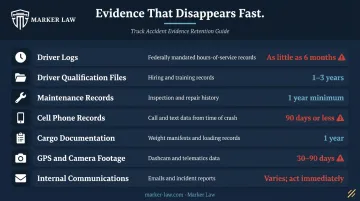
Each of these evidence types has its own retention window — and most are short. Trucking companies routinely deploy their own investigators to crash scenes quickly. Without an attorney moving just as fast on your behalf, that evidence can disappear before you realize what's been lost.
Identifying All Liable Parties to Maximize Every Source of Compensation
One of the most significant financial advantages of having an experienced truck accident lawyer is the ability to identify every party that shares liability. Each additional defendant can mean access to a separate insurance policy — and a larger total recovery.
Who Can Be Held Liable
| Party | Basis for Liability |
|---|---|
| Truck driver | Speeding, fatigue, distraction, impairment |
| Trucking company | Negligent hiring, inadequate training, pressuring HOS violations, failure to maintain vehicles |
| Cargo loader/shipper | Improper loading, overloading, unsecured freight |
| Maintenance contractor | Failure to identify or repair known defects |
| Manufacturer | Defective brakes, tires, or other components |
Federal Motor Carrier Safety Regulations impose legal responsibility on motor carriers for a driver's negligent acts and omissions. In practice, this means a trucking company can be held liable even when the driver was classified as an independent contractor.
Why This Matters for Compensation
A victim who only pursues the driver's individual coverage can leave substantial money behind, particularly when injuries are catastrophic and medical costs span years. 2024 SCI Model Systems data puts the first-year costs of high tetraplegia at roughly $1.36 million, with annual subsequent costs near $243,000. No individual driver's policy comes close to covering that.
Illinois follows a modified comparative fault standard under 735 ILCS 5/2-1116. Recovery is barred if a plaintiff's fault exceeds 50%, and reduced proportionally for any fault below that threshold.
Defense teams exploit this rule aggressively, shifting blame onto victims wherever possible. An attorney who can document the trucking company's systemic failures — skipped inspections, ignored safety violations, unrealistic delivery schedules — gives the defense far less room to maneuver.
Calculating the Full Value of Your Claim — Including Future Damages
Underestimating future costs is one of the most common ways truck accident victims end up undercompensated. Insurance companies calculate offers based on what they believe you'll accept, not what your injuries will actually cost over a lifetime.
Damages a Truck Accident Lawyer Accounts For
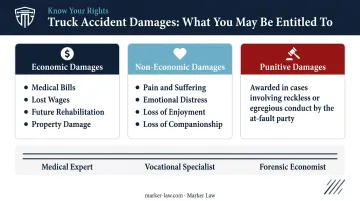
Economic damages:
- Current and projected future medical bills
- Lost wages and reduced earning capacity
- Long-term rehabilitation and home care costs
- Vehicle and property damage
Non-economic damages:
- Pain and suffering
- Emotional distress
- Loss of enjoyment of life
- Loss of companionship (in wrongful death cases)
Punitive damages: Available when the trucking company's conduct was reckless or egregious — for example, knowingly allowing an unqualified driver to operate a vehicle after multiple violations.
Putting accurate numbers on those categories requires more than a spreadsheet. Attorneys work with medical experts, vocational rehabilitation specialists, and forensic economists to project future losses. Illinois Pattern Jury Instructions account for the present cash value of future medical care and lost earnings, but those projections need expert documentation to carry weight in negotiations or at trial.
Why Timing Matters
Initial settlement offers often arrive before the full extent of injuries is established. Accepting early forfeits the right to recover more later — even if your condition deteriorates significantly. Jason Marker advises clients to hold off on any offer until treatment has stabilized and future costs are fully documented. That way, the settlement reflects your actual situation, not just the first few months of bills.
Countering Insurance Company Tactics That Minimize Payouts
Commercial trucking insurers are not passive after a crash. They contact victims directly, seek recorded statements that can later be used to undercut claims, and make early settlement offers designed to close cases before the full scope of damages is known.
Having legal representation changes that dynamic immediately. Once an attorney is retained, all insurer communication must go through counsel, removing direct pressure from the victim. From there, the attorney works on multiple fronts:
- Analyzes applicable policy limits to identify the full recovery available
- Counters lowball offers with documented evidence of actual damages
- Demonstrates a credible willingness to litigate — insurers settle more favorably when they believe a case will actually go to trial
Jason Marker spent three years on the defense side representing insurance carriers before transitioning exclusively to plaintiff advocacy. That experience gives him a specific advantage in truck accident cases : he knows how adjusters evaluate claims, where they look for weaknesses, and what arguments they'll deploy to reduce a payout. As he puts it: "I learned their playbook." Marker Law builds cases from day one with those tactics in mind, including preparing every case as if it will go to trial, which strengthens the negotiating position even in cases that ultimately settle.
What Happens When You Handle a Truck Accident Claim Without a Lawyer
Black box data gets overwritten without a spoliation letter. The trucking company's liability never surfaces without industry knowledge. Future damages get undervalued, and the first settlement offer ends up looking like the only option.
Self-represented victims are negotiating against professional claims adjusters and defense attorneys whose full-time job is minimizing payouts. That's not a fair contest.
Three facts that can make or break an unrepresented claim:
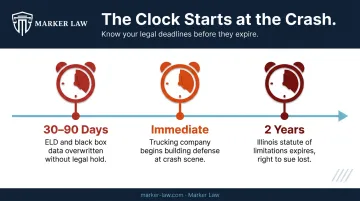
- Illinois has a 2-year statute of limitations for personal injury claims under 735 ILCS 5/13-202 — delays don't just cost evidence, they can cost the right to sue entirely
- Electronic logging device data is typically overwritten within 30–90 days without a legal hold
- Trucking companies begin building their defense immediately — every day without an attorney is a day the other side works uncontested
Marker Law operates on a contingency fee basis — no upfront costs, and no attorney fees unless compensation is recovered. For most victims, that means the decision to get legal help comes down to timing, not money.
Frequently Asked Questions
Can a truck accident attorney get you a bigger settlement?
Yes. Represented victims typically recover more because attorneys identify all liable parties, document future damages with expert support, and negotiate from a position of legal leverage that unrepresented claimants can't replicate. Insurance adjusters know this — and they adjust their offers accordingly.
How much does a truck accident lawyer cost?
Marker Law works on a contingency fee basis: no upfront costs and no attorney fees unless compensation is recovered. For personal injury cases, the fee is typically around one-third of the recovery. Any potential costs are explained upfront before anything is signed.
When should I contact a truck accident lawyer after a crash?
As soon as possible — ideally within days of the accident. Black box and ELD data can be overwritten within 30–90 days, and trucking companies begin investigating immediately. Waiting weeks to hire a lawyer shrinks the window to preserve the evidence that drives case value.
Who can be held liable in a truck accident beyond the driver?
Liability can extend to the trucking company (for negligent hiring, training failures, or maintenance violations), the cargo loader, third-party maintenance contractors, and parts manufacturers. Identifying each liable party is essential to accessing all available compensation sources.
What evidence matters most in a truck accident case?
Black box and ELD data, driver qualification files, maintenance and inspection records, cell phone records, cargo documentation, and witness statements are critical. Most of it starts disappearing fast and must be secured through a legal hold notice sent to the carrier as early as possible.
How long does a truck accident case take to settle in Illinois?
Timelines vary based on injury severity, number of liable parties, and whether the case settles or goes to trial. Many cases resolve after treatment stabilizes, which can take a year or more for serious injuries. Complex trucking cases often take longer. Accepting an early settlement before the full picture is clear typically costs victims significant compensation.