But signing a contingency fee agreement without understanding it is a mistake. The headline settlement number you might receive is not what you take home. How costs are deducted, what liens attach to your recovery, and what happens if your case goes to trial all affect your actual payout — sometimes significantly.
This guide covers what a premises liability contingency fee agreement is, the specific clauses it must contain under Illinois rules, how to calculate your real net recovery, and what to watch for before you sign.
TL;DR
- You pay no attorney fees unless your case settles or wins — zero upfront cost
- Illinois Rules of Professional Conduct Rule 1.5 requires the agreement to be in writing, signed by the client, and disclose all fee percentages and cost deductions
- The correct Illinois personal injury statute of limitations is 735 ILCS 5/13-202 — two years from the date of injury
- Your net recovery equals: settlement minus attorney fee, minus case costs, minus medical liens
- Cost deduction order (before vs. after the fee percentage) directly affects how much you take home
What Is a Premises Liability Contingency Fee Agreement?
A contingency fee agreement is a written contract between an attorney and a client where the attorney's compensation depends entirely on the outcome. No recovery means no attorney fee — period. This sets it apart from two common alternatives:
- Hourly billing — the attorney charges for time regardless of outcome
- Retainer arrangements — the client pre-pays for legal services upfront
Premises liability cases are especially suited to this model. After a slip and fall or dog bite, injured people often face immediate financial pressure: medical bills, lost wages, and out-of-pocket expenses that begin accumulating before any settlement is in sight. Requiring upfront legal fees in that situation would make representation inaccessible to most victims.
That financial pressure is also why the contingency model aligns incentives so effectively. The attorney only gets paid if the client recovers — and generally earns more if the recovery is larger — so both parties are working toward the same goal.
In Illinois, contingency fee agreements for personal injury and premises liability claims are legally binding contracts governed by the Illinois Rules of Professional Conduct. To be enforceable, they must meet specific requirements — including being in writing, signed by both parties, and clearly stating the fee percentage and how costs are handled.
Key Contents Every Premises Liability Contingency Fee Agreement Must Include
A valid, enforceable contingency fee agreement covers more than just the percentage. Under Illinois Rule of Professional Conduct 1.5, the agreement must be in writing, signed by the client, and address each of the following.
Scope of Representation
The agreement should define exactly what legal matter the attorney is handling: specifically, the premises liability claim arising from a described incident, including the date, location, and nature of the injury. This matters because it determines whether the attorney's services cover pre-suit negotiation only or extend through trial and appeal.
Fee Percentage and Sliding Scale
The agreement must state the exact percentage the attorney receives. In Illinois premises liability cases, contingency fees generally fall between 33% and 40% of the gross recovery. Many firms use a sliding scale:
- Lower percentage if the case settles before a lawsuit is filed
- Higher percentage if the case proceeds to litigation or trial
Trial preparation requires substantially more attorney time (depositions, expert preparation, court appearances) which is why the percentage increases at the litigation stage.
Case Costs and Expenses
The agreement must distinguish between attorney fees and case costs. Case costs typically include:
- Court filing fees
- Expert witness fees
- Medical record retrieval charges
- Deposition transcripts and court reporter fees
- Service of process fees
The agreement must specify who advances these costs (typically the attorney) and, critically, whether costs are deducted from the settlement before or after the attorney fee percentage is calculated. This distinction directly affects your net recovery. The order of deduction can shift hundreds or even thousands of dollars in your final payout.
Client's Right to Approve or Reject Settlements
Under Illinois Rule 1.2(a), an attorney must abide by the client's decision whether to settle. The agreement should confirm this in writing. Your attorney advises — you decide. No settlement can be accepted without your explicit consent.
Termination and Mid-Case Withdrawal
The agreement must address what happens if you fire your attorney, or if the attorney withdraws, before the case resolves. In Illinois, a terminated attorney may still be entitled to reasonable compensation for services already rendered — a doctrine called quantum meruit.
Understand this clause before signing. It can create financial complexity if you later decide to switch attorneys.
Medical Liens and Third-Party Reimbursement
Medical providers, health insurers, Medicare, and Medicaid may all assert liens against your settlement. Under 305 ILCS 5/11-22, Illinois Medicaid holds a statutory charge on injury recoveries for the total amount of medical assistance provided. Medicare conditional payments must similarly be repaid when a settlement is reached.
These liens reduce your take-home amount. The agreement should acknowledge they exist and explain how they will be handled. Experienced attorneys routinely negotiate lien amounts down on behalf of their clients.
Attorney Fees vs. Case Costs: What's the Difference?
The contingency fee percentage — say, 33% — covers only the attorney's legal services. It is not an all-inclusive number. Case costs are tracked separately and reimbursed from the settlement on top of that fee, which catches many clients off guard at settlement time.
Two Ways Costs Get Calculated
There are two common deduction structures, and they produce different outcomes for you:
Method 1 — Fee first, then costs: The attorney's percentage is applied to the gross settlement first. Case costs then come out of your remaining share.
Method 2 — Costs first, then fee: Case costs are deducted from the gross settlement first. The attorney's percentage is then applied to that lower number — putting more money in your pocket.
Here's how those methods play out on the same $60,000 settlement with $5,000 in case costs and a 33% attorney fee:
| Method 1 (Fee First) | Method 2 (Costs First) | |
|---|---|---|
| Gross Settlement | $60,000 | $60,000 |
| Attorney Fee (33%) | $19,800 | $18,150 (33% of $55,000) |
| Case Costs | $5,000 | $5,000 |
| Client Net | $35,200 | $36,850 |
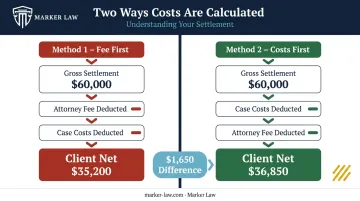
The difference is $1,650 — on the same settlement, with the same fee percentage. Your agreement must specify which method applies.
That's why it matters which method your agreement uses — and why you should confirm this before signing. At Marker Law, case costs are advanced by the firm and reimbursed from the settlement at the end of the case, so no out-of-pocket expense is required during representation.
How to Calculate Your Net Recovery from a Premises Liability Settlement
The formula is straightforward, but many clients don't work through it until they're sitting at a settlement conference:
Net Recovery = Total Settlement − Attorney Fee − Case Costs − Medical Liens
Sample Breakdown: $50,000 Settlement
The following is a realistic but hypothetical example. Actual outcomes vary based on fee percentage, costs incurred, and lien amounts in each specific case.
| Item | Amount |
|---|---|
| Gross Settlement | $50,000 |
| Attorney Fee (33% pre-suit) | − $16,500 |
| Case Costs | − $3,000 |
| Medical Lien (estimated) | − $8,000 |
| Client Net Recovery | $22,500 |
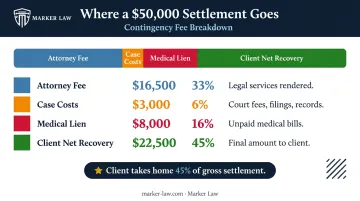
In this example, the client takes home $22,500 from a $50,000 settlement (45% of the gross). That ratio is common in personal injury cases — it's the predictable cost structure of litigation, not a sign that anything went wrong.
Cases involving complex liability — negligent security, governmental property claims, or commercial property maintenance failures — typically carry higher costs because they require expert witnesses and extended litigation timelines. Each additional expert can add $3,000–$8,000 or more in case costs, directly reducing what the client takes home.
Illinois-Specific Requirements for Contingency Fee Agreements
Illinois has clear rules governing how contingency fee agreements must be structured.
Rule 1.5: What the Written Agreement Must Contain
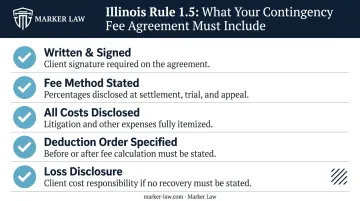
Under Illinois Rule of Professional Conduct 1.5 (adopted 2010, amended July 1, 2023), a contingency fee agreement must:
- Be in a writing signed by the client
- State the method by which the fee is determined, including specific percentages at settlement, trial, and appeal
- Disclose all litigation and other expenses to be deducted from recovery
- State whether expenses are deducted before or after the contingent fee is calculated
- Notify the client of any expenses they may owe even if they do not prevail
The rule also requires a written closing statement at case resolution showing the outcome, the client's remittance, and how it was calculated.
Statute of Limitations: 735 ILCS 5/13-202
The Illinois personal injury statute of limitations is 735 ILCS 5/13-202, which requires injury-to-person claims to be filed within two years of when the cause of action accrued. (Some secondary sources incorrectly cite 750 ILCS 5/13-202 — that statute does not exist; verify the correct citation before relying on any agreement template.)
The contingency agreement itself doesn't start this clock. Still, signing quickly matters: early representation preserves evidence, documents the scene, and keeps filing deadlines on track. Government property claims may carry even shorter notice deadlines.
Fee Reasonableness
Illinois Rule 1.5(a) prohibits attorneys from charging unreasonable fees. The Illinois Supreme Court in Richards v. SSM Health Care, Inc. recognized one-third as the typical contingency fee in personal injury cases. General personal injury benchmarks place the range at 33%–40%, though no Illinois statute caps the percentage for ordinary premises liability claims. Reasonableness under Rule 1.5 controls.
At Marker Law, the contingency fee agreement is provided in plain language before any representation begins — no upfront costs, no retainer. The structure follows Rule 1.5 requirements, and every client receives a free initial consultation to review it.
What to Watch for Before Signing Your Contingency Fee Agreement
Three things deserve particular attention before you put pen to paper:
Vague language on cost deductions. If the agreement doesn't specify whether costs are deducted before or after the fee percentage is applied — or doesn't define what counts as a "cost" — ask for written clarification before signing. Vague language almost always costs the client money at settlement.
No explanation of what happens if you lose. A legitimate agreement addresses the client's responsibility — if any — for advanced costs in the event of no recovery. Illinois Rule 1.5 requires this disclosure. If an attorney skips this clause or can't explain it, that's a red flag.
An unusually high fee percentage without justification. The 33%–40% range reflects the general personal injury benchmark in Illinois. A firm asking for significantly more should be able to explain what added complexity or risk justifies the departure. Illinois professional conduct rules prohibit unreasonable fees outright — not just discourage them.
Frequently Asked Questions
What are the requirements for a contingency fee agreement in Illinois?
Illinois Rule of Professional Conduct 1.5 requires the agreement to be in writing, signed by the client, and clearly state the fee percentage, how it's calculated, and whether expenses are deducted before or after the fee is applied. All case costs must be disclosed, and the attorney must provide a written closing statement when the case concludes.
How much will I get from a $50,000 settlement?
After a 33% attorney fee (approximately $16,500), estimated case costs, and any medical liens, your net recovery from a $50,000 settlement could be significantly reduced. The exact figure depends on your fee agreement's deduction order, actual costs incurred, and lien amounts — ask your attorney for a written estimate before settling.
What should I not tell my attorney?
Tell your attorney everything. Withholding facts about prior accidents, pre-existing conditions, or your own conduct at the time of the incident can unravel your claim if the defense uncovers the gap during discovery or at trial. There are no safe omissions.
Can I negotiate the contingency fee percentage in Illinois?
Fee percentages can sometimes be discussed before the agreement is signed, particularly in straightforward cases. Any negotiation must happen before signing — not after a settlement is reached. Attempting to modify an agreed fee after the fact is generally not permitted under Illinois ethics rules.
What happens if I lose my premises liability case?
Under a contingency fee agreement, you owe no attorney fee if there's no recovery. Your agreement must still specify whether you're responsible for any advanced case costs if the case is lost — Illinois Rule 1.5 requires that disclosure upfront.
Do premises liability cases cost anything upfront?
No. There are no upfront attorney fees under a contingency arrangement. The attorney advances case costs and is reimbursed only out of a successful settlement or verdict — you pay nothing out of pocket to get started.