The short answer: you're not legally required to hire one. But the moment you report an injury in Illinois, the insurance carrier assigns an experienced adjuster to your file. Their job is to pay you as little as possible. The system isn't designed to be fair to injured workers — it's designed to be navigated by professionals on both sides.
This guide covers when you can reasonably go it alone, when you genuinely need an attorney, and what a workers' comp lawyer actually does that you probably can't replicate on your own.
TLDR
- Illinois law doesn't require you to hire a lawyer for a workers' comp claim
- Self-filing makes sense only for minor injuries with no lost wages and a cooperative employer
- Denied claims, serious injuries, permanent disability, or insurer disputes all strongly call for an attorney
- Illinois workers' comp attorneys work on contingency — you pay nothing unless you recover
- Attorney fees are capped at 20% of your recovery under Illinois law
When You Might Not Need a Workers' Comp Lawyer
A narrow set of situations genuinely supports handling a claim yourself:
- The injury is clearly minor — a small cut, a mild sprain
- You required one or two medical visits with no ongoing treatment
- You missed no work, or missed only a day or two
- Your employer reported the injury promptly and without pushback
- The insurer accepted the claim and is paying medical expenses without dispute
That said, even straightforward claims carry one serious risk. Under IWCC's official guidance, an approved settlement contract generally terminates your right to future cash and medical benefits.
That matters because injuries don't always reveal themselves immediately. A back sprain turns into a herniated disc. A "routine" shoulder strain requires surgery six months later.
Signing off too early — or making an error in your initial paperwork — can permanently close off those future benefits. A free consultation with an attorney before you accept any settlement costs you nothing and could protect you from a decision you can't undo.
Signs You Definitely Need a Workers' Comp Lawyer
Your Claim Was Denied or Disputed
When an employer or insurer challenges the work-related nature of your injury, you're no longer filing paperwork. You're building a legal case. The appeals process before the Illinois Workers' Compensation Commission (IWCC) involves evidentiary hearings, legal arguments, and procedural rules that experienced defense attorneys navigate daily. Going in without representation puts you at a significant structural disadvantage.
Your Injury Is Serious or Permanent
Spinal cord injuries, traumatic brain injuries, amputations, severe burns, and permanent partial or total disability cases involve long-term benefit calculations worth potentially hundreds of thousands of dollars. Insurers fight these cases aggressively. The higher the stakes, the more resources they commit to minimizing what they pay.
The Insurer Is Playing Games
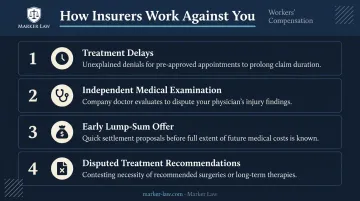
Standard insurance tactics include:
- Delaying approval for treatment your doctor already ordered
- Ordering an Independent Medical Examination (IME) with their chosen physician — a process authorized under 820 ILCS 305/12 that frequently produces reports favorable to the insurer
- Offering a lump-sum settlement shortly after the injury before the full extent of damage is known
- Disputing your doctor's treatment recommendations without a clinical basis
These aren't coincidences. They're deliberate strategies — and Jason Marker knows them firsthand. Before switching exclusively to injured workers, he spent three years representing employers and insurers. He learned their playbook from the inside, and that background now works for his clients.
You Have a Pre-Existing Condition
Insurers routinely argue that a prior condition — a previous back injury, an old knee surgery — is the real cause of your current symptoms. An attorney can gather the medical evidence needed to prove that your workplace injury either caused or significantly aggravated the condition, which is compensable under Illinois law.
You're Also Pursuing SSDI Benefits
This combination matters financially. According to the Social Security Administration, the combined total of SSDI plus workers' compensation benefits generally cannot exceed 80% of your pre-disability average earnings — the excess is deducted from your Social Security payments. How your settlement is structured directly affects whether that offset applies — and by how much. Workers who sign without legal counsel often discover this problem only after the settlement is final.
What a Workers' Comp Lawyer Does for You in Illinois
Knows What the Other Side Is Doing
The insurer assigned to your claim has handled thousands of cases. Their adjusters know which questions to ask, which inconsistencies to look for, and which early offers workers typically accept without realizing the full value of what they're giving up.
At Marker Law, Jason Marker spent his first three years representing employers and insurers, learning exactly how defense teams approach claim investigation and settlement negotiation. He now uses that knowledge to anticipate those moves before they're made.
Handles All Deadlines and Filings
Illinois has strict, unforgiving timelines:
- 45 days to notify your employer of a work injury
- 3 years from the accident (or 2 years from the last compensation payment, whichever is later) to file a claim with the IWCC
Missing either deadline can permanently forfeit your right to benefits. An attorney manages these requirements from day one.
Builds the Medical Evidence That Wins Claims
Marker Law's practice data shows that IME reports favor the insurer approximately 80% of the time, concluding the worker is fine, has reached maximum medical improvement, or that the injury wasn't work-related.
Countering an unfavorable IME requires:
- Coordinating with your treating physician to document the actual scope of your injury
- Obtaining expert testimony when necessary
- Challenging the insurer's doctor directly — either through medical evidence or by presenting your treating physician as a competing expert witness at an IWCC hearing
Negotiates the Full Value of Your Claim
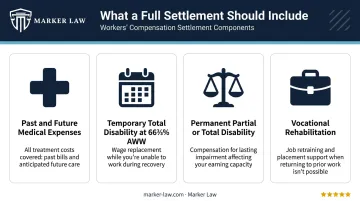
A settlement offer from an insurer is a starting position, not a fair number. Marker Law evaluates whether an offer accounts for:
- All past and future medical expenses
- Temporary total disability payments (generally 66⅔% of your average weekly wage while you cannot work)
- Permanent partial or total disability benefits
- Vocational rehabilitation if you can't return to your former job
The firm prepares every case as if it will go to trial, which gives them stronger negotiating leverage and makes it harder for insurers to lowball the final number.
Represents You Through the IWCC Process
According to the IWCC FY2024 Annual Report, 63% of the 1,268 arbitration decisions issued in 2024 were appealed to the Commission. That's not a process where showing up unprepared works out well. Marker Law handles cases through the full IWCC system — arbitration, Commission review, and if necessary, Circuit Court and beyond.
What Does a Workers' Comp Lawyer Cost in Illinois?
The Fee Structure Is Straightforward
Illinois law caps workers' comp attorney fees at 20% of the compensation recovered, under 820 ILCS 305/16a. Marker Law charges exactly that — 20% of the total settlement or award, paid only when compensation is recovered. Small case-related expenses — medical records, expert fees in complex cases — are covered by the firm upfront and reimbursed from the settlement, never billed to you during the process.
The Real Cost Is Going Unrepresented
Workers without legal representation are more vulnerable at every stage:
- Adjusters know unrepresented workers are more likely to accept early, low offers
- Procedural errors or missed deadlines can close out a claim entirely
- Without medical evidence coordination, IME reports often go unchallenged
The attorney's fee is typically a fraction of the additional compensation a lawyer helps recover — especially in serious injury cases where the insurer is motivated to pay as little as possible.
No Financial Risk to Find Out Where You Stand
Marker Law offers a free initial consultation with no obligation. Whether your situation warrants legal representation or not, you'll leave the call with a clearer picture of what your claim is actually worth.
Frequently Asked Questions
Frequently Asked Questions
Do I need a lawyer for workers' compensation?
Not legally, but in most cases, having one is strongly advisable. The insurer has professional legal support from the moment you report an injury. If your claim involves serious injury, a dispute, or permanent disability, going unrepresented creates a significant imbalance.
What injuries are covered by workers' compensation in Illinois?
Illinois workers' comp covers injuries and illnesses arising from employment — traumatic injuries (falls, equipment accidents, lifting injuries), occupational diseases, repetitive stress injuries, and aggravation of pre-existing conditions caused by work activity.
What are the chances of winning a workers' comp claim?
Success depends on injury type, documentation quality, and whether the claim is disputed. The WCRI's 2024 research on attorney representation confirms that attorney involvement affects indemnity payments across 31 states — represented workers consistently fare better than those who go unrepresented.
How much does a workers' compensation lawyer cost in Illinois?
Illinois workers' comp attorneys work on contingency: no fee unless you recover compensation. By statute, fees are capped at 20% of the amount recovered.
What happens if my workers' comp claim is denied in Illinois?
A denial can be appealed through the IWCC, starting with an arbitration hearing. If that decision is unfavorable, a panel of commissioners can review it, followed by Circuit Court. Building the right evidence and arguments to overturn a denial is not straightforward without an attorney.
When should I contact a workers' compensation attorney?
Contact one before making any recorded statements to the insurer or signing anything. Early mistakes — accepting an initial settlement offer or misreporting injury details — can permanently limit what you're able to recover.