Illinois workers' compensation is designed to protect you — but the outcome depends heavily on what you do in the first 24–72 hours. Insurance companies start building their defense immediately. Adjusters are trained to minimize payouts. And a single misstep early on can undermine an otherwise valid claim.
This guide covers exactly what to do after a workplace injury in Illinois, what benefits you're entitled to, how to fight back if your claim is denied, and when a personal injury lawsuit may also be on the table.
TL;DR
- Illinois workers' comp is a no-fault system — you don't need to prove employer negligence to receive benefits
- Report within 45 days or risk losing your right to benefits entirely
- Workers' comp covers medical costs, lost wages, and disability — pain and suffering is not covered
- Insurance adjusters work to minimize your payout from day one — knowing their tactics helps you protect your claim
- A denied claim isn't final — you have the right to appeal before the Illinois Workers' Compensation Commission
What to Do Immediately After a Workplace Injury in Illinois
The actions you take in the first hours and days after getting hurt can determine whether your claim succeeds or fails. Mistakes made early are difficult to correct, and the insurer's adjuster begins evaluating your claim before you've even seen a doctor.
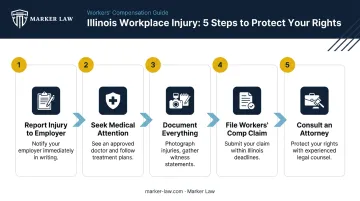
Step 1: Report the Injury to Your Employer Right Away
Under 820 ILCS 305/6, you must notify your employer of a workplace injury as soon as practicable — and no later than 45 days after the accident. Miss that window and you risk losing your entire claim.
Same-day reporting is always the safest approach. Your report should include:
- Date and time of the incident
- Location where it occurred
- How the injury happened
- Every body part affected
Don't rely on a verbal conversation. Follow up with an email or text to create a written record. Keep a copy.
Step 2: Seek Medical Attention Immediately
Delayed treatment hands insurers an easy argument: if the injury were serious, why did you wait? Get evaluated the same day if possible.
In Illinois, your employer or their insurer may direct you to a specific physician for an initial evaluation. Under 820 ILCS 305/8(a), you generally have two choices of treating physician (and their referral chains) at the employer's expense. Confirm the process with your employer, but know that the right to choose your own doctor exists.
Step 3: Document Everything
From the moment the injury happens, document aggressively:
- Photograph the accident scene, the hazard, and your injuries
- Get contact information from any coworkers who witnessed the incident
- Save every medical record, bill, prescription, and written communication
- Keep a daily journal — record your symptoms, missed workdays, and how the injury affects sleep, mobility, and daily tasks
That journal becomes powerful evidence if the claim is disputed. Adjusters rely on documented records to challenge your account — a detailed journal makes that much harder to do.
Step 4: File the Workers' Compensation Claim
Once you notify your employer, they're required to file a First Report of Injury with the Illinois Workers' Compensation Commission (IWCC). If your employer refuses or fails to do so, Marker Law can help you file directly with the IWCC using the IC01 Application for Adjustment of Claim through the Commission's CompFile system.
The statute of limitations for filing a workers' comp claim in Illinois is 3 years from the date of injury, or 2 years from the last benefit payment, whichever is later. Filing late gives insurers grounds to question the claim's legitimacy — don't give them that opening.
Step 5: Consult a Workers' Compensation Attorney
Once your injury is reported and you're receiving medical care, consult a workers' comp attorney. Most attorneys, including Marker Law, work on a contingency fee basis — meaning you pay nothing unless compensation is recovered, so there's no financial risk to getting advice early.
Attorney Jason Marker spent three years on the defense side representing employers and insurance carriers before switching exclusively to injured workers. He knows the exact playbook adjusters use. That insider perspective now works for his clients, not against them.
What Workers' Compensation Benefits Are You Entitled To in Illinois?
Insurance companies rarely volunteer the full picture. Here's what Illinois law actually entitles you to receive.
Medical Benefits
The employer must pay for all reasonable and necessary medical treatment related to your injury — emergency care, surgeries, prescriptions, physical therapy, diagnostic tests. No deductibles, no copays. You should never receive a bill for treatment covered under workers' compensation.
Temporary Total Disability (TTD)
If your injury prevents you from working at all during recovery, TTD benefits replace 66 2/3% of your average weekly wage, subject to a statutory maximum. The current IWCC maximum TTD rate is $2,008.60 per week (effective January 15 through July 14, 2026). Rates update every January 15 and July 15.
Temporary Partial Disability (TPD)
If you can return to lighter-duty work at reduced pay while recovering, TPD compensates for a portion of the wage difference. In short, returning to modified work before you're fully recovered shouldn't mean taking a financial hit.
Permanent Partial or Total Disability (PPD/PTD)
If the injury causes lasting impairment, you may be entitled to PPD benefits based on the body part affected and the degree of impairment as rated by a physician. For injuries on or after June 28, 2011, the scheduled benefit runs 76 weeks for a thumb and 205 weeks for a hand, among other scheduled body parts.
If you're permanently unable to work at all, permanent total disability benefits under 820 ILCS 305/8(f) may apply — a separate and distinct benefit from PPD.
Vocational Rehabilitation
If you can't return to your previous job, Illinois workers' comp may provide vocational rehabilitation services — including retraining, job placement assistance, and maintenance costs — to help you transition to different work.
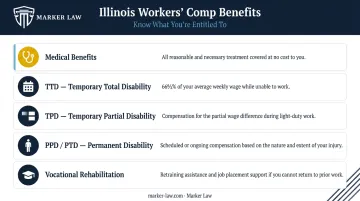
Illinois workers' comp covers five main benefit categories:
- Medical: All reasonable, necessary treatment at no cost to you
- TTD: Wage replacement (66 2/3%) if you can't work during recovery
- TPD: Partial wage difference if you return to reduced-pay work
- PPD/PTD: Scheduled or ongoing compensation for permanent impairment
- Vocational Rehab: Retraining and job placement if you can't return to your old role
What to Do If Your Illinois Workers' Comp Claim Is Denied
Claim denials are common. The IWCC received 34,366 new cases in FY2024, and disputes are a routine part of the system. A denial means the fight shifts to a formal process — one you can win with the right steps.
Understand Why the Claim Was Denied
The insurer must provide a written explanation. Common denial reasons in Illinois include:
- Injury not reported within 45 days
- Insurer claims the injury is pre-existing
- No witnesses to the incident
- Dispute over whether the activity was within the scope of employment
Each reason requires a different response. Knowing the specific basis for denial shapes your entire next move.
File a Petition for Adjustment of Claim with the IWCC
If the insurer denies your claim or cuts off benefits, you can file an IC01 Application for Adjustment of Claim with the IWCC. This triggers a formal hearing before an arbitrator under 820 ILCS 305/19. Of the 36,087 cases closed in FY2024, settlements accounted for 87% — meaning most disputes resolve before a full hearing, especially with competent representation.
Build a Stronger Evidentiary Record
Filing the petition is only half the work. A denied claim requires more — not less — documentation to back it up:
- Obtain detailed medical opinions from your treating physicians directly linking the injury to workplace activity
- Gather written witness statements
- Document the timeline of your reporting and treatment precisely
Watch out for the Independent Medical Examination (IME). Insurers routinely send workers to doctors they select and pay — and those opinions frequently conflict with your treating physician's findings. Under 820 ILCS 305/12, you have the right to have your own physician present at the exam, and you must receive the IME report at least 48 hours before any hearing.
An experienced attorney can counter an unfavorable IME with your treating physician's testimony and, where appropriate, request that the Commission order an impartial examination.
Why Legal Representation Matters Here
The appeals process involves formal procedures, evidentiary rules, and insurance defense teams who do this every day. Workers who go it alone face a significant disadvantage. Jason Marker spent three years on the defense side building those cases for employers and insurers before switching to plaintiff work. He knows the arguments they'll use — and how to take them apart.
Workers' Comp vs. Third-Party Personal Injury Claims
Illinois workers' compensation is generally the exclusive remedy against your employer — you typically cannot sue your employer directly for negligence. But if a third party caused or contributed to your injury, a separate personal injury lawsuit is available alongside your workers' comp claim.
Common third-party scenarios include:
- A negligent subcontractor on a construction site
- A defective piece of equipment from a manufacturer
- A property owner whose hazardous premises caused your fall
- Another driver who hit you while you were working
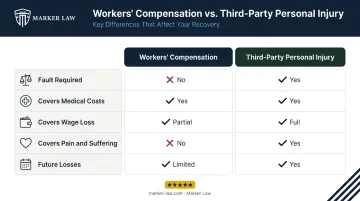
These two claims operate under very different rules:
| Workers' Compensation | Third-Party Personal Injury | |
|---|---|---|
| Fault required? | No | Yes |
| Covers medical costs? | Yes | Yes |
| Covers wage loss? | Partial | Full |
| Covers pain & suffering? | No | Yes |
| Future losses? | Limited | Yes |
Pursuing both simultaneously is possible — and in serious injury cases, the third-party claim can recover far more. The workers' comp side covers your medical bills and partial wages; the personal injury claim adds pain and suffering, full wage loss, and future damages.
One important wrinkle: Illinois subrogation rules under 820 ILCS 305/5(b) require the workers' comp insurer to be reimbursed from any third-party recovery for benefits it paid. Coordinating both claims to avoid double-recovery issues — and to maximize what you actually keep — is something Marker Law handles from the start.
Common Mistakes That Can Hurt Your Illinois Workers' Comp Claim
Each of these mistakes gives the insurance company ammunition to deny or reduce your claim:
Delaying the report or not reporting in writing. Verbal reports are harder to prove. Waiting even a few days gives the insurer grounds to question both the timing and the severity. Report the same day, in writing, and keep a copy.
Returning to work before you're medically cleared. An insurer can point to your early return as evidence the injury wasn't serious, cutting off or reducing benefits. Follow your doctor's restrictions precisely.
Giving a recorded statement without consulting an attorney first. Adjusters are trained to ask questions in ways that produce statements they can later use against you. You have no obligation to provide a recorded statement to the insurer before speaking with a lawyer. Don't do it.
Posting on social media. Insurance investigators actively monitor claimants' profiles for photos or posts that appear inconsistent with the reported injury. The Illinois Appellate Court has recognized video and photographic evidence as admissible in injury cases. Assume you're being watched.
Frequently Asked Questions
What qualifies as a workplace injury in Illinois?
Under the Illinois Workers' Compensation Act, a covered injury is any condition caused, aggravated, or accelerated by work-related activities — including traumatic accidents, repetitive stress injuries, and occupational diseases. You don't need to prove your employer was at fault.
How long do I have to report a workplace injury?
Illinois law requires you to notify your employer as soon as possible. Failing to report within 45 days can result in complete denial of benefits. Same-day or next-day reporting is always the safest approach.
Can I be fired for filing a workers' compensation claim?
No. Under 820 ILCS 305/4(h), employers are prohibited from retaliating against workers for filing a workers' comp claim. If your employer fires or demotes you for filing, that retaliation is itself an actionable legal claim.
What is the average workers' comp settlement worth?
Settlement amounts vary widely based on injury severity, permanent impairment, lost wages, and whether a third-party claim is also available. No reliable average exists. Marker Law can assess the full value of your specific claim, including damages many workers don't know to pursue.
What if my workers' compensation claim is denied?
File an IC01 Application for Adjustment of Claim with the IWCC. This initiates a formal hearing before an arbitrator. Attorney representation at this stage is critical — insurers and employers arrive with legal counsel, and you should too.
Can a hernia be covered under workers' comp?
Yes. A hernia caused or aggravated by work activity — such as heavy lifting — can qualify under Illinois workers' compensation. Report the injury promptly and seek immediate medical documentation linking the condition to your job duties.
Marker Law represents injured workers throughout Chicagoland and Northern Illinois, including DuPage, Will, Cook, Kane, and Kendall counties. If you've been hurt at work, call 331-295-8005 or reach out online for a free consultation — no upfront costs, no fees unless you recover.