Many injured Illinois workers find themselves in exactly this position, unsure whether their claim will ever be resolved. What most don't realize is that Illinois law sets specific deadlines for insurer action, and missing those deadlines has consequences. Understanding the timeline is the first step to protecting yourself.
This article covers the legal response windows under Illinois law, what the insurer is doing during that period, the different outcomes your claim can receive, why claims get denied, and what to do if yours is one of them.
TL;DR
- Illinois law requires employers to begin TTD payments or provide a written explanation within 14 days of receiving notice that you can't work due to injury
- Under Section 19(l), after a written demand for benefits, the employer has 14 days to state the reason for any delay in writing
- Insurers can accept, deny, or voluntarily pay while investigating — your rights differ depending on which path they choose
- A denial is not final: Illinois workers can appeal through the IWCC, with a statute of limitations of 3 years from the date of accident
- An attorney with insider knowledge of how insurers build denial cases significantly improves your odds on appeal
Illinois Workers' Comp Denial Timeline: How Long Does the Insurer Have?
There's a common misconception that Illinois law gives insurers one fixed deadline — say, 30 or 60 days — to accept or reject an entire claim. In practice, Illinois sets multiple separate deadlines tied to specific triggering events, with real financial penalties for insurers who ignore them.
The 14-Day Response Rules
Under the Illinois Workers' Compensation Act, two separate 14-day rules govern how quickly an employer must act:
- After notice of inability to work — the employer must either begin paying TTD benefits or provide a written explanation for any denial or delay
- After a written demand for Section 8(a) or 8(b) benefits — under Section 19(l), the employer has 14 days to state in writing why benefits are being delayed
These aren't the same trigger. The first clock starts when the employer learns you can't work. The second starts only after you formally demand benefits in writing. If you haven't made a written demand, the second clock may not be running at all.
What Starts the Clock?
Under Section 6 of the Act, the type of injury determines which notice rules apply:
- Traumatic injuries: You must give notice of your injury as soon as practicable, and no later than 45 days after the accident. A defective or late notice doesn't automatically bar your claim — but it can if the employer proves undue prejudice from the delay.
- Occupational diseases: For conditions developed gradually from workplace exposure, notice must be given as soon as practicable after disablement. Under the Illinois Occupational Diseases Act, the Commission can only bar a claim if the failure to give notice substantially prejudiced the employer.
What Happens If the Insurer Ignores the Deadline?
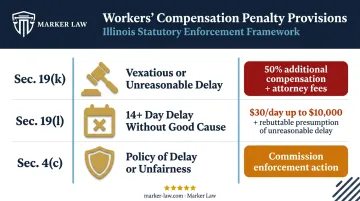
Illinois law builds financial penalties directly into the statute for insurers who delay without cause. Under Section 19(k) and 19(l):
- Section 19(k): Unreasonable or vexatious delay can result in additional compensation equal to 50% of the amount otherwise payable, plus attorney fees
- Section 19(l): Delays of 14 or more days without good cause create a rebuttable presumption of unreasonable delay, triggering penalties of $30 per day, up to $10,000
- Section 4(c): The Commission can act against insurers who have a policy of delay or unfairness in adjusting and paying claims
If your claim is sitting without a response, those penalty provisions are exactly what an experienced workers' comp attorney will use to push the insurer to act.
What Happens to Your Claim While the Insurer Decides
While you're waiting, the insurer isn't sitting still. Understanding what's happening behind the scenes helps you avoid missteps that could damage your claim.
The Investigation Period
During the decision window, insurers typically:
- Review your medical records and treatment history
- Verify your employment status and wages
- Interview witnesses or your supervisor
- Order an Independent Medical Examination (IME) (an exam performed by a doctor the employer selects and pays for)
On IMEs: Section 12 of the Illinois Workers' Compensation Act gives employers the right to require this exam at their expense, at a location reasonably convenient for you. Refuse without good cause and your compensation can be suspended during that period. The employer must also share the IME report with you no later than 48 hours before any arbitration hearing.
What You Should Be Doing During This Window
Keep a paper trail. Document everything:
- All communications with your employer and their insurer (emails, letters, voicemails)
- Your medical appointments, treatment, and any out-of-pocket expenses
- Daily notes on pain levels, limitations, and missed work
- Any wage loss you're experiencing
One Warning About Recorded Statements
Insurers often request recorded statements during the investigation period. There is no Illinois statute requiring you to give one. Our advice: don't give a recorded statement before consulting an attorney. Insurance adjusters are skilled at framing questions in ways that make even truthful answers seem inconsistent. A casual comment about your injury can be used to suggest it's less serious than it is.
Accepted, Denied, or Delayed: The Insurer's Options Explained
When the insurer finishes its investigation, your claim lands in one of four categories.
Full Acceptance
The employer accepts liability and begins paying benefits. Under Illinois law, you're entitled to:
- Medical expenses: All necessary first aid, medical, surgical, and hospital services to cure or relieve the injury
- TTD (Temporary Total Disability): Begins on the 4th day of incapacity; if incapacity continues 14+ days, compensation is paid from the day after the accident. The rate is 66⅔% of your average weekly wage, subject to statutory minimums and maximums
One important caveat: a full acceptance doesn't guarantee fair treatment. The insurer may accept liability but still dispute the extent of your injury, the necessity of specific treatments, or your actual wage rate. Have an attorney review any acceptance before assuming it covers everything you're owed.
Formal Denial
A denial must come as a written notice explaining the basis for rejection. That's a legal position — not a verdict. You can challenge it directly through the Illinois Workers' Compensation Commission.
Voluntary Payment While Investigating
Employers can make voluntary benefit payments without it being treated as a final admission of liability. The IWCC Handbook confirms that voluntary payment doesn't waive the employer's right to dispute the claim. If the employer later stops TTD payments before you return to work, they must provide a written explanation no later than the date of the last payment — and penalties may apply if they don't.
No Response at All
Illinois law doesn't use the term "constructive denial," but silence isn't a dead end. Several legal tools are available when an insurer goes quiet:
- Section 19(a): Disputed questions go to an arbitrator
- Section 19(b-1): Provides an expedited emergency hearing if you're not receiving medical care or TTD — you must serve the employer at least 15 days before filing, and the employer has 15 days to respond
- Sections 19(k) and 19(l): Delay penalties may apply when benefits are withheld without justification
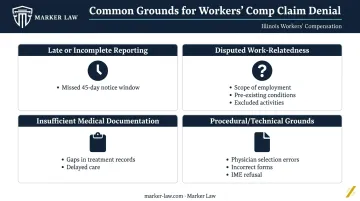
Common Reasons Workers' Comp Claims Are Denied in Illinois
Knowing why claims get denied is half the battle; most of these grounds can be challenged with the right documentation and timely action.
Late or Incomplete Reporting
The 45-day notice window under Section 6 is the most commonly missed deadline. Workers who don't report promptly — often because they hope the injury will resolve, or because they fear retaliation — give insurers a ready-made defense. Even a late report doesn't automatically bar your claim, but you'll need to overcome the prejudice argument.
Disputed Work-Relatedness
This is the most common substantive denial ground. Insurers argue the injury:
- Occurred outside the scope of employment
- Was a pre-existing condition unrelated to work
- Happened during an excluded activity (voluntary recreational programs, commuting, or while committing a felony are statutory exclusions)
Causation disputes require medical evidence connecting the injury to your job duties — and sometimes expert testimony.
Insufficient Medical Documentation
Gaps in treatment records are frequently used against claimants. If you didn't seek treatment immediately, or stopped before being cleared by a doctor, the insurer will argue the injury wasn't serious or wasn't work-related.
The practical rule: consistent, documented medical care is your strongest evidence — and the hardest for an insurer to dismiss.
Procedural and Technical Grounds
Claims can be denied for reasons that have nothing to do with the injury itself:
- Failure to follow Illinois's physician selection rules (generally limited to two physicians and their referral chains under Section 8(a))
- Incorrectly filed forms
- Refusal to submit to an employer-requested IME
Procedural denials are often the most straightforward to overturn on appeal, provided you respond before the filing deadlines pass.
Steps to Take After a Workers' Comp Denial in Illinois
A denial notice is a starting line, not a finish line.
The Filing Deadline You Cannot Miss
Under Section 6 of the Workers' Compensation Act, you have 3 years from the date of the accident to file an Application for Adjustment of Claim with the IWCC — or 2 years from the last compensation payment, whichever is later. Missing this window forfeits your right to benefits.
What to Do Immediately After a Denial
- Read the denial letter carefully — the stated reason tells you exactly what evidence you need to counter it
- Pull together your documentation: medical records, lost wage evidence, employer and insurer communications, and witness information
- Stop talking to the insurer — once denied, any statement you make can be used to reinforce their position
- Contact an attorney promptly — the statute of limitations will not pause while you decide
That fourth step is worth taking seriously. Jason Marker spent three years on the defense side representing employers and insurance carriers before founding Marker Law. He knows how adjusters construct denial justifications — the specific arguments they build around late reporting, causation gaps, and medical record inconsistencies — because he used to build them. That experience shapes how he challenges them.
The IWCC Appeals Process
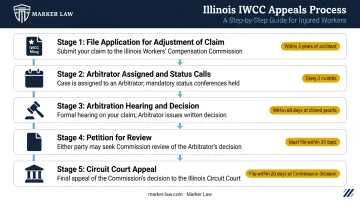
Filing the Application for Adjustment of Claim initiates the formal dispute process:
- The IWCC assigns an arbitrator to your case
- Cases are placed on a status call every 3 months; parties can request trial
- Arbitrators generally issue decisions within 60 days after proofs are closed
- If the arbitration ruling goes against you, a Petition for Review must be filed within 30 days of receiving the decision
- Commission review decisions can be further appealed to circuit court within 20 days of receiving that decision
Each stage is an opportunity to present stronger evidence — a denial at arbitration still leaves circuit court review on the table.
Frequently Asked Questions
Can an insurance company reject a claim after 3 years?
Illinois workers have 3 years from the date of accident (or 2 years from the last compensation payment) to file a claim. An insurer can still dispute a claim within that window — but once the statute of limitations passes without a filed claim, you generally lose the right to benefits regardless of when the insurer acts.
What is the 120-day rule in workers' compensation?
There is no 120-day accept/deny rule under Illinois workers' compensation law. Illinois requires injury notice within 45 days under Section 6 of the Workers' Compensation Act — the "120-day rule" applies in other states and doesn't reflect any Illinois statutory deadline for insurers.
Why are workers' comp claims denied?
The most common reasons are late injury reporting, disputes over whether the injury is work-related, insufficient medical documentation, and procedural errors like incorrect forms or physician selection. Most of these can be challenged through the IWCC appeals process.
What happens if the insurer doesn't respond within the required deadline?
Illinois law allows penalties under Sections 19(k) and 19(l) for insurers who miss statutory deadlines — including 50% additional compensation for vexatious delay and $30 per day (up to $10,000) for unreasonable delay. If you haven't received a written response after demanding benefits, an attorney can pursue those penalties on your behalf.
How long do I have to appeal a workers' comp denial in Illinois?
You have 3 years from the date of your accident (or 2 years from the last compensation payment) to file a claim petition. Once an arbitrator issues a decision, you have 30 days to file a Petition for Review. These deadlines are hard — waiting too long eliminates your options.
Do I need a lawyer if my workers' comp claim is denied?
Technically, you can appeal on your own — but the IWCC itself advises against it. An experienced workers' comp attorney understands what evidence the Commission looks for and how insurers build their defenses. Marker Law handles denied claims on contingency, so there are no upfront costs and no fees unless you recover compensation.