Here's the short answer — you almost certainly don't need money to hire a commercial vehicle accident lawyer. The fee structure used by virtually every attorney in this space is built specifically to remove that financial barrier.
This article breaks down how contingency fees work, what gets deducted from your settlement, why commercial vehicle cases carry unique cost considerations, and what to ask before signing anything.
TL;DR
- Commercial vehicle accident lawyers work on a contingency fee basis — typically 33%–40% of the recovery — with no upfront cost
- The percentage is usually lower (around 33.3%) if the case settles before a lawsuit is filed, and higher (up to 40%) if litigation begins
- Case expenses such as expert witnesses, filing fees, and deposition costs are separate from attorney fees and also deducted from the settlement
- Illinois Rule 1.5(c) requires all fees and cost arrangements to be disclosed in writing before work begins
- Victims with legal representation recover more on average than those who handle claims alone — even after fees are deducted
How Contingency Fees Work in Commercial Vehicle Cases
Almost every commercial vehicle accident attorney works on a contingency fee agreement: no upfront payment, no hourly billing, no invoices while your case is pending. The attorney earns a fee only if compensation is recovered — whether through settlement or a jury verdict.
The Standard Fee Range
According to the ABA, contingency fees in personal injury cases are typically one-third to 40% of the recovery. This range applies nationally, including in Illinois, where no numeric cap exists for ordinary personal injury cases — only a reasonableness standard under Illinois Rule of Professional Conduct 1.5.
At Marker Law, personal injury cases typically involve a fee of around one-third (33.3%), though the exact percentage depends on the circumstances of each case.
The Sliding Scale: Why Stage Matters
Most contingency fee agreements use a tiered structure tied to where the case resolves:
| Case Stage | Typical Fee Range |
|---|---|
| Settles before lawsuit is filed | ~33.3% |
| Lawsuit filed / active litigation | ~35–38% |
| Case goes to trial or appeal | Up to 40% |
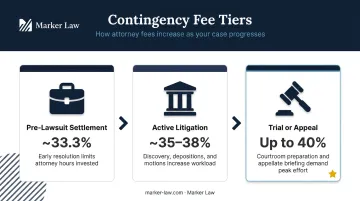
Trial preparation requires substantially more attorney time, expert coordination, and resources than a pre-litigation settlement — which is why the fee increases as the case progresses.
A Concrete Example
Say your case settles for $250,000. Here's what the math looks like before case expenses:
- At 33.3%: Attorney fee = $83,250 → Client receives $166,750
- At 40%: Attorney fee = $100,000 → Client receives $150,000
Case expenses then reduce those figures further. Whether expenses come out before or after the attorney's percentage is calculated can shift your net recovery by thousands — that breakdown is covered in the next section.
Illinois Disclosure Requirements
Illinois Rule 1.5(c) requires that every contingency fee agreement be in writing and signed by the client before work begins. The agreement must specify:
- The percentage(s) applicable at each stage
- What litigation expenses will be deducted
- Whether expenses are deducted before or after the attorney's fee is calculated
- Any costs the client may owe even if the case is not won
Illinois Rule 1.5(c) exists precisely so clients aren't surprised at the end of a case. If any of these terms aren't clearly written in the agreement before you sign, ask for clarification — or find a different attorney.
Attorney Fees vs. Case Expenses: What's Actually Deducted
The contingency fee covers your attorney's legal work. Case expenses are a separate category — out-of-pocket costs your attorney advances to investigate and litigate your claim. Both are deducted from your gross settlement at the end of the case.
Common Case Expenses in Commercial Vehicle Claims
Commercial vehicle cases generate more expenses than standard car accident claims, because the evidence is more complex:
- Accident reconstruction expert fees: physics-based crash analysis establishing how the collision occurred
- Black box (EDR) data retrieval: Event Data Recorders capture pre-crash vehicle dynamics, driver inputs, and system status in the seconds before impact
- Electronic logging device (ELD) records: hours-of-service data governed by FMCSA rules
- Driver qualification file and maintenance records: required under 49 CFR Part 391 and Part 396
- Court filing fees: Cook County Law Division charges $388 for new personal injury filings; federal civil filing fees run $405
- Deposition and court reporter fees
- Expert medical witness fees
- Medical records retrieval: Illinois statutory rates apply under 735 ILCS 5/8-2001(d)
Because these costs can add up quickly in commercial cases, Marker Law advances all case expenses on behalf of clients. You won't receive invoices during the case — costs are reimbursed from the settlement only if compensation is recovered.
The Deduction Order: It Matters More Than You Think
How expenses are calculated relative to the attorney fee directly affects your net recovery. Illinois Rule 1.5(c) specifically requires this to be disclosed — here's why:
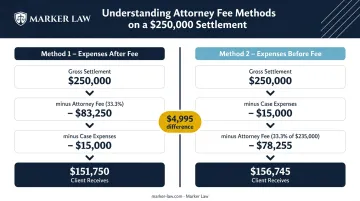
Method 1: Expenses deducted after the fee is calculated (more favorable to you)
- Gross settlement: $250,000
- Attorney fee (33.3%): −$83,250
- Case expenses (e.g., $15,000): −$15,000
- Client receives: $151,750
Method 2: Expenses deducted before the fee is calculated
- Gross settlement: $250,000
- Case expenses: −$15,000
- Net after expenses: $235,000
- Attorney fee (33.3% of $235,000): −$78,255
- Client receives: $156,745
The difference between methods is roughly $5,000 on a $250,000 settlement — real money that belongs in your pocket. Ask any attorney you're considering to walk through this calculation before you sign the fee agreement.
Why Commercial Vehicle Cases Are More Complex — And What That Means for Fees
Commercial vehicle accidents aren't just bigger car accidents. They involve a different legal landscape entirely — one where experienced counsel earns its cost many times over.
Multiple Liable Parties
A standard car accident typically involves two drivers. A commercial vehicle crash may involve:
- The truck driver
- The trucking or fleet company (direct negligence + respondeat superior)
- Cargo loaders (if improper loading caused instability)
- Vehicle or parts manufacturers (product liability)
- Third-party maintenance contractors
Each additional defendant adds investigation depth, legal filings, and attorney hours. Marker Law handles all of these simultaneously — identifying every party that shares responsibility rather than pursuing the easiest target.
Federal Regulations as Evidence
Commercial vehicles are governed by FMCSA regulations covering hours of service, driver qualification files, maintenance records, and inspection logs. FMCSA rules limit property-carrying drivers to 11 hours of driving after 10 consecutive hours off duty — violations of these limits become direct evidence of negligence.
Building this regulatory case requires attorneys who know how to request, preserve, and litigate using FMCSA evidence. That's a distinct skill set from standard personal injury work.
The Defense Response Starts Immediately
Defense-side practice publications document that trucking companies and their insurers often deploy specialized legal teams within hours of a serious crash — on the scene to preserve evidence favorable to the carrier before injured victims have even left the hospital. Jason Marker spent three years on the defense side representing employers and insurers before transitioning exclusively to plaintiff advocacy. That experience shapes his response: Marker Law sends legal hold notices immediately upon retention, requiring carriers to preserve ELD data, dash cam footage, and GPS records that are typically overwritten within 30 to 90 days.
Higher Stakes Demand More Investment
The scale of harm in these cases makes thorough preparation non-negotiable. NHTSA data shows 5,472 people were killed in large truck crashes in 2023, with 70% being occupants of other vehicles. In Illinois alone, IDOT recorded 11,105 tractor-trailer crashes in 2023, including 103 fatal crashes and 1,831 injury crashes.
Catastrophic injuries require accident reconstructionists, medical specialists, and economic experts to document future medical costs and lost earning capacity. Marker Law advances all expert costs on the client's behalf and recovers them from the settlement — clients pay nothing upfront.
Is Hiring a Commercial Vehicle Accident Lawyer Worth It?
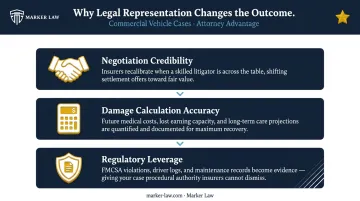
Commercial vehicle insurers are represented by experienced defense teams whose objective is to minimize what they pay unrepresented claimants. An attorney changes that dynamic in three concrete ways:
- Negotiation credibility — insurers know an attorney will file suit if the offer is inadequate
- Damage calculation accuracy — full recovery includes future medical costs, lost earning capacity, and pain and suffering, not just current bills
- Regulatory leverage — FMCSA violations, hours-of-service logs, and maintenance records become powerful evidence when properly obtained and presented
The IRC has documented that attorney involvement in auto injury claims has grown substantially, with roughly 50% of bodily injury claimants now using attorneys — a figure that reflects how consistently professional representation improves claim results.
At Marker Law, Attorney Jason Marker offers a free initial consultation with no fee unless compensation is recovered. With 25+ years of Chicagoland litigation experience and a career that began on the defense side, he's positioned to anticipate exactly the tactics commercial carriers use after a crash.
Marker Law serves clients throughout DuPage, Will, Cook, Kane, and Kendall counties, including Naperville, Aurora, Wheaton, Bolingbrook, and the broader Chicago area.
Frequently Asked Questions
How much of my settlement will I keep after commercial vehicle accident lawyer fees?
After the contingency fee (typically 33%–40%) and case expenses are deducted from the gross settlement, the remainder goes to you. Ask your attorney whether expenses are deducted before or after the fee is calculated, as this affects your net recovery. Disclosure is required in writing under Illinois Rule 1.5(c).
Is it worth hiring an attorney for a commercial vehicle accident?
Yes. Commercial vehicle cases involve federal FMCSA regulations, multiple liable parties, and defense teams that mobilize within hours of a crash. An attorney counters those advantages and accurately values damages — including future costs that unrepresented claimants routinely miss.
What should I not say to a commercial vehicle accident lawyer?
Don't speculate about fault, downplay injuries, or say anything inconsistent with your documented medical condition. Be honest and consistent — exaggerating or minimizing details creates vulnerabilities the defense will exploit.
Do I have to pay upfront to hire a commercial vehicle accident lawyer?
No. Under a contingency fee agreement, no upfront payment is required. The attorney is paid only if compensation is recovered.
What case expenses might be deducted from my settlement besides attorney fees?
Common expenses include accident reconstruction expert fees, black box (EDR) data retrieval, court filing fees, deposition and court reporter costs, expert medical witness fees, and medical records retrieval. These are typically advanced by the attorney and repaid from the settlement only if the case is won.
How long does a commercial vehicle accident case typically take?
Cases that settle before litigation may resolve in several months. Complex claims with disputed liability, multiple defendants, or catastrophic injuries often take one to three years or longer. The timeline varies widely depending on the parties involved and whether the case goes to trial.